Google and AI engines are currently cracking down on self-promotional listicles.
Lily Ray tracked 6 brands that lost 29-49% of their traffic after publishing hundreds of listicles where they put their company at number one. Seer Interactive also found that listicle citations have dropped by 30% in ChatGPT.
So if publishing your own listicles is no longer a reliable play, what actually moves the needle?
Getting featured in other people’s listicles. Specifically, the ones already ranking in Google and showing up in LLM answers.
This guide walks through the steps.
Step 1: Find Listicle Opportunities
The first step is to gather all relevant listicles in your category.
There are two ways to find listicle opportunities:
Use Google search operators
You can use Google search operators to surface existing listicles that are already indexed and ranked by the search engine.
The syntax is straightforward:
“[your category]” intitle:”best” OR intitle:”top”
For example, if you run CRM software, use “CRM” intitle:”best” OR intitle:”top”.
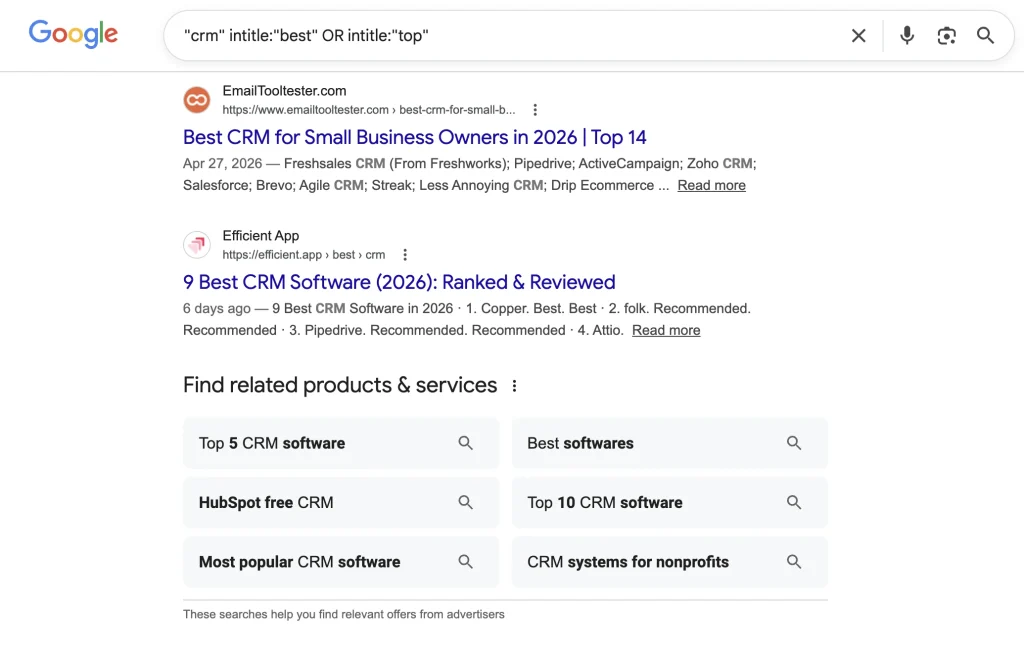
To go deeper on a specific publisher, use site:domain.com intitle:”best” OR intitle:”top” to pull all listicle content they’ve published in one go.
This is the exact tactic used by Brandon Schroth, Founder of Reporter Outreach, for all his clients.
For prospecting, we run bulk site-searches across our publisher database to find existing listicles in a client’s niche. Google operators do the heavy lifting. Something like: site:domain.com intitle:”best” OR intitle:”top”.

Brandon Schroth, Founder of Reporter Outreach
Use a listicle outreach tool
If you’d rather skip the manual work, use a listicle outreach tool like ListBrew.
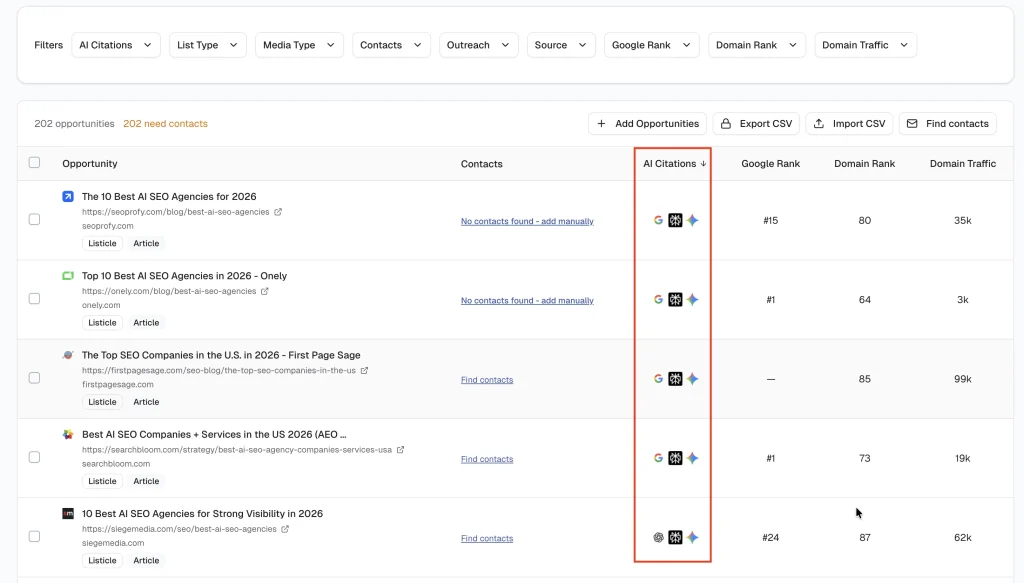
It helps you find listicles already ranking in Google and appearing in LLM answers for your target keyword in minutes.
These are the pages you want to appear on. They have established authority and audience base, and AI systems are already pulling citations from them.
Simply sign up for free and create a new campaign. After that, enter your brand details, target keyword, and preferred AI engines.
ListBrew will then pull every listicle already ranking for that keyword across Google and your chosen LLMs.
Step 2: Filter and Prioritize Your Targets
Not every listicle is worth your time and effort.
The goal of this step is to cut your list down to the pages where inclusion is realistic, valuable, and achievable.
I only target listicles that are already updating, have a clear inclusion logic, and feature companies with a similar market position to ours. That usually cuts my prospect list by about 60%, but it doubles reply quality.

Loc Dang, Digital Marketing Specialist at Cricket One
Evaluate each opportunity against four criteria:
- Relevance. Do you brand truly belong in the listicle? The clearest signal is whether it already features your direct competitors.
- Organic performance. Is the listicle already ranking in Google and driving considerable traffic?
- AI citations. Check whether the listicle is being cited in AI answers. An inclusion there can instantly boost your AI visibility.
- Last update time. Is the list constantly being updated?
The last one matters more than most people think. A static listicle that hasn’t been touched in two years is unlikely to be refreshed just for you.
Tom Pinder, Founder of StartVest, gave a useful trick:
Use the Wayback Machine to confirm whether the author has updated the piece in the last 12 months. Stale lists rarely refresh regardless of how good your pitch is.
Tom Pinder, Founder of StartVest
Once you’ve filtered for active, relevant listicles, study each article before you draft a single email.
Look at which companies they included, what criteria they applied, and whether the methodology feels genuinely researched or partnership-driven. That context shapes everything about your outreach.
Before reaching out, I usually spend time studying the existing article itself — what kind of companies they included, whether the writer prefers data-heavy examples or founder stories, how often the article gets updated, even whether the recommendations feel genuinely researched or just affiliate-driven. You can usually tell pretty quickly what angle they respond to.

Syed Asif Ali, Founder of Point Media
Step 3: Find the Right Person to Contact
One common outreach mistake is reaching out to someone who has no editorial control over the article.
For example, guest post contributors or freelance writers who write for multiple sites, as Syed Asif Ali pointed out:
I learned pretty quickly that not every writer has editorial control anyway, especially freelancers contributing to larger publications. Now I check bylines and LinkedIn profiles first before investing too much time into outreach.
Syed Asif Ali, Founder of Point Media
Here’s what you need to do before sending an outreach email:
- Check the listicle’s byline to make sure the author is an in-house employee.
- If the author isn’t clearly mentioned, use tools like Hunter and Apollo to find the publication’s editor or content manager instead.
- You can also check the company’s LinkedIn profile to see who’s likely responsible for content production.
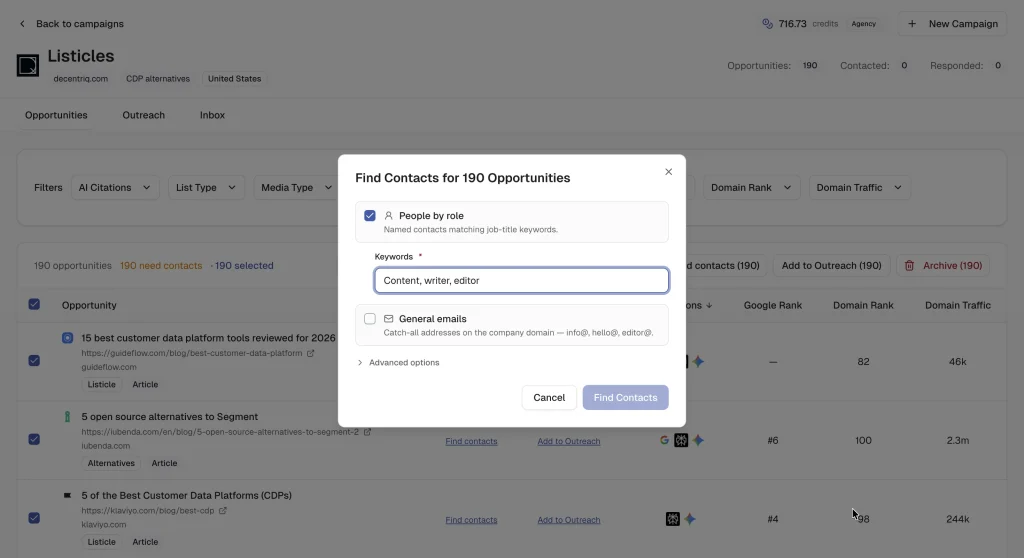
If you’re a ListBrew user, you can find contact details in bulk for all listicle opportunities directly inside the platform.
There’s also a feature that lets you search contacts by role, so you can send a pitch to the right person.
Step 4: Send a Personalized Pitch
Writers and editors receive a lot of requests from link builders every day, so make sure your pitch actually stands out.
Sending the same pitch to everyone is a recipe for disaster, as Rachel Sinclair, Acquisitions Director at US Gold and Coin, put it:
The most common outreach mistake is sending the same template to every writer covering “top” and “best” lists. Positive outcomes from generic outreach are uncommon.

Rachel Sinclair, Acquisitions Director at US Gold and Coin
Here are five ways to improve your outreach emails and increase your reply rate:
Personalize your subject line
Your subject line is the first thing your prospects read, so make sure it catches their attention.
Thomas Oldham, Founder of WebMotion Media, shared his approach:
My email technique is simple. I personalize every subject line with the publication name and a benefit they missed.

Thomas Oldham, Founder of WebMotion Media
Make the opening line relevant
Once they open your email, your opening line determines whether the reader keeps reading or ignores your pitch.
Reference something specific from their article to show you genuinely read their content and aren’t sending a generic outreach email.
I almost never lead with ‘we’re the best option’ because every pitch says that. I try to reference something specific from their article first so it’s obvious I actually read it.
Syed Asif Ali, Founder of Point Media
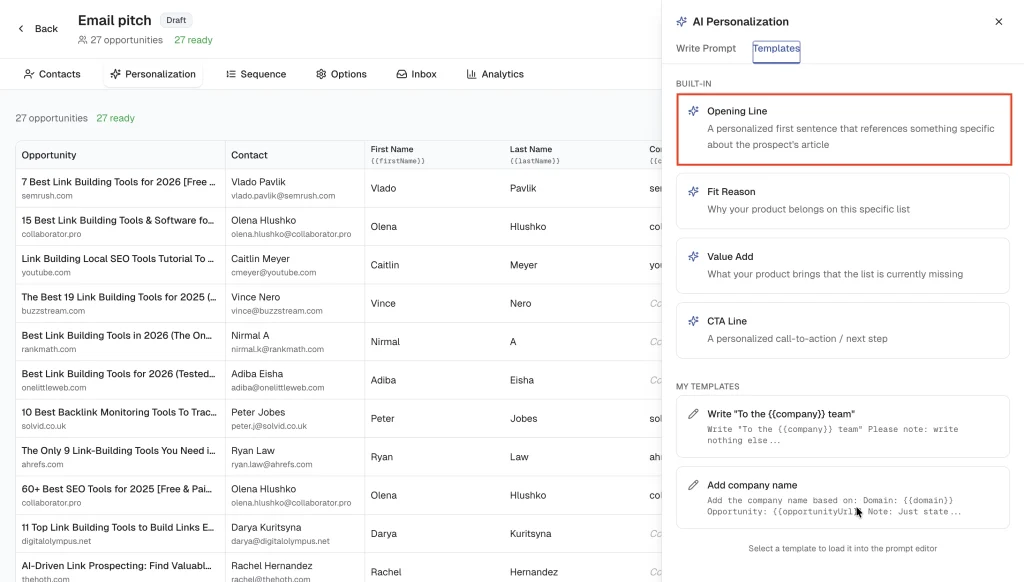
In ListBrew, you can use the built-in AI feature to pull relevant details about each listicle and personalize your opening line.
Explain why you belong in the listicle
In the next line, explain how your tool, product, or service adds value to the article instead of simply asking to be included.
One effective tactic comes from Brandon Schroth: identify a specific gap in the listicle and position your company as the missing piece.
Every email references the specific article, acknowledges what’s already on the list, and makes a short case for why the client belongs. Something like “noticed you included X and Y. [client] recently launched a feature that addresses [specific gap in the list], might be worth adding.”
Brandon Schroth, Founder of Reporter Outreach
This works because it actually helps the editor improve the list.
Editors do not care that you exist. They care whether adding you makes the article more useful.
Loc Dang, Digital Marketing Specialist at Cricket One
Make it paste-and-publish ready
Make it easy for the writer or editor to update the listicle by preparing a blurb they can easily copy and paste.
Don’t forget to follow the content’s structure and writing style.
We always include: 40 to 60 word neutral, non-salesy blurb they can paste in, 1 main benefit plus 1 differentiator, recommended anchor text, and image/logo link. The easier you make it to update the article in under 2 minutes, the higher the inclusion rate.

Dieter Blom, Director at Versys Media
Offer something in return
Don’t just ask for a mention; provide something valuable for the author or editor, too.
Irina Maltseva, Founder & AI SEO Advisor at Seen, said it best:
You should bring value. No value = no pitch. These are the rules of the listicle outreach game.

Irina Maltseva, Founder & AI SEO Advisor at Seen
Here are some ideas:
- Link exchange. Offer to link back to the prospect from your own website or a partner site.
- Content distribution. Offer to promote the listicle to your newsletter, social channels, and community groups once you’re featured.
- Free product access. If you run a SaaS company, give them temporary premium access, a trial account, or demo credits to test your product properly.
Step 5: Follow Up Without Being Annoying
Most outreach campaigns fail because people send one email and give up.
Editors and writers are busy. Your email may get buried, forgotten, or opened at the wrong time. A polite follow-up can dramatically increase your response rate — but only if it adds value instead of pressure.
I think people massively underestimate follow-ups. Most outreach campaigns fail because people send one email and emotionally collapse when they don’t get a reply. We’ve had placements land after 14 follow-ups over 5 months. Not joking. One editor ignored me for weeks until I referenced a Muay Thai fight I had in Brazil years ago after noticing he trained BJJ. Suddenly we had a conversation. Humans are weird. SEO people forget that.

Deepak Shukla, Founder and CEO of LemStudio
A good rule: follow up 2–3 times maximum, spaced a few days apart.
We send one follow-up after 4 to 5 business days, then a final nudge 7 to 10 days later. After that, we only circle back if the article is visibly updated in the future. The follow-ups are very short, sometimes just a 2-line check-in and a reminder of the benefit to their readers.
Dieter Blom, Director at Versys Media
To increase the reply rate, David Vail, Vice President of Business Development at Latitude Park, also advised adding new information.
Give the editor a fresh angle: a new feature launch, an updated case study result, a relevant piece of coverage you just received. Something that makes the second email worth opening.
Add new information in your follow-up. Don’t just bump the thread—give them a fresh angle or a recent development. That’s what separates the replies from the silence.

David Vail, Vice President of Business Development at Latitude Park
Bonus Tactics (Optional But Worth to Try)
Here are two additional, non-obvious tactics that can really boost your response rate:
Pitch during the research phase, not after publication
Your best window to get included is when the writer is building the list, not after it’s already live.
This works for a simple reason: it speeds up the research process for the writer.
We’ve had the best success reaching out to list creators during their research phase, not after they’ve already published. Most people pitch completed lists, but if you can catch them while they’re building their “Best X Tools for Y” article and offer genuine insights or case studies, you’ll get included way more often.

Danyon Togia, Founder of Expert SEO
One way to monitor these opportunities is by subscribing to journalist platforms like Qwoted, Haro, Source of Sources, MentionMatch, etc.
Build relationships before you need placements
Another tactic is to build relationships with writers, journalists, content marketers, and founders.
When someone already knows your name, has seen you contribute helpful insights, or has interacted with you in a community, your outreach no longer feels like a random request from a stranger.
Tooba Jamal, Senior Content Associate at Growth Marketing Pro, gave his two cents:
For listicle outreach, the most effective approach I’ve found is relationship-based networking through Discord and Slack communities, industry peers, or in-person events. The idea is to invest time in building genuine connections so you can collaborate on listicle inclusions down the line. For example, I’m in a Discord channel where founders and executives in my industry gather, and we regularly exchange listicle opportunities there.

Tooba Jamal, Senior Content Associate at Growth Marketing Pro
GEO Listicle Best Practices
Peec AI analyzed 5.7 million listicles across 8 AI engines: ChatGPT, Claude Sonnet 4, Gemini, AI Mode, AI Overview, GPT-5 Search, Copilot, and Perplexity.
Their findings could shape your GEO listicle strategy:
- Being included in listicles does matter to AI visibility, but only if the listicles are frequently cited by LLMs.
- Your position in the listicle also matters. Brands in position #1 has the highest visibility lift (+16.5 percentage points (pp)).
- More listicles eventually stop adding much. Maximum impact is often reached after just a few repeated placements. The goal isn’t to be included in every listicle, but to win the few listicles that AI actually cites (use ListBrew to find those).
- Each AI engine behaves differently. Google’s AI products (AI Overviews and AI Mode) tend to cite more sources, while ChatGPT and Copilot tend to rely on a smaller set of sources, which means being featured in a top-ranked listicle can have a much larger impact on your visibility.
Case Study: How We Secured 18 Listicle Placements in 7 Months
Between October 2025 and May 2026, Position Digital secured 18 listicle placements on sites with Domain Ratings ranging from 18 to 70.
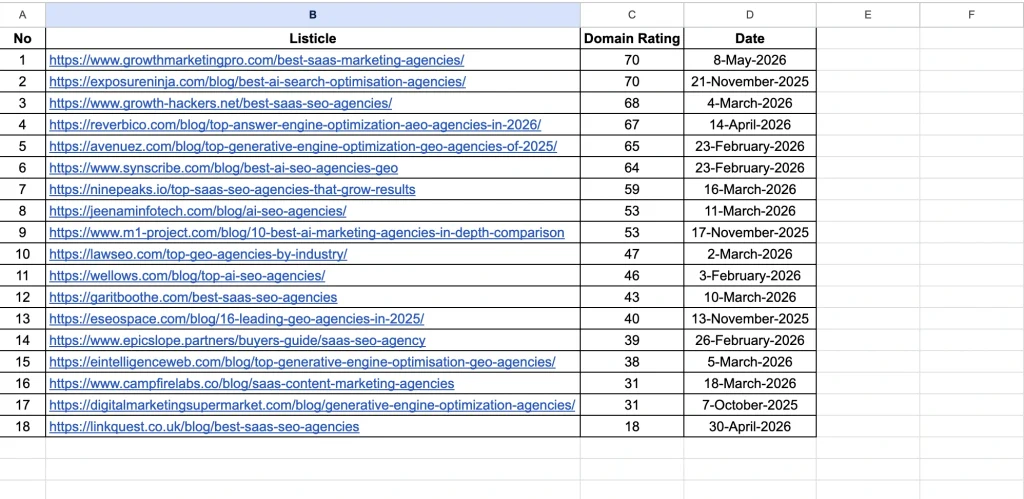
The approach was built on three interlocking moves:
- First, we published our own listicles targeting competitive keywords and ranked them in Google’s top 10. That gave us something credible to trade.
- Second, those ranking listicles generated inbound requests for listicle exchanges from other sites looking for high-authority inclusion opportunities.
- Third, we ran proactive outreach to other publishers offering a listicle exchange. Because our own listicles were already ranking highly, those publishers had a clear reason to collaborate.
The case study makes one thing clear: having your own ranked listicles isn’t just a content play. It’s outreach leverage. Publishers are far more open to including you when you can return the value.
Listicle Outreach Email Template
Here’s the email template we used to secure 18 listicle placements:
Initial email
Subject line: Inclusion in your [listicle name] roundup
Hi [First Name],
I came across your roundup of the best [topic] here, and I think our [company / product / tool] can be a great fit.
We focus on helping [your target audience] scale through [your expertise]. You can check out our client results here [add link to case studies].
If helpful, I can provide a short write-up that matches the format of your roundup, along with other details you may need.
In return, I’d also be happy to feature [the prospect’s brand name] in our [your listicle]. It’s currently ranking on Google and AI answers, so inclusion would give you instant visibility.
Let me know if you’re interested!
Best regards,
Sean
Follow-up email (if no reply)
Hi [First Name],
I wanted to follow up on my previous email about including my [company / product / tool] in your [listicle name] roundup.
To make it easier for you, I’ll provide a short write-up that matches your format.
In return, I’ll also feature your brand in either our existing listicle (currently ranking #2 in Google) or our upcoming guest post for [partner site].
Do you think it’s something you’d be open to?
Best regards,
Sean
Get Featured in Listicles That Matter
LLMs love citing listicles, especially for commercial queries where users are comparing options.
According to Wix, listicles are cited in 40.9% of commercial queries in AI Mode, ChatGPT, and Perplexity.
That’s why getting included in the right listicles can instantly improve your visibility in AI search.
But if you don’t have the experience, connections, or time to consistently land those placements, the process can quickly become overwhelming.
That’s where Position Digital’s listicle link building services come in.
We have the team, expertise, and tools to consistently land placements in listicles that Google ranks, LLMs cite, and your target audience consumes.
Contact us today and let’s set up a quick meeting to discuss your needs!
FAQs About Listicle Outreach
What is listicle outreach?
Listicle outreach is the process of identifying “best” and “top” lists already ranking in Google or cited by AI systems, then securing a placement within those articles.
Rather than publishing self-promotional lists, getting featured in established third-party roundups can give your brand more authority and AI visibility.
How long does listicle outreach take to show results?
Most placements are confirmed within two to six weeks of initial outreach, though some editors take longer.
Once you’re added, the impact on AI visibility can come almost instantly, as the web search functionality in most LLMs is retrieving results from the web in real time.
How do I know which listicles are worth targeting?
Prioritize listicles that have organic traffic and AI citations, and have been updated within the last 12 months. Use ListBrew to find those listicle opportunities.
What should I include in a listicle outreach pitch?
Every pitch needs four elements:
- A specific reference to the article (not a generic opener)
- A clearly identified gap the current list doesn’t address
- One or two concrete proof points of why you belong in the listicle
- A paste-ready 40-60 word blurb written in the outlet’s voice
Does listicle outreach actually improve AI visibility?
Yes. Research from Ahrefs shows that 43.8% of ChatGPT citations are drawn from “best X” listicles. Getting featured in established, well-ranking lists increases the probability that AI systems will surface your brand when answering relevant queries.