AI-powered search is rewriting the rules of online visibility. Instead of a familiar list of blue links, users are increasingly presented with AI-generated answers that shape which brands they notice—or ignore.
For marketers and business owners, this shift raises an urgent question: is your brand being surfaced in AI results, or left out of the conversation entirely?
In this guide, I’ll show you exactly how to track your AI brand visibility across platforms like Google’s AI Overviews and ChatGPT, and which tools can help you stay ahead.
I also asked AI tracking tool founders and SEO experts to share their insights on what actually matters in this new era of brand discovery.
Why Should I Track AI Brand Visibility?
Google remains the undisputed leader in search, but AI adoption has surged massively in recent months.
According to the latest AI search studies:
- Daily AI usage as a search tool doubled from 14% to 29.2% between February and August 2025.
- ChatGPT usage for general information searches tripled from 4.1% to 12.5% during the same period.
- Google’s AI Mode usage has grown roughly 4x since its launch in May.

AI referral traffic has also grown up pretty exponentially for our clients. At the moment, we’re seeing around 30 to 40% month-on-month growth since last year.
The trend is clear: generative AI is slowly but surely becoming a major discovery channel.
If your brand is nowhere to be seen in AI Overviews or Perplexity answers, you’re essentially handing over traffic and leads to your competitors.
This is why monitoring your AI visibility is crucial to staying competitive in the new search landscape.
It’s how you see where your brand currently stands, spot opportunities to outrank competitors, and protect your reputation as AI systems become the new gatekeepers of information.
Key Metrics to Measure in AI Search
Traditional SEO metrics like rankings and clicks still matter, but they only tell part of the story.
According to Yordan Dimitrov, SEO Manager at Reflect Digital:
SEO is far from dead; it is, in fact, evolving at a rapid pace. However, our approach to AI search needs to adapt to those changes in both technology and user behaviour shifts which come with it. In the discovery stage, users are now getting answers without having to click through to a website, which makes click-based metrics less reliable.

Yordan Dimitrov, SEO Manager at Reflect Digital
In AI search, visibility is measured differently — by how often, how prominently, and how accurately your brand appears in generative answers.
Here are the core metrics to track:
| Metric | What it measures | Where to get it | What good looks like |
| Mention rate | % of your tracked prompt set where the brand is named at all | AI visibility tool; manual prompt log | 20–30% in a category with 5–10 credible players |
| Citation rate | % of answers that link to a page you own | AI visibility tool; GSC AI Mode data | Always lower than mention rate — a wide gap means models know you but don't source you |
| Share of voice | Your mentions as a % of all brand mentions across the prompt set | AI visibility tool | At or above your organic market share; below it means you're under-indexed |
| Answer position | Whether you appear first, mid-list or last within a generated answer | Manual review; some tools score it | First or second mention on your top five commercial prompts |
| Brand sentiment | How the model characterises you when it does mention you | AI visibility tool; manual review | Neutral to positive; recurring negative framing is a source-content problem to fix upstream |
| Branded search volume | Searches for your brand name, as a downstream proxy for AI exposure | Google Search Console; Google Trends | Rising in step with mention rate |
| AI referral traffic | Sessions arriving from chatgpt.com, perplexity.ai, gemini.google.com and similar | GA4, referral source | Small but high-intent — watch conversion rate, not volume |
| AI referral conversions | Goal completions from those sessions | GA4 | Typically converts above the organic average — this is the number that justifies budget |
Brand mentions
The number of times your brand name appears in AI-generated responses, whether or not it includes a link.

Why it matters:
Mentions are the foundation of AI visibility. They show whether AI models even recognize your brand in the first place.
No brand mention means you don’t exist — your competitors are getting all the attention.
But it’s not about getting mentions; it’s about getting mentions for the right queries:
The question that matters is not just ‘are we mentioned?’ but ‘are we being recommended when customers ask dealbreaker questions that influence buying decisions?’

Steve Toth, CEO at Notebook Agency
Citations
How often AI answers reference your content as a source, either through inline links or sidebar citations.

Why it matters:
When AI links to your content, it positions your business as an authority, builds trust with users, and can generate valuable referral traffic. Being cited as a source also means you can control the narrative in AI answers.
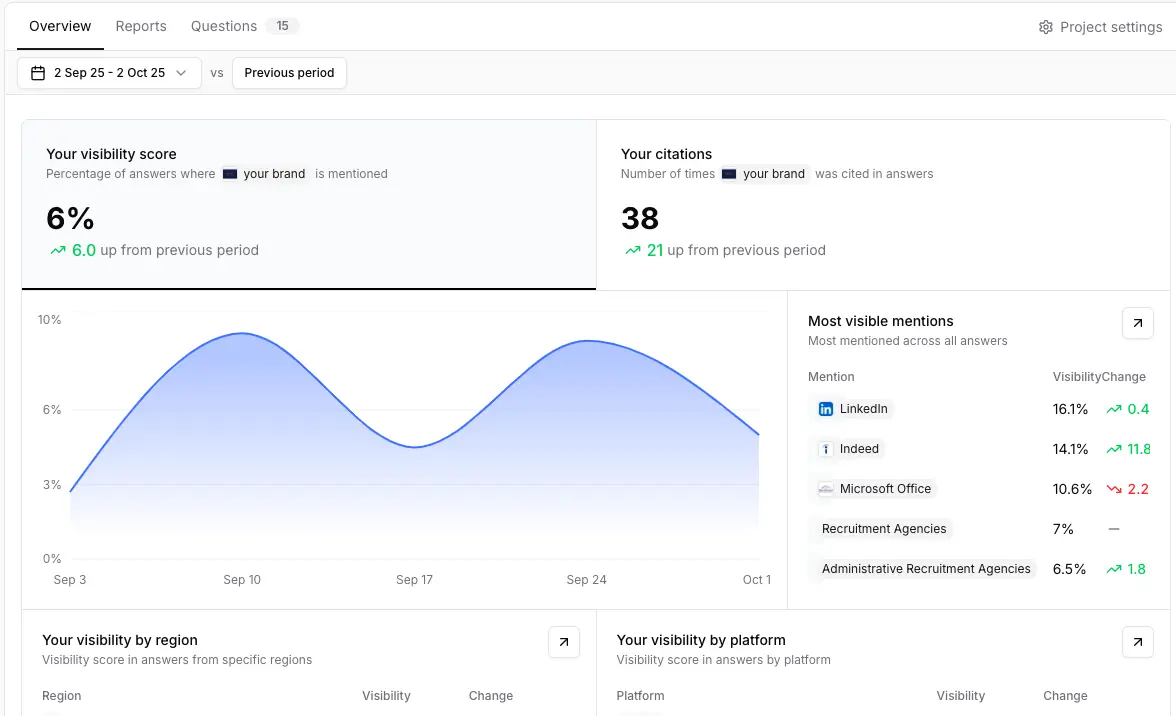
AI visibility score
The percentage that shows how often your brand appears in AI-generated responses for specific queries you’re tracking.
Here’s the formula: number of brand mentions divided by total answers multiplied by 100.
For example, if you track 100 prompts, and your brand appears in 25 of those responses, then your visibility score is 25%.
Why it matters:
AI visibility score makes it easier to track how your brand is performing in AI search over time.
If your score is consistently going up month after month, that means your GEO strategy is working well, and vice versa.
Share of voice
The percentage of your brand’s presence and visibility in AI answers compared to all competitors.
Why it matters:
Share of voice reveals whether your brand is leading the conversation or being overshadowed. Even if your own visibility score looks healthy, competitors with a higher share are capturing more authority, trust, and potential customers.
Tracking this metric helps you identify gaps, set realistic goals, and prioritize where to focus efforts to win back attention.
Brand sentiment
The tone in which large language models (LLMs) portray your brand, which is classified as positive, neutral, or negative.
Why it matters:
A positive sentiment builds trust and authority, while negative or inaccurate descriptions can damage reputation and influence customer decisions.
Tracking sentiment helps you safeguard how AI systems portray your brand and spot areas where better content or PR is needed.
Branded searches
The number of times users include your brand or product name in traditional Google searches.
Why it matters:
AI assistants like ChatGPT and Perplexity often recommend brands without providing clickable links. When that happens, users turn to Google to search for those brands manually.
Tracking branded search volume helps you spot indirect traffic driven by AI exposure—even if you can’t yet attribute it precisely.
A steady increase in branded searches can indicate your brand is being mentioned more frequently in AI answers.
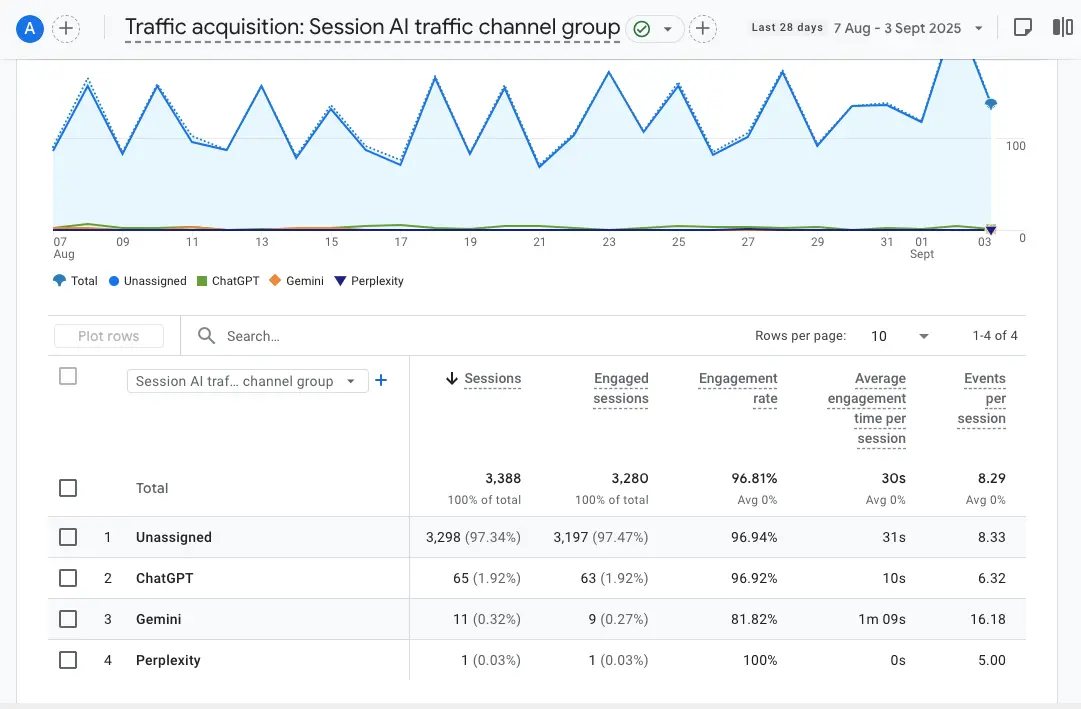
AI referral traffic
The amount of traffic driven to your website from links or citations in AI-generated answers.
Why it matters:
A surge in AI referral traffic could mean your content is being cited more frequently in AI answers.
It also reveals which platforms (like Perplexity, Bing Copilot, or ChatGPT with browsing) are sending the most engaged visitors, so you can focus your optimization efforts where they’ll have the biggest impact.
AI referral conversions
The number of leads, sign-ups, or sales that originate from users clicking through AI-sourced answers.
Why it matters:
From what I’m seeing, conversions from AI referrals tend to be far higher than those from traditional search.
One of the main reasons is because these users have already been pre-qualified by AI recommendations, meaning they arrive with stronger intent.
By tracking these AI referral conversions, you can understand the real ROI of your AI visibility.
How to Track Visibility Across AI Platforms
Traditional SEO platforms like Ahrefs and Semrush are now offering brand monitoring features to keep pace with AI search.
At the same time, a new wave of dedicated AI visibility tools is emerging, each promising an easy way to track your presence across platforms like Google AI Overviews, Perplexity, and ChatGPT.
But here’s the catch: most of these tools simply track existing SEO keywords (or modified versions of them). That doesn’t reflect today’s reality, where prompts are longer, more conversational, and vary significantly between users.
Preston Boling, Account Executive at Scrunch AI, sums it up perfectly:
If you want to understand your brand’s visibility in AI Search, start thinking less about keywords and more about how large language models remember and talk about your brand. Run real prompts, things users would actually ask, like ‘best [industry] platforms’ or ‘alternatives to [competitor]’, across ChatGPT, Perplexity, and Gemini. See if your brand shows up, how it’s described, and what sources are cited.

Preston Boling, Account Executive at Scrunch AI
To get an accurate picture, you need to move beyond synthetic prompts and start tracking real customer queries.
In a survey by SEOFOMO, MJ Cachón, SEO Consultant and Director at Laika, says:

Conduct prompt research
Use the following sources to identify the queries your target customers are searching online:
- Google Search Console: This tool shows you the exact queries visitors use to find your website. Just go to the Performance tab and scroll down to the Queries section.

- Customer data: Sales transcripts and support chat logs can be goldmines for prompt research. They tell you how your customers actually phrase their problems.
- Google’s SERP features: Autocomplete suggestions and “People Also Ask” boxes reveal common and emerging queries in your niche.
- Industry forums: Platforms like Reddit, Quora, and niche communities give you unfiltered, real-world phrasing from your audience.
Once you’ve pulled together a list of potential prompts, you can take it further by feeding them into ChatGPT (or another LLM) to expand the list.
For example, you can input “What are the best project management tools for startups?” and ask the model to suggest 10 similar questions users might ask. This helps you cover variations you couldn’t capture through SEO data alone.
Or, if you want to discover real user conversations in AI chat, use a tool called Aiso. It shows you the actual prompts your audience is typing into ChatGPT, along with their follow-up questions.

Run a manual AI visibility analysis
You’ve got a list of prompts. Now let’s see how your brand actually shows up across AI platforms for those queries.
You can either do this manually or invest in a dedicated tool.
But whatever the method you choose, the most important part of monitoring brand visibility in AI search is to just get started, said Kevin White, Head of Marketing at Scrunch.
The most important part of monitoring brand visibility in AI search is to just get started. Whether that’s running your own prompts with a custom agent or using an AI search product, the best way to learn is to just get started.

Kevin White, Head of Marketing at Scrunch AI
Here’s how to analyze your AI visibility using the manual method:
- Pick 20 to 50 prompts with the highest business value (commercial intent).
- Feed each prompt into Google AI Mode, ChatGPT, Perplexity, and any other LLMs your audience may be using.
- Monitor whether your brand is mentioned or cited, how it’s positioned, and how it’s framed (positively or negatively).
- See which competitors show up more often and how they’re described.
- Record your findings in a spreadsheet.
Pro tips: Use incognito mode to reduce bias from personalized results. Set a weekly reminder to track your progress over time.
Also, make sure to quantify your AI visibility reports.
It’s easier to track progress when you have clear numbers to benchmark against. Here’s how to calculate your core AI visibility metrics:
- AI visibility score: (Brand mentions ÷ total prompts tested) x 100. Example: If your brand shows up in 15 out of 50 answers, your visibility score is 30%.
- Citation rate: (Number of citations ÷ total prompts tested) x 100. Example: If your content is cited as a source in 10 out of 50 answers, your citation rate is 20%.
- Share of voice: (Your brand mentions ÷ total mentions of all brands) x 100. Example: If your brand is mentioned 20 times and competitors are mentioned 80 times collectively, your share of voice is 20%.
Use automated tracking tools
Manual tracking is a good starting point. But as you begin tracking more and more prompts, it increasingly becomes harder and more time-consuming to manage.
That’s when you should consider investing in an automated AI visibility monitoring tool.
You simply need to feed your custom prompts, and the tool will automatically run those prompts across different AI models and document the results.
It’s such a huge time saver. The only problem? The accuracy and reliability of the data.
For starters, does the tool scrape chats from the actual UX or API? Because they return different results.
Even if the tool uses UX scraping, which reflects real user experience, there are countless AI models and they’re constantly changing.
Model versions update, retrieval/search gets switched on or off, reasoning settings vary, and UI experiences evolve.
Han Le, CEO of Trackerly AI, made a very valid point:
The user-facing experience for LLMs are constantly changing; model versions, search features, reasoning levels, etc. To truly monitor your AI visibility, you need to understand how flexible your tool is at keeping up with changes. What good is tracking a ChatGPT prompt using 4o without search, if the consumers of your brand are using GPT5 with search?

Han Le, CEO of Trackerly AI
Another challenge is LLM personalization, which makes “standardized” tracking even harder.
Each AI model tailors responses based on user history, location, preferences, or past interactions.
The same prompt can produce meaningfully different outputs—making it difficult for AI tracking tools to gather accurate responses, as Lily Ray shares on LinkedIn:
So, until these AI visibility trackers can find a solution to this problem, it’s nearly impossible to measure your AI visibility with 100% accuracy.
The Next Steps: Improving Your AI Visibility
Tracking your brand presence in AI search is only the beginning. The real value comes from turning these insights into an actionable plan.
If you’re struggling with a low AI visibility score and poor brand sentiment, here’s how you can start improving and start ranking in Google’s AI Mode, ChatGPT, and other LLMs:
Boost your topical authority
AI models tend to cite sources that demonstrate deep expertise on a subject. If your content only scratches the surface, you risk being overlooked in favor of competitors with better, more in-depth articles.
Here’s how to improve your topical authority:
- Cover a topic thoroughly: Whatever you’re writing about, always make sure you provide comprehensive, detailed coverage that answers user questions from multiple angles. Shallow content is less likely to be cited.
- Create in-depth content hubs: Build clusters of related articles around your core topics so AI systems see your brand as a go-to authority.
- Publish original content: Share unique data, research, or case studies that can’t be found elsewhere. AI models often prioritize citing original sources.
- Showcase expertise: Add author bios, highlight credentials, and include expert commentary to reinforce credibility and trustworthiness.
- Stay consistent: Regularly update and expand your content library to cover new angles and emerging trends in your niche.
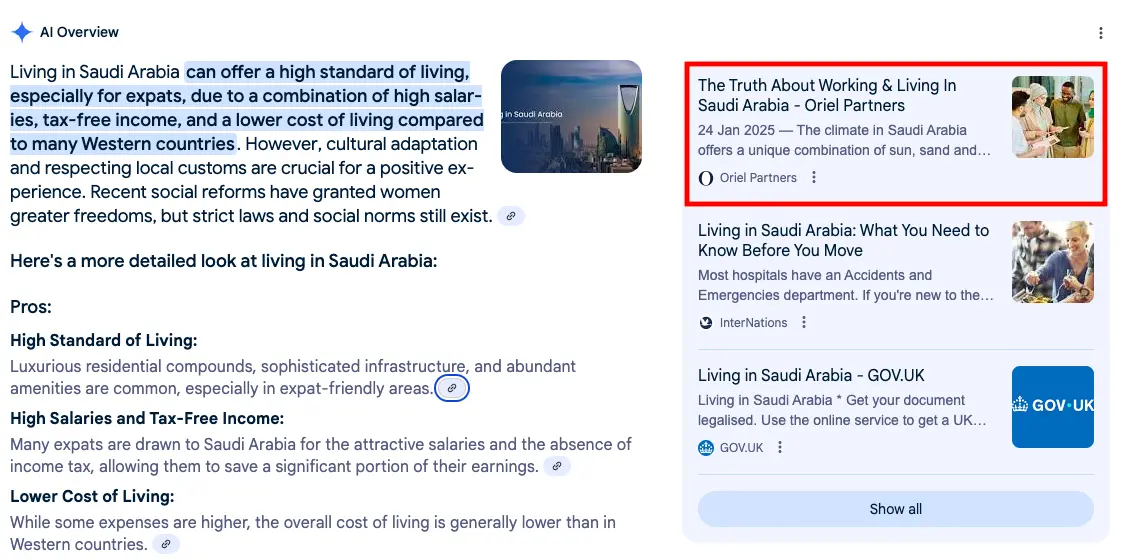
This is the exact strategy we used to improve our client’s AI visibility. We dove into Google’s People Also Ask and Reddit threads to uncover the real questions their audience was asking.
Armed with those insights, we expanded their content by adding new sections and detailed FAQs tailored to those queries. This not only improved topical depth but also made the content more “citation-friendly” for AI models.
The result? The article was featured in AI Overviews for 17 different keywords.
Strengthen your online presence
Besides their own training data, AI platforms and LLMs also pull data from the web. The more frequently your brand appears across the internet, the more likely AI systems to recognize and trust it.
Here’s how to build a strong online presence:
- Get mentions from high-authority sites: Pitch stories, contribute expert commentary, or secure digital PR placements to earn coverage on respected industry publications.
- Get your brand listed on cited content: Ensure your company appears in “best of” lists, comparison articles, and resource roundups that AI models often reference.
- Be active on relevant forums and social media: Participate in conversations on platforms like Reddit, LinkedIn, or niche communities.
Pro tip: A quick win is to find citation gaps—pages already being cited by AI where your competitors are included but you’re missing. If you can get your brand added to those articles, you increase the chances of being pulled into future AI-generated answers.
As Malte Landwehr, CPO & CMO at Peec AI, points out:
Collect the most cited URLs and check whether those pages already mention your brand. That tells you where to invest in PR, partnerships, or content updates.

Malte Landwehr, CPO & CMO at Peec AI
Fix negative and inaccurate mentions
If you notice negative sentiment or incorrect information about your brand in AI answers, go straight to the sources and fix them.
For example, if someone left a 2-star rating on Trustpilot, reach out to the person, resolve the issue, and ask them to change their initial rating.
Maybe a third-party listicle mentions outdated product details or inaccurate descriptions about your brand. In that case, ask them to update the content.
Fred Laurent, Founder & CTO of Waikay, explains why this step is crucial to educate AI systems about your brand:
If an AI model frequently mentions your company for ‘t-shirts’ but ignores ‘jackets’ or ‘sustainable materials’, it signals a topic imbalance in how your brand is represented. By filling those content gaps and reinforcing missing associations, you’re not optimizing for search engines — you’re training the AI ecosystem to understand your brand correctly.

Fred Laurent, Founder & CTO of Waikay
Ensure crawlability
If AI bots can’t crawl your pages, then they won’t show up in AI answers no matter how much effort you put in.
Thomas Peham, Co-Founder & CEO of OtterlyAI, shares the importance of site crawlability:
Our study found that AI crawlers frequently get blocked by robots.txt files, CDNs, or JavaScript-heavy sites. Run regular audits using tools like OtterlyAI’s AI Crawler Simulation Tool to verify your content is actually accessible to GPTBot, PerplexityBot, and Claude-Searchbot. This is table stakes – if AI can’t crawl you, you won’t get cited.

Thomas Peham, Co-Founder & CEO of OtterlyAI
Follow this technical GEO checklist to make sure AI can crawl, index, and surface your content:
- Allow AI bots in your robots.txt file: Add major AI crawlers such as ChatGPT-User, PerplexityBot, and Claude-Web, and explicitly set them to Allow so they can access your content.
- Check your CDN settings: Some CDNs, like Cloudflare, have default settings or protections that block AI bots. So, if you use Cloudflare (or any other CDN), make sure it’s not blocking AI crawlers.
- Check for paywalls or restricted content: AI systems generally can’t access gated content. Make sure your most valuable pages are publicly accessible.
- Avoid JavaScript-heavy content: Most AI crawlers can’t render JavaScript. Use server-side rendering or static HTML to ensure your core content is accessible.
Partner With a Reliable GEO Agency
Being visible in AI-driven search requires the right strategy, consistent execution, and ongoing optimization.
If you don’t have the knowledge, time, or team to manage it all, partnering with an AI SEO agency like Position Digital is a great solution.
We’ll handle everything from prompt research and brand visibility tracking to content optimization and digital PR, so your brand gets surfaced in AI answers and gets found by the right customers.
Ready to improve your AI visibility? Contact us today!
FAQs
What is AI brand visibility?
AI brand visibility is how often and how prominently your brand appears in answers generated by AI systems — ChatGPT, Google AI Overviews and AI Mode, Perplexity, Claude and Gemini.
Unlike a blue-link ranking there is no single position to hold: the same prompt can return a different answer to different users, so visibility is measured as a rate across many prompts rather than a rank on one.
What is a good AI visibility score?
There is no cross-industry benchmark, because every vendor calculates the score differently — most blend mention rate, citation rate and position within the answer across a prompt set you define yourself.
The number is only meaningful against itself, so set a baseline in month one and track direction from there.
As a rough guide, in a category with five to ten credible players, appearing in 20–30% of relevant prompts puts you in genuine contention; under 10% means you are effectively invisible.
How do you track AI brand mentions?
There are three methods, in increasing order of reliability:
- Manual spot-checks: run 20–30 buying-intent prompts across each platform monthly and log the mentions in a sheet — free, but slow and easily unrepresentative.
- Platform analytics: Search Console now reports AI Mode impressions, and GA4 can segment referral traffic from LLMs like ChatGPT and Perplexity.
- Dedicated tools: automated platforms run a fixed prompt set on a schedule and track mention rate, citations, sentiment and share of voice over time. Most brands start manual and move to tooling once they need trend data rather than a snapshot.
How is AI brand monitoring different from social listening?
Social listening tools track what people say about you across social platforms, forums and news. AI brand monitoring tracks what models say about you when a user asks a question.
The distinction matters because the inputs differ: social sentiment is generated continuously by humans, while model answers are shaped by training data, retrieval sources and citations.
You can have excellent social sentiment and still be absent from every AI answer in your category.
How do you increase brand visibility in AI?
Four levers, roughly in order of impact:
- Get cited on the sources models actually retrieve from — industry listicles, comparison pages, review sites and Reddit.
- Publish content structured for extraction, with direct answers, tables and clear definitions.
- Build brand mentions, linked and unlinked, across authoritative sites.
- Make sure your own pages are crawlable by AI user agents.
Improvement is slower than traditional SEO: expect to measure change over quarters, not weeks.
What are the best AI brand monitoring tools?
The category splits in two:
- Dedicated AI visibility tracking platforms such as Profound, Peec AI, Scrunch and Otterly were built for this and cover more platforms and higher prompt volume.
- Established SEO suites like Ahrefs Brand Radar, Semrush’s AI toolkit, and SE Ranking have also added AI tracking modules that cost less if you already pay for the suite.