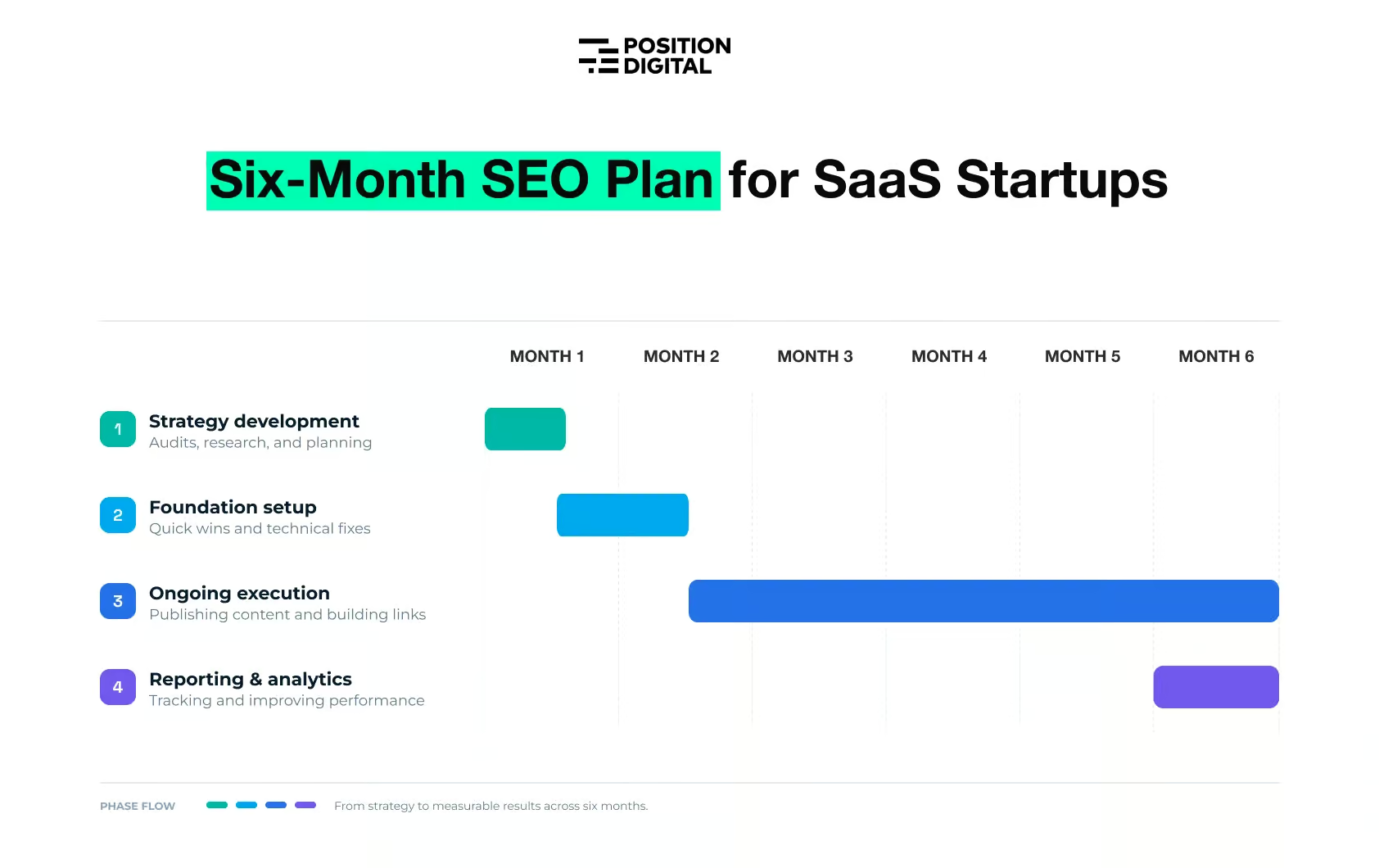
Content marketing remains one of the highest ROI-growth channels for B2B SaaS companies.
Blog content is a big part of that. According to First Page Sage’s 2026 benchmarks, B2B SaaS SEO averages 702% ROI with a break-even time of 7 months (measured over a 3-year window).
But the playbook is changing.
AI can now summarize the world’s information in seconds. People can find the answers they need without reading your articles. And because of that, the value of “educational” blog posts is shrinking.
Informational Content is Becoming Less Effective
A few months ago, Ryan Law, Director of Content Marketing at Ahrefs, posted this on LinkedIn:

Thanks to LLMs, users now have the option to access information quickly and easily.
They no longer have to endure the pain of browsing a company’s help center articles or blog posts just to learn how to install software.
There will be no reason to tolerate visiting a random SaaS company’s resource center just to find utilitarian information. Searchers will no longer suffer the inconvenience of trawling through the corporate backwaters of the internet just to learn how to install software or cook a common recipe.
And in the end, this strategy will stop working altogether.
Traffic and leads will stop coming, and companies will stop seeing the value of producing generic informational content.
There will be no place for regurgitated Wiki content shared on one of a hundred lookalike static HTML pages. Companies will no longer see economic rewards from simple information arbitrage. The uneasy truce we’ve tolerated for the past decade will end. We will finally draw a line under the era of information arbitrage as a dominant marketing strategy.
The Types of B2B SaaS Content That Work in 2026
I’m not saying that blog content is dead. It’s still a great channel to drive thousands of organic visitors to your website.
But there’s a much lower incentive to create educational blog content. The first reason is because AI Overviews are eating up clicks for informational queries.
And even when these informational articles do bring traffic, they rarely drive revenue. Most readers are there to learn, not buy tools.
That’s why the focus should shift towards two types of content:
- Original content that AI can’t replicate because it’s rooted in your story, your data, your customers, and your point of view.
- Product-led content that helps buyers evaluate your solution and take action, which actually generates leads, not just traffic.
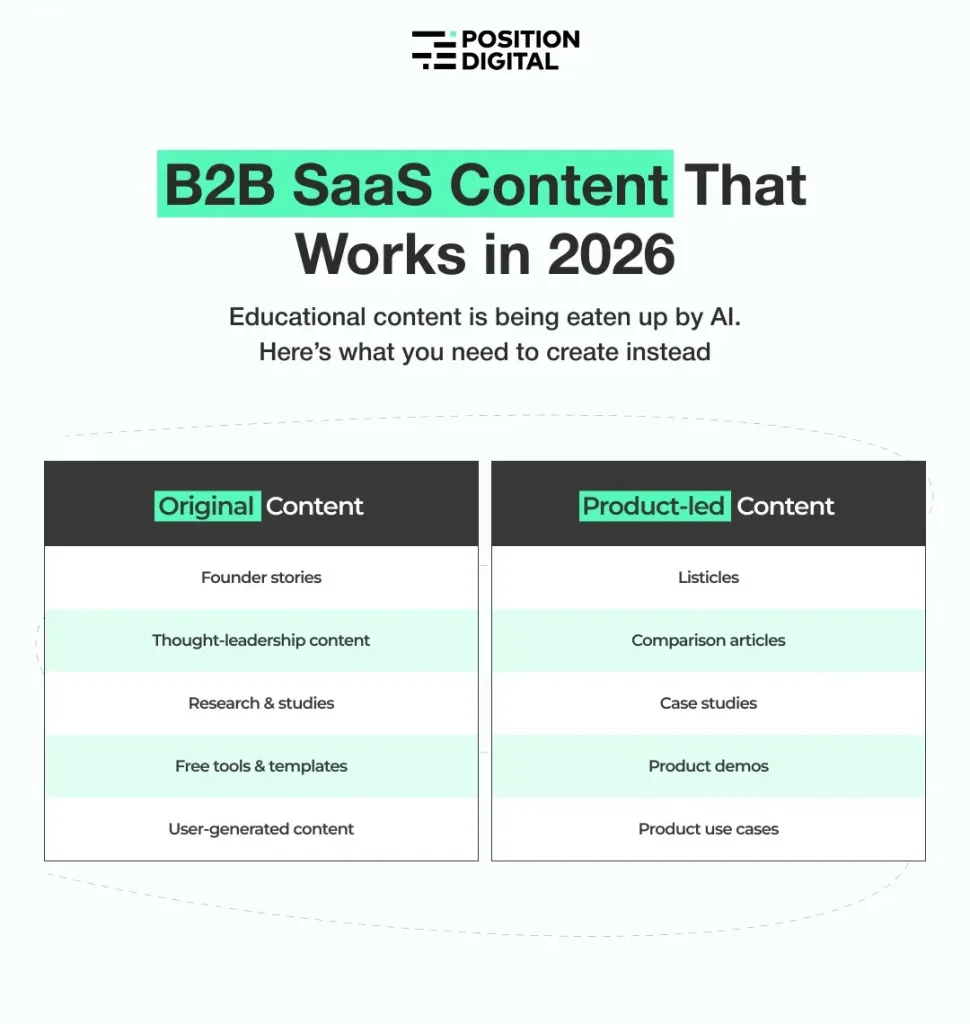
Examples of product-led content
Listicles
This is probably the most used tactic in the SaaS content marketing space today, simply because it works great.
According to a recent AI SEO study, “Best X” listicles are the most cited page types in ChatGPT responses, accounting for 43.8% of all page types.
Listicles work because they match how people search when they’re ready to buy (e.g. what’s the best X software for Y?).
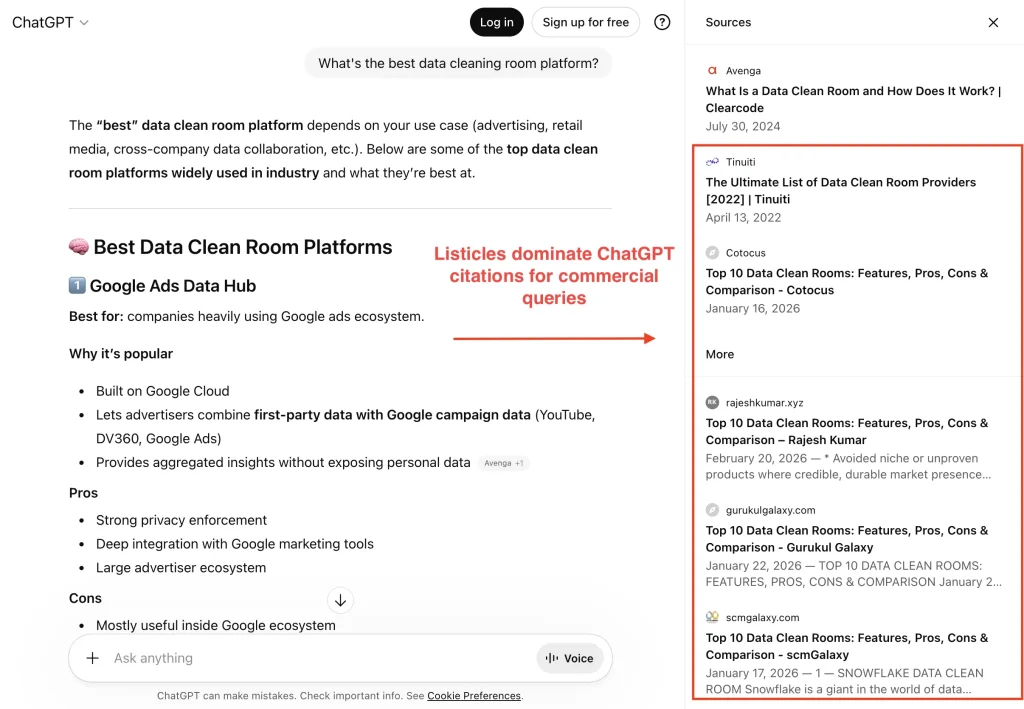
But be careful. Producing self-promotional listicles at scale can get your site punished by Google.
Every listicle you create should be genuinely helpful:
- Use clear selection criteria (pricing, must-have features, limitations, support, integrations, etc).
- Explain drawbacks, limitations, and tradeoffs with honesty (including your own software).
- Include real proof that you actually test the tools (screenshots, GIFs, and short videos).
- Match search intent (best overall, best for X, best for Y).
Comparison articles
Listicles help buyers build a shortlist. Comparison articles help them make the final call.
Once someone is down to 2–3 options, their questions change. They’re no longer asking “what’s the best tool?”
They’re asking:
- Which one is better for my exact use case?
- Is Y worth the extra cost?
- Will this actually work with our stack?
That’s why “X vs Y” and “X alternatives” pages convert so well. They’re built for high-intent buyers who are already in decision mode—and just need a clear, honest push in one direction.
Here’s a good example of a comparison article from one of our clients, Resource Guru.
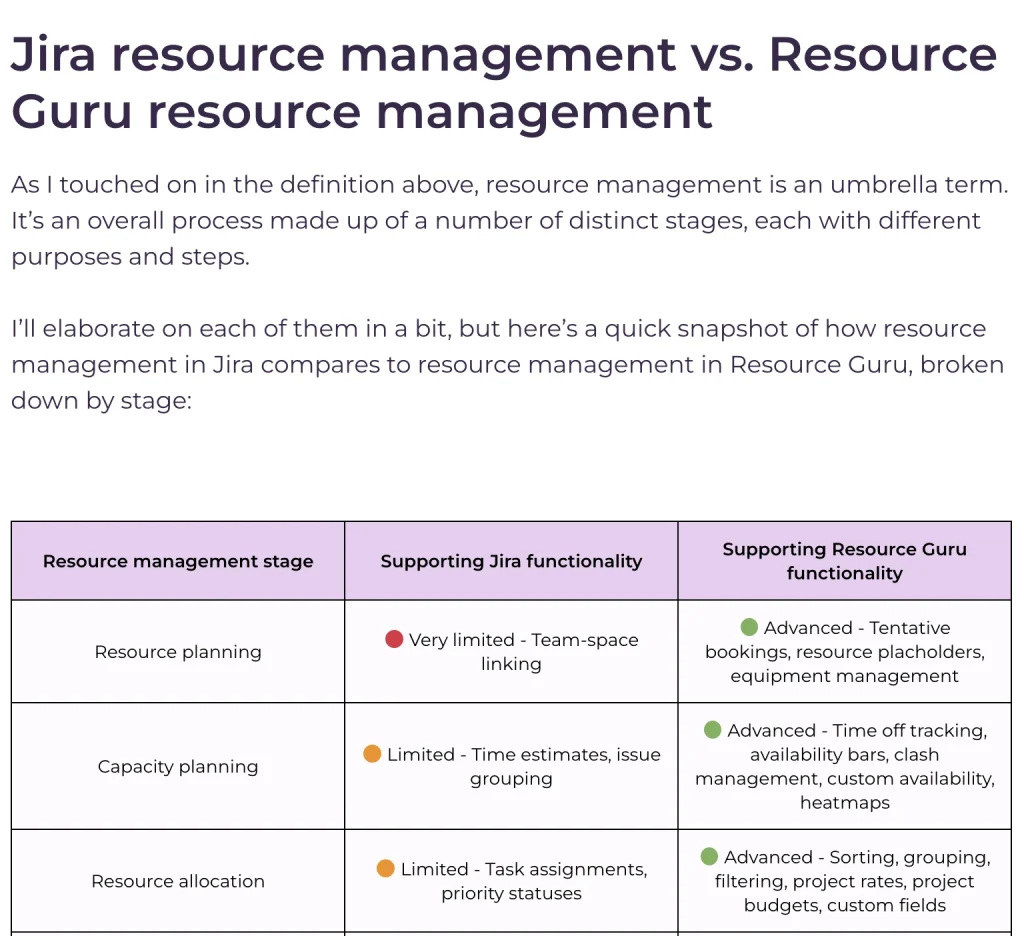
The article is cited by AI Overview for the keyword “Jira resource management alternatives.” As a direct result, Resource Guru is now being recommended as one of the best Jira alternatives.
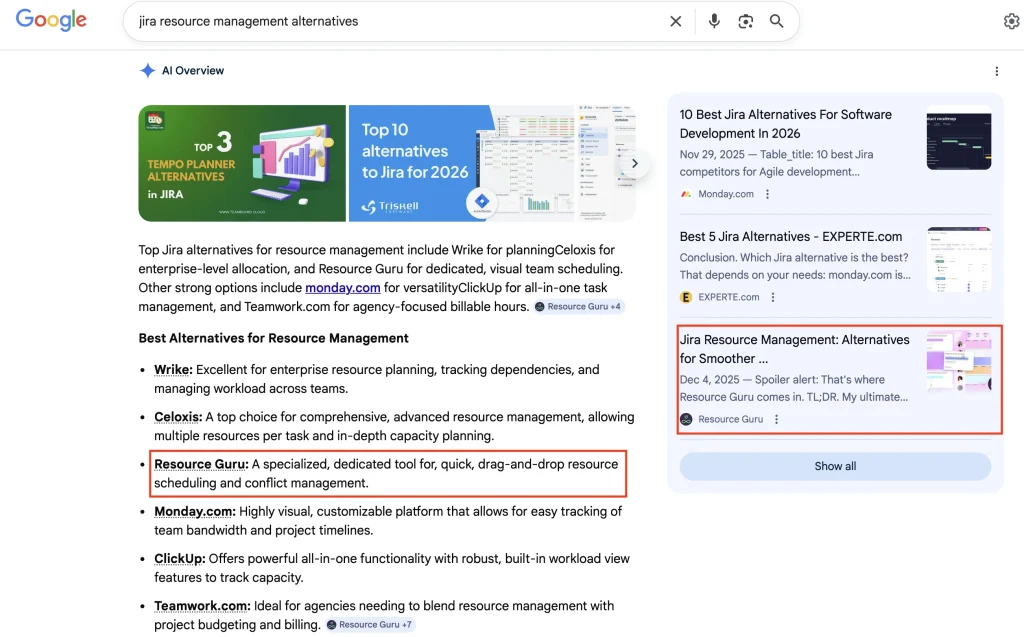
It’s a great way to “steal” existing Jira users who are actively looking to switch, or new buyers who are just comparing options.
Case studies
Proof speaks louder than any claims you could make.
At the bottom of the funnel, buyers aren’t looking for more promises. They want evidence that your product works for a company like theirs.
A strong case study shows how your product helps customers grow from A to Z:
- What the initial problem was
- Why existing solutions weren’t working
- How they implemented your product
- And what results they achieved
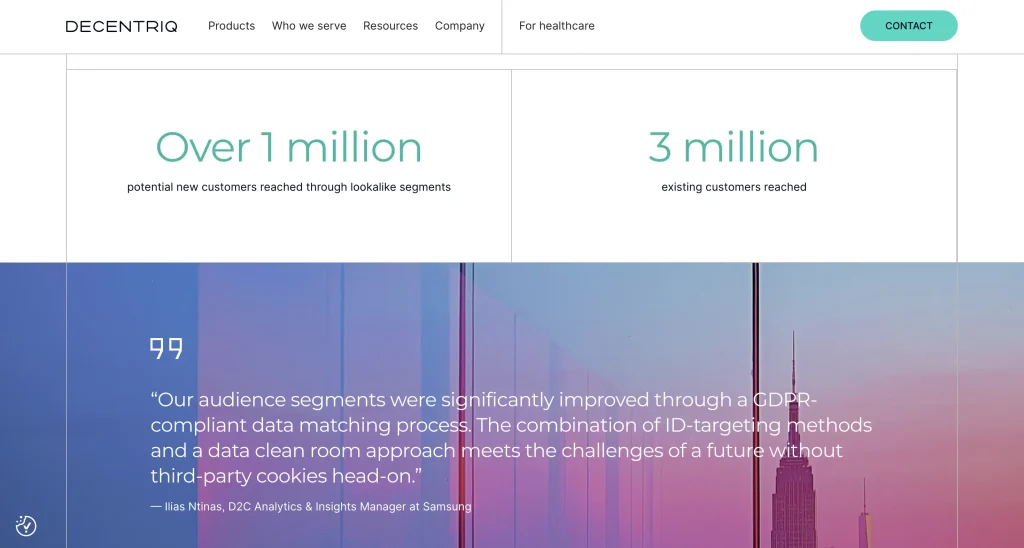
The more concrete the proof, the better. Numbers, screenshots, and direct quotes make your case studies look a lot more believable and credible.
Live product demos
Launch a virtual “demo day” event inviting your potential customers to have an interactive demo of your product.
Madhav Bhandari, VP of Marketing at Storylane, explained on the Ahrefs Podcast why this concept worked for them:
All of these buyers looking for software, they don’t want to get on a sales call. They don’t want to share their credit card details. They don’t want to fill a demo form. They just want to see the product.

Madhav Bhandari, VP of Marketing at Storylane
Storylane did two demo events, which brought them an instant surge in brand awareness and signups.
Everybody loves the concept, we’ve got a ton of registrations and we don’t even have to put a lot of effort in that. I think our webinars used to get like 100 registrants. And we put this out and we got 800 registrations and we’re like, okay now we’re on to something.
Madhav Bhandari, VP of Marketing at Storylane
Product use cases
Use cases are a great way to show all the cool stuff people can do with your product.
Instead of listing features, walk through specific scenarios. Show the problem, the setup, and the outcome. That helps prospects quickly connect their situation to your solution.
Ahrefs recently did this in a fun way with the “Ahrefs Use Cases Showdown” webinar.
Tim Soulo and Glen Allsopp each shared real, high-leverage Ahrefs workflows, and the audience voted on which use cases were most powerful.
That’s a great format to copy because it’s:
- Practical (real workflows, not theory)
- Interactive (people stay engaged)
- Product-led (the tool is the star, not the slides)
Examples of original content
Founder-led content
People are tired of polished corporate marketing. They want raw “behind-the-scenes” content that shows your company’s journey, the people behind it, and the product you’re building.
That’s why founder-led content works exceptionally well these days for B2B companies, especially on LinkedIn.
Adam Robinson actually bootstrapped two B2B SaaS startups to over $30 million ARR using LinkedIn as his number one user acquisition channel.
On the Ahrefs Podcast, he explained why founder content works:
Most businesses were started for a reason. And usually, that reason is a pretty good story. So really nailing down that story and just telling it where your audience lives is just a compelling channel.

Adam Robinson, CEO and Founder of Retention.com
Founder content works because it’s hard to fake. It’s opinionated. It’s specific. It’s rooted in real experience.
Here are a few content formats that work particularly well:
- Thought leadership: Share your honest takes on industry trends, bad advice you disagree with, lessons from failed experiments, and what you’re seeing in the market.
- Case studies: Share real customer success stories: how they went from A to Z with the help of your software.
- Video walkthroughs: Record yourself walking through how your product solves real user problems.
Jamie Thomson, Founder of Brand New Copy, gave one crucial copywriting tip to B2B SaaS founders: talk to a person, not a business.
Even in B2B relationships, your content is being read by people, so it needs to appeal to human interests as well as those of the business.

Jamie Thomson, Founder of Brand New Copy
Original research
AI is great at aggregating existing information. But it can’t create new information.
New data can only be obtained through research: surveys, experiments, studies, and real-world analysis.
That’s your opportunity.
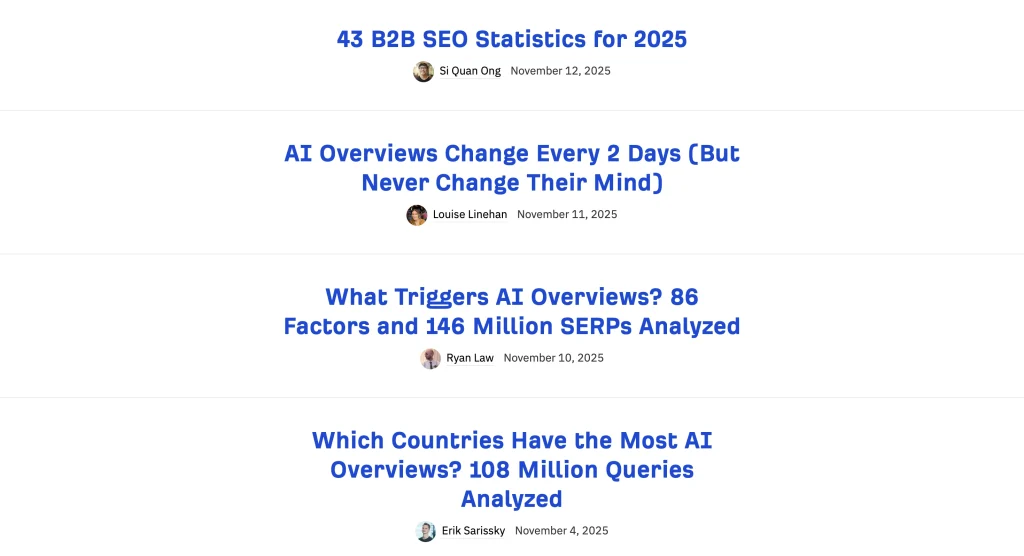
When you publish original data, you become the source everyone else references—SEOs, journalists, content marketers, and even AI systems looking for something credible to cite.
And it’s actually backed by data (pun intended). According to SaaS marketing studies:
- B2B SaaS websites that offer original research tend to have higher organic traffic (29.7%) than those that don’t (9.3%). (Stratabeat)
- 88% of B2B SaaS marketers report positive ROI from proprietary research, while 64% said data-driven content brings higher conversion rates. (Datalily)
We’re seeing the same pattern with our clients.
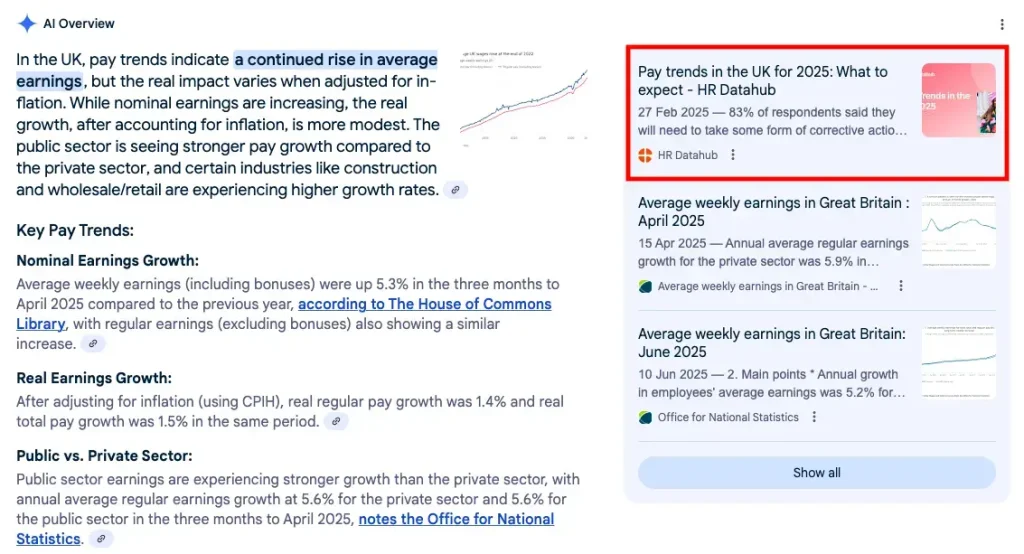
After updating one of HR Datahub’s blog posts with fresh, original data from their own survey, we saw a clear uplift in performance.
The article jumped from position 35 to 1 in just 4 weeks, earned citations in AI platforms, and brought 200% more webinar signups.
Free tools & templates
Free tools can be powerful traffic drivers—if they’re genuinely useful.
The key is to build tools that solve one clear problem well, ideally something closely related to your core product.
Ahrefs is a great example.
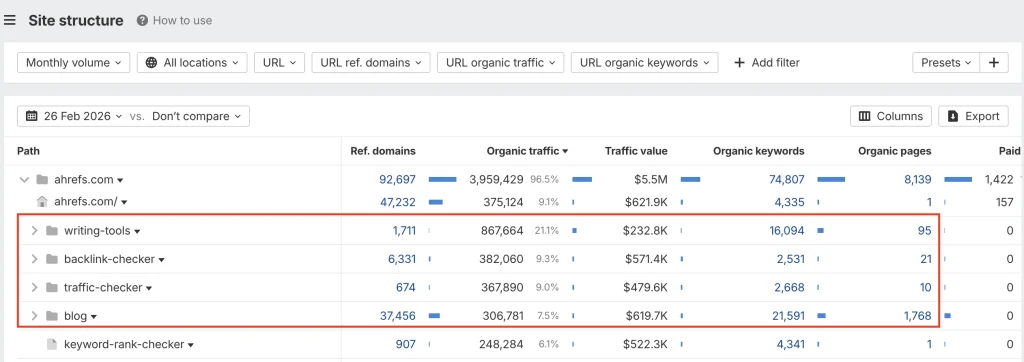
Their free SEO tools (writing tools, backlink checker, traffic checker) support their main product while delivering standalone value. And those tools generate more organic traffic than their blog—with far fewer pages.
Templates can also work well, especially in sectors where your customers deal with repetitive processes.
Some examples:
- HR / People Ops: Job description templates, compensation benchmarking sheets, onboarding checklists, performance review frameworks.
- Sales / RevOps: Outbound email sequences, account plans, pipeline review templates, MEDDIC sheets, ROI justification decks.
- Marketing: Campaign planning templates, content calendars, content briefs, reporting dashboards, attribution models.
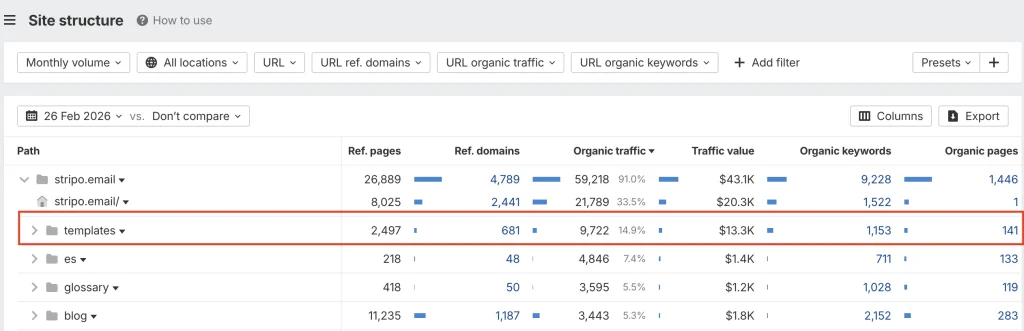
Besides its homepage, Stripo (an email template builder) actually got most of its traffic from template pages.
User-generated content
A lot of buying decisions don’t happen solely on Google anymore.
They happen in private Slack groups. In Discord servers. In niche communities where people ask:
- “Has anyone tried X?”
- “What are you using for Y?”
- “Is this tool actually worth it?”
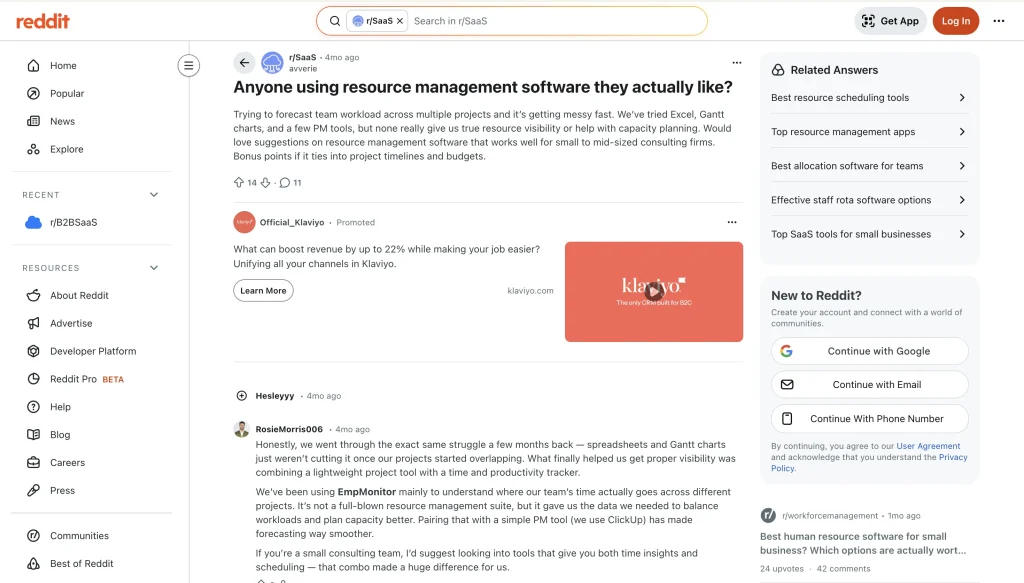
Real user recommendations carry a lot more weight than anything you could publish on your own site.
How to Create a B2B SaaS Content Strategy That Drives Sales
Here’s a simple framework B2B SaaS founders can follow to create a content strategy that actually drives leads, not just traffic.
1. Define your “buyer”, not just “user”
In B2B, your job isn’t just to convince the person who uses the product, but also convince their boss (decision maker) to buy your product.
- The user is thinking: “Will this software help me do my job easier and faster?”
- The buyer is thinking: “Is this worth the risk and the money spent?”
Two completely different mindsets.
And here’s the thing: the buyer might never use your product. They often make a decision to purchase your software or not based solely on your messaging.
That’s why it’s absolutely critical to define your buyer persona and build your entire content marketing strategy around them.
Practical tips
- Track the last 10-50 persons who purchase your paid plan (not just sign up to the free trial or request a demo).
- Look at their job titles or roles. For example, if the majority of your paying customers are “agency owners”, then that’s your ideal customer profile (ICP).
- Interview a sample of your ICP to uncover their pains, goals, objections, and why they chose you over competitors.
2. Decide which channels to focus on
The next step is to figure out where your buyers spend their time online.
How do they find information? Where do they discover tools, compare options, and ask for recommendations?
Those are the channels you need to be visible on.
For B2B SaaS, data says that these channels bring the best results:
- SEO: Google is still the biggest traffic source for websites. But the competition is stiff, so you need the right SEO strategy to win. If you have no prior experience, partnering with a reliable SaaS SEO agency is the smart move.
- GEO/AEO: Around 89% of B2B buyers now use generative AI platforms to research information during their buying process. If your software doesn’t show up in the answers, you’re losing a lot of potential customers.
- LinkedIn: 80% of B2B social media leads come from LinkedIn. LinkedIn Ads also bring 2x higher conversion rates than Google Ads, while the cost per lead is 28% lower.
- Reddit: The fact that there’s a dedicated channel for B2B SaaS on Reddit should tell you about its potential. B2B buyers are tired of self-promotional content; they want honest recommendations from real users.
- YouTube: People want to see products in action. In fact, 46% of tech B2B buyers will purchase a product after watching the video content.
Practical tips
- Ask new leads where they heard about you in registration forms and sales calls.
- Check the top referral sources in your Google Analytics account.
- Conduct a competitive analysis—find out which channels your competitors invest in.
3. Build an acquisition funnel
B2B sales cycles are typically long, so you need to map your content to different stages of the buyer’s journey:
Discovery (top funnel)
Prospects are aware of their problem, and they’re looking for a tool to solve it.
Your goal here is brand awareness, making sure that your target audience knows that your software exists as a solution to their problem.
The best content types for this stage are:
- SEO content: Tutorials, help centers, and use case articles designed to solve specific problems people are searching online. Avoid generic “what is” type of content, as AI can answer that in seconds.
- Thought leadership content: Strong opinions, contrarian takes, and lessons from real experience that make you look credible in the eyes of your audience.
- Partnership content: Appear in popular media platforms your target audience already follow. Become a guest in podcasts, get your content featured in newsletters, and get your SaaS listed in “best X tools” listicles.
Comparison (middle funnel)
Prospects are actively evaluating options to find the best software solution for their needs and budget.
Your goal here is to convince them that your SaaS is the perfect match.
Most SaaS and tech companies aren’t short on content. There’s often great blog traffic already, but not quite enough sitting between “someone found your article” and “someone started a trial.” Adding just a few well-targeted pieces, a comparison page, and some use-case content for the person doing the evaluation can move signup numbers faster than months of top-of-funnel publishing. It’s one of those small shifts that makes a big difference.

Anastasiya Khvin, Marketing Manager at Aimers
The best content types for this stage are:
- Comparison articles: “X vs Y” and “X alternatives” content that clearly explains your software’s strengths and weaknesses compared to other solutions.
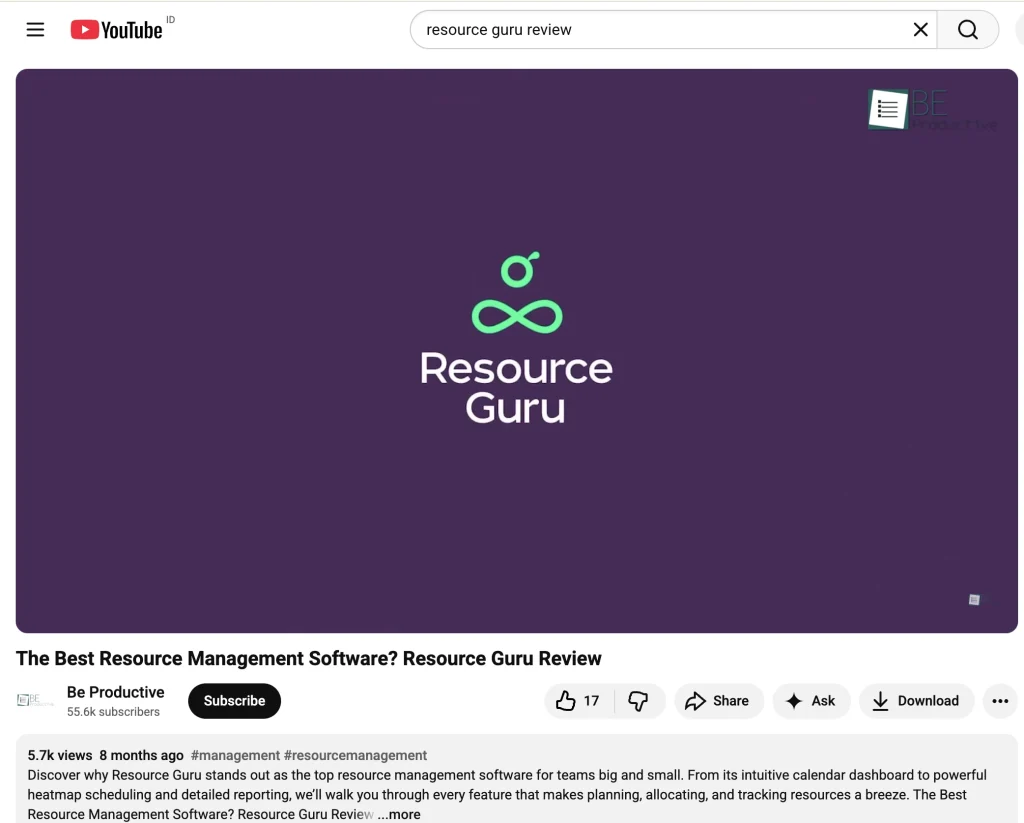
- Reviews: Ask your existing customers to leave positive reviews on platforms like G2 and Capterra. Collaborate with trusted tech blogs (like TechRadar) and YouTube influencers to review your product.
Conversion (bottom funnel)
At this stage, potential buyers are ready to make a purchase.
Your goal is to remove objections, reduce perceived risk, and make the purchase feel like the safest choice.
The best content types for this stage are:
- Social proof: Customer testimonials and success stories that help buyers feel confident that others like them have already seen results with your product.
- Landing pages: High-intent pages tailored to a specific use case, industry, or role—clearly explaining who it’s for, what it solves, and why it’s better. Include proof points, FAQs, and a clear next step.
Further reading:
Practical tips
- Start from your bottom-funnel content (case studies, pricing page, product pages, use case pages, etc), then publish top-funnel content to drive traffic to these pages.
- Each landing page should solve one problem and speak to one buyer persona. If you try to speak to everyone at once, you’ll end up resonating with no one.
- Make signing up easy. Use a clear, action-oriented CTA and remove unnecessary friction—no long forms and complicated processes. The fewer obstacles between interest and action, the higher your conversion rate.
Joshua Ritchie, Co-founder of Column Five, shares how his content funnel looks like:
We’re currently focused on a few things, including: high-intent BOFU content to bolster our SEO/AI search visibility for the 5% in market, building out our YouTube, and LinkedIn Thought Leadership ads for TOFU.”

Joshua Ritchie, Co-Founder of Column Five
4. Define your core messaging
Don’t treat individual content pieces as standalone assets.
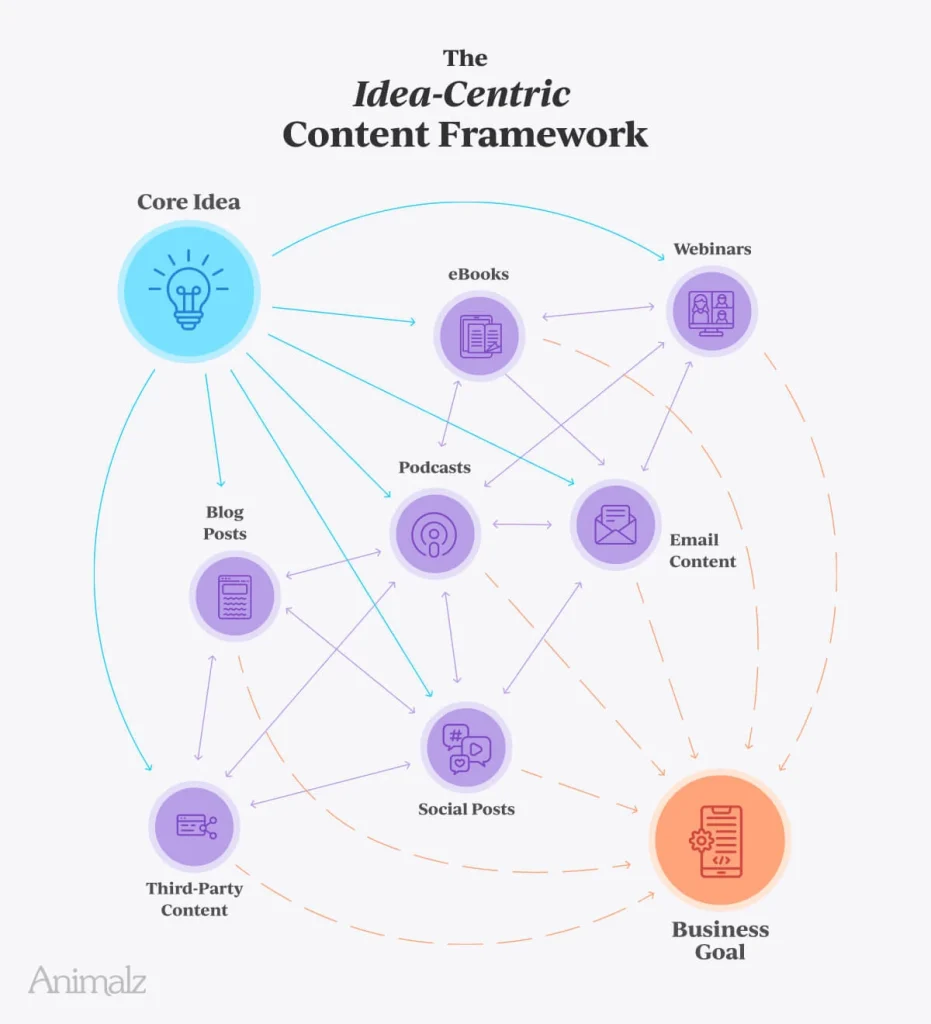
Instead, every article, social media post, landing page, and sales asset you publish should be centered around one key idea or theme.
The biggest mistake B2B SaaS companies make with content marketing is focusing on execution before they figure out their narrative. They produce more — more blogs, more case studies, more social posts — without ever clarifying and sharpening the story that should run through all of it.

Ross Crooks, Co-Founder of Column Five
This is called the Idea-Centric Content Framework, and it helps you:
- Build memorable positioning: When every piece of content reinforces the same core idea, people will start associating that idea with your brand.
- Attract the right customers: People who believe in your idea will naturally become your supporter or follower.
Practical tips
- Start with what makes you different. What’s the one thing you do better than competitors—and what belief or approach drives that?
- Turn that into 1–2 core themes. Broad enough to create lots of content from, but specific enough that people can associate it with your brand.
- Test the themes in public. Weave them into a few LinkedIn posts, a blog article, a webinar, or a sales deck. Pay attention to what gets replies, DMs, and demo requests.
- When something clicks, commit. Bake it into everything: your homepage copy, product pages, case studies, comparisons, and editorial calendar. Consistency is the multiplier.
5. Define success metrics by funnel stage
Different types of content serve different purposes. So, how you measure “success” is also different.
Here are the key metrics you should track to assess the effectiveness of your content in each stage:
| Funnel Stage | Primary Goal | Key Success Metrics |
| Discovery (Top Funnel) | Attract the right audience and build awareness | Impressions, organic clicks, unique visitors, branded search volume |
| Comparison (Middle Funnel) | Get shortlisted and evaluated | Demo requests, free trial signups, sales-qualified leads |
| Conversion (Bottom Funnel) | Remove objections and close deals | Paid subscriptions, MRR (monthly recurring revenue), ARR (annual recurring revenue) |
Turn Your Strategy Into a Content System
Strategy is nothing without execution.
Once you know who your buyers are and where they spend time, start publishing there. Test different formats, angles, and hooks, then double down on what attracts qualified leads and drives demos.
That’s how you find content-market fit—and turn content into a predictable growth channel.
If you want help building a content system that drives pipeline, partnering with a SaaS content marketing agency like Position Digital can get you there faster.
If that sounds like what you need, let’s talk!