
In the last few months, over 90% of our leads were coming through AI chatbots.
The funny thing is, our SEO performance has never been better. We rank high for some of our most important keywords. Organic traffic hit around 2,000 visits a month — a peak for us. By every traditional metric, things were going well.
But when new leads told us how they found us, the answer was almost always the same: ChatGPT, Claude, or Google’s AI Overviews.
That experience taught us something important: ranking well in traditional search and being recommended by AI are two different games. You can win one and still be invisible in the other.
A GEO audit is how you find out where you stand in the second game — and what it’s going to take to win it.
Key Takeaways
- A GEO audit shows whether AI can find, understand and recommend your brand. It checks how well your site is positioned to appear in ChatGPT, AI Overviews, AI Mode, Gemini, Claude and Perplexity.
- The process has three steps. Measure your current AI visibility, audit four layers (technical, brand and entity, content citability, offsite presence), then build a prioritized action plan.
- Fix access first. If AI crawlers can’t reach your pages, nothing else gets you cited, and 69% of AI crawlers can’t execute JavaScript. Blocked crawlers, unindexed pages and missing schema come first.
- It isn’t a one-off. Models update often and competitors gain or lose citations, so keep monitoring.
What is a GEO Audit?
A GEO (generative engine optimization) audit is an evaluation of how well a website is positioned to appear in AI-generated answers from tools like ChatGPT, Google’s AI Overviews and AI Mode, Gemini, Claude, and Perplexity.
It focuses on whether AI systems can:
- Crawl and access your content
- Understand your brand and entities
- Retrieve accurate information about your company
- Trust your site as a credible source
- Cite or mention your brand in AI-generated responses
Think of it as an SEO audit, but instead of asking “can Google find and rank this page?”, you’re asking “can an LLM find, understand, and confidently recommend this brand?”
Step 1: Measure Your Current AI Visibility
Before auditing and fixing anything, you first need to know how you currently appear in AI responses.
Does AI mention or recommend your brand at all? If yes, is the information accurate, outdated, or hallucinated?
Are LLMs citing your content as a source? How do you compare to competitors in AI responses?
This baseline audit helps you identify where you’re already visible, where you’re missing, and what needs to improve.
Here’s the process:
Conduct prompt research
In SEO, we track keywords. In GEO, we track prompts.
Unfortunately, LLM providers like OpenAI and Anthropic currently don’t provide prompt data to the public.
It may change in the future, but for now, you’ll have to make the most of the available information.
Here are some places you can gather prompt data:
- Sales calls and support tickets. The questions prospects ask your team are often the same questions they ask AI assistants. Review call transcripts, chat logs, and support tickets to uncover the exact language buyers use.
- Long-tail queries in GSC. Look for long-tail, question-shaped queries in your Google Search Console report. These are the closest public proxy for conversational AI prompts at the moment.
- SEO keywords. Turn your target keywords, as well as competitors’ top keywords, into the questions someone would realistically ask an assistant. Use AI tools like ChatGPT to come up with different variations and angles for each query.
- Fan-out queries. Check what sub-queries AI searches in the background when answering a prompt. It can help you explore more subtopics and prompt ideas. Use a Query Fan-Out Extractor tool for this.
You can discover more ways to research prompts in this Ahrefs guide.
Record the AI answers for those prompts
Once you have your prompt list, run those prompts across the platforms that matter most for your audience:
ChatGPT, Claude, Perplexity, Google AI Overviews, AI Mode, and Gemini.
Don’t forget to use the incognito mode and log out of your AI accounts to avoid bias.
For each platform, record:
- Brand presence. Is your brand being mentioned and recommended?
- Accuracy. Is what the AI says about your brand correct and accurate?
- Positioning. How are you described, and where do you appear relative to competitors?
- Sentiment. Whenever your brand appears in AI answers, check whether the mention is positive, neutral, or negative.
- Citation rate. Is your content being used as a source in AI answers? If yes, how many times?
- Competitor share. Who is being mentioned and cited instead of you, and how often?
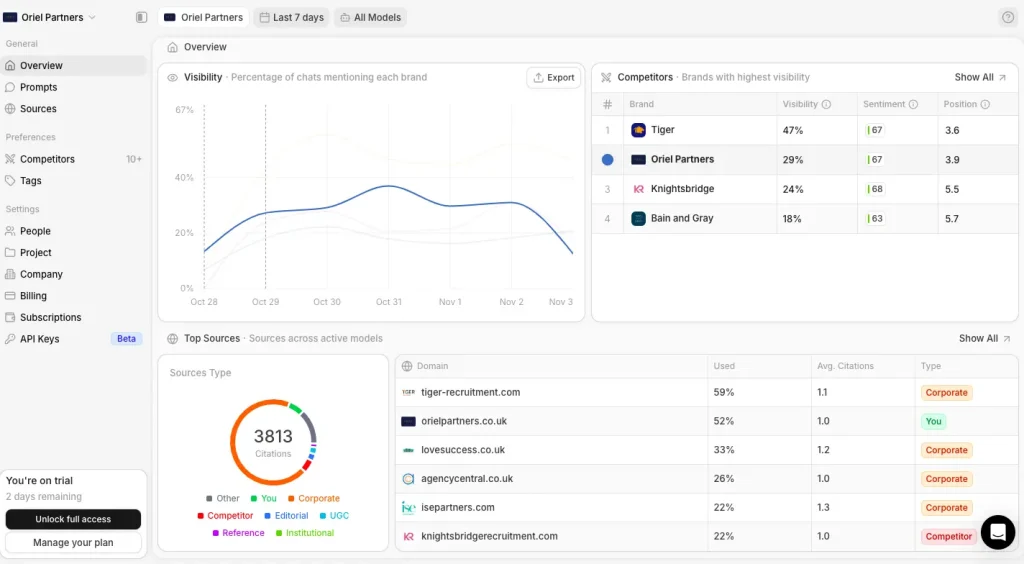
You can also use AI visibility tracking tools like Writesonic, OtterlyAI, Ahrefs Brand Radar, and Semrush’s AI Toolkit to automate prompt tracking and track your brand visibility across platforms over time.
Check out our guide on how to monitor brand visibility in AI search for the complete steps.
Analyze the findings
Based on the visibility audit result, measure your performance against these metrics:
| Metric | What it means | How to measure | Example |
| Brand visibility | The number of times AI mentions or recommends your brand in the answer | Prompts where your brand appears ÷ total prompts tested x 100% | Mentioned in 12 of 40 prompts = 30% visibility |
| Citation rate | How often AI uses your own content as a linked source | Responses citing your site ÷ total responses tested x 100% | Cited in 5 of 40 responses = 12.5% citation rate |
| Share of voice | How often your brand appears versus competitors for the same prompts | Your mentions ÷ total brand mentions (you + competitors) x 100% | 12 of 50 total brand mentions = 24% share of voice |
| Sentiment & accuracy | Whether the mention is positive, neutral, or negative, and whether the facts AI states are correct | Manually go through each response mentioning your brand and record what it says | ”Positive, accurate” on 9 of 12 mentions; 1 hallucinated your pricing |
These numbers should give you an idea of your overall visibility in AI search.
However, they only tell you part of the story. For example, a 30% brand visibility score shows you’re missing from most answers, but not which answers, which pages let you down, or which platforms ignore you.
Those are the details that tell you what to fix.
So, break your results down across three dimensions to see where the patterns are:
- Prompts. Identify which prompts trigger answers that mention or cite you, and which ones leave you invisible. The gaps tell you where to focus, often a whole category of buyer questions you’re absent from.
- Pages. Work out which of your pages AI actually visits, retrieves, and uses as a source, versus the ones it never touches. If your strongest commercial pages are invisible while a stray blog post gets cited, that’s a content and technical signal worth chasing.
- AI platforms. Every model behaves differently. Track where you’re winning visibility (say, Perplexity) and where you’re absent (say, Google AI Overviews), because the fix for one platform rarely transfers cleanly to another.
Compile all these findings in a document.
Step 2: Audit Your AI Readiness
Once you’ve identified where you’re winning and losing visibility, the next question is what’s causing those results.
The answer usually sits within one of these underlying GEO audit layers.
| Layer | What it covers | Why it matters |
| Technical GEO Audit | Whether AI crawlers can access, render, and parse your content | If bots can’t reach your pages, no amount of content or PR work will get you cited |
| Brand & Entity Audit | How your brand is defined, described, and associated with the right topics across AI platforms | AI models cite brands they can clearly identify and confidently categorize |
| Content Citability Audit | Whether your content is structured in a way that makes it easy for LLMs to extract and reference | AI models cite what they can cleanly retrieve — dense, unstructured content gets skipped |
| Offsite Presence & Reputation Audit | The quality and consistency of your brand mentions across third-party sites, publications, and listicles | LLMs use offsite signals to validate brand authority and decide whether a source is worth citing |
Layer 1: Technical GEO Audit
No amount of content optimization work will get you cited if AI can’t visit your pages in the first place.
The purpose of this audit is to make sure AI systems can access, crawl, and understand your content easily.
There are two types of AI systems to account for:
AI crawlers
AI crawlers are automated programs that browse websites and gather content for AI systems to learn from, index, or retrieve later.
They can only use content they are able to discover and access. Before you worry about citations, visibility, or AI recommendations, you first need to confirm that these systems can actually reach your website.
Use the following checks to assess whether your site is accessible to the major AI crawlers and retrieval systems:
- Is there any AI bot activity on your website? Check your server logs for visits from major AI crawlers — GPTBot, ClaudeBot, PerplexityBot, OAI-SearchBot, and Google-Extended. If none of these bots appear in your logs, it’s a strong signal that something is blocking them.
- Are your pages indexed by Google and Bing? LLMs frequently retrieve pages from both search engines during web fetching.
- Is Cloudflare blocking AI crawlers? If you use Cloudflare, check whether the AI bot blocking feature is enabled inside security settings.
- Is your robots.txt file blocking AI bots? Make sure it allows major AI bots like GPTBot, OAI-SearchBot, ClaudeBot, PerplexityBot, and Google-Extended to crawl your site.
- Does your site rely on JavaScript rendering? 69% of AI crawlers can’t execute JavaScript. If your site is built on a JavaScript-heavy framework, implement server-side rendering to fix this.
- Do your pages load fast? Use Google PageSpeed Insights to check your Core Web Vitals. Make sure they stay within the recommended thresholds.
- Does every page have a clean HTML structure? It should follow a logical heading hierarchy and contain well-organized sections with one main idea per paragraph.
- Have you implemented schema markup? Structured data helps engines understand and interpret your content more accurately.
- Does your domain have a llms.txt file? An llms.txt file gives AI systems a plain-text summary of your site’s content and structure. It’s kind of like an XML sitemap for LLMs.
Recommended tools:
- Google Search Console to verify whether important pages are indexed by Google and identify crawl or indexing issues.
- Bing Webmaster Tools to check indexing status, crawl activity, and visibility in Bing’s search ecosystem.
- Google PageSpeed Insights to measure Core Web Vitals, page speed, and technical performance.
- Google Rich Results Test to validate structured data and identify schema implementation issues.
- Schema Markup Validator to test and verify schema markup across your pages.
- Cloudflare Dashboard to review bot management, security rules, and AI crawler settings if your site uses Cloudflare.
- Screaming Frog Log File Analyser to check visits from AI crawlers such as GPTBot, ClaudeBot, PerplexityBot, OAI-SearchBot, and Google-Extended.
- TechnicalSEO Robots.txt Tester to validate robots.txt directives and confirm AI bots are not being blocked unintentionally.
AI agents
AI agents are programs that visit websites and apps to complete tasks on behalf of a user, like comparing products, pulling pricing, or filling in a form.
AI crawlers only retrieve information from your content. AI agents have the ability to do stuff on your site. This is where the future of the internet is heading, so it’s crucial that your site is AI agent ready.
There are two layers to check:
Layer 1 is everything that determines whether an agent can read and navigate the page itself:
- Semantic HTML. Does the page use proper HTML elements such as headings, buttons, forms, tables, and lists? Agents rely on semantic structure to understand what each element represents.
- Stable layout. Does the page maintain a predictable structure? Interfaces that constantly shift, reorder elements, or dynamically inject content can make agent navigation harder.
- Accessible Rich Internet Applications (ARIA). Have you implemented appropriate ARIA labels, roles, and landmarks? These accessibility signals help agents identify navigation menus, buttons, dialogs, forms, and other interactive components.
- Accessibility primitives. Are buttons, links, forms, and controls built using standard web patterns? Custom components without proper accessibility support can be difficult for agents to interpret.
- Rendered DOM. Can an agent understand the page after rendering? Many agents interact with the rendered Document Object Model (DOM), not just the source HTML. Important content and actions should be available in the rendered page without requiring fragile interactions.
Layer 2 is all the machine-readable signals and protocols that sit outside the page and tell agents how to discover and interact with your site:
- robots.txt. Does your robots.txt file provide clear crawling guidance and avoid unintentionally blocking agent-related access?
- sitemap.xml. Have you set up an XML sitemap? Does it expose important URLs and resources that agents may need to discover?
- HTTP link headers. Are relevant resources exposed through standard link relations and machine-readable metadata?
- llms.txt. Have you published a llms.txt file? An llms.txt file gives AI systems a plain-text summary of your site’s content and structure. It’s kind of like an XML sitemap for LLMs.
- The /.well-known/ directory. Have you implemented relevant machine-readable resources within the /.well-known/ directory? This location is increasingly becoming the standard place for agent discovery and interoperability.
- Markdown negotiation. Serving a clean Markdown version of a page on request can cut the tokens an agent needs to read it.
- OAuth metadata. Can agents securely authenticate and obtain permission to access protected resources?
- MCP and A2A discovery. The Model Context Protocol and Agent-to-Agent standards let agents discover what your site can do programmatically. Both are early but moving fast.
- WebMCP. Extends MCP into the page so agents can take actions, like running a search or pulling a record, rather than just reading.
- Commerce protocols. Emerging agentic-commerce standards that let agents complete transactions. Relevant mainly if buyers might purchase through an assistant.
Recommended tools:
- Cloudflare’s AI readiness scanner evaluates how ready your website is for AI agents. The tool checks for many of the technical signals discussed above, including discoverability, machine-readable metadata, protocol support, and agent accessibility.
- Google’s Lighthouse is launching a new report that analyzes whether your site is AI agent friendly. You don’t need to download any software; it’s available inside Chrome. Follow this tutorial to run the report on your site.
- Agentchecker tests how accessible and understandable your website is to AI agents, helping identify technical barriers that may prevent agents from interacting with your content and services.
- Glippy analyzes websites from an AI agent perspective, highlighting discoverability, machine-readability, and agent compatibility issues that could affect future AI-driven traffic and transactions.
Layer 2: Brand & Entity Audit
AI systems do not “understand” brands the way humans do. They infer identity through repeated entity associations across trusted sources.
Your goal is to make every major entity around your company explicit, consistent, structured, and repeated across the web.
Core entities to check:
- Brand name. Is it written consistently across the web? LLMs may confuse “Apple” and “Apple Technologies” as two separate entities. Choose one canonical name and stick to it.
- Founder name(s). Is the founder name consistently linked to the company on the website, business directories, social media profiles, and guest post author bios
- Business category. Do you explicitly associate your brand name with your category in your own content? Don’t say “We are a CRM platform”, but say “HubSpot is a CRM platform.”
- Location(s). Whether you’re a local business or an international brand, state every country, city, and region that you serve.
- Product or service name. Your products and services should be treated as standalone entities — but always connect them back to your brand. For example: Google’s AI Overviews, Apple’s iPhone, Ahrefs’ Site Explorer, etc.
Where to check:
- Owned assets. Make sure your entities are consistent across your website, newsletter, social media profiles, YouTube channel, and other marketing channels you own.
- Google Knowledge Panel. Search your brand name and review what Google associates with your entity: company description, founders, social profiles, website, reviews, category, and related products. Incorrect or incomplete information here often propagates into AI systems.
- Business directories. Check Crunchbase, Clutch, G2, Capterra, Yelp, and industry directories for naming consistency, categories, locations, and descriptions.
- Social media. Make sure your LinkedIn, Instagram, YouTube, Twitter, and Facebook bios are up-to-date.
- Author bios & guest posts. Ensure every founder or employee bio consistently links the person back to the company using the same positioning language.
- Press mentions & podcasts. Review how journalists, hosts, and third-party sites describe your company and products. Correct outdated or inaccurate descriptions where possible
Layer 3: Content Citability Audit
AI models don’t read your content the way search engines do.
Instead of analyzing the whole page, LLMs scan for extractable answers — short, self-contained passages that can be pulled out and cited without additional context.
Your goal is to make every piece of content easy for AI to parse, extract from, and attribute accurately.
What to check:
- Does each page lead with its most important point? AI prioritizes content from the first 30% of a page. If your key claim, definition, or conclusion is buried after three paragraphs of background, AI may never reach it.
- Does every page follow a logical H1 → H2 → H3 structure? AI crawlers use your headings to build a semantic map of the page. A broken hierarchy distorts that map and reduces citation accuracy.
- Are your H2s phrased as questions (where natural)? For every section, open with a question and answer it directly in the first sentence. The Q&A structure mirrors how AI retrieves and surfaces information.
- Are your paragraphs short and self-contained? Stick to one idea per paragraph. If you’re making two points, write two paragraphs.
- Do you spell out entity names? AI learns context and associations through named entities. Avoid vague sentences like “This tool does this” or “We are a X company.” Instead, say “Ahrefs is an SEO tool that does this and that.”
- Does your content include facts and stats? Content with 5–7 statistics earns a 20% higher citation likelihood. The typical AIO-cited article also covers 62% more facts than the typical non-cited one.
- Does your content include expert insights? Including expert quotes with credentials can increase AI Overviews visibility by 78%. Pages with expert quotes also average 4.1 citations on ChatGPT versus 2.4 for pages without them.
- Is your content up-to-date? LLMs prefer citing fresh content. Make sure to regularly update your most important pages.
Layer 4: Offsite Citation Audit
AI models don’t just read your website.
They form opinions about your brand based on what the rest of the web says about you — third-party publications, review platforms, listicles, forums, and press mentions.
Your goal is to build a consistent, authoritative offsite footprint that AI models encounter repeatedly and trust enough to cite.
What to check:
- Are you included in listicles that AI cites? Getting featured in cited listicles can improve your chances of being recommended by AI systems, according to a Peec AI study.
- Are you covered by publications AI learns from? Various AI SEO studies suggest that LLMs learn from authoritative publications like Forbes, Business Insider, Nerdwallet, Investopedia, Value Penguin, and more.
- Is your brand being discussed in community forums? Reddit threads, Quora answers, and niche community forums are heavily indexed by AI models.
- Are you featured on review platforms? G2, Capterra, Clutch, and Trustpilot are high-authority sources AI models pull from when evaluating and recommending software and services.
- Are your brand mentions accurate? When multiple pages say the wrong things about you, those inaccuracies will get picked up by LLMs.
- Is there any negative sentiment about your brand? From Seer Interactive’s case, we can learn one thing: all it takes is one negative review from one customer to ruin your reputation in the age of AI.
Step 3: Create a GEO Action Plan
The audit tells you where you stand. What you do with that information is what decides whether your brand shows up in AI answers.
So now, your goal is to turn audit findings into a prioritized roadmap based on impact and effort.
Categorize every issue by priority
Use three levels:
- High Priority
These are issues that directly prevent AI systems from discovering, understanding, or trusting your content.
Fixing them often produces the biggest gains.
Examples:
- AI crawlers blocked by robots.txt
- Important pages not indexed
- Cloudflare blocking AI bots
- Missing schema markup on key pages
- Critical pages hidden behind JavaScript rendering
- Medium Priority (Fix Next)
These issues don’t stop visibility entirely, but they reduce your likelihood of being cited or recommended.
Examples:
- Incorrect company information across directories
- AI hallucinating basic facts about your business
- Weak heading structures and missing FAQs
- Long introductions before answering questions
- Limited coverage in industry publications
These improvements increase citation probability and recommendation frequency.
- Low Priority
These are emerging initiatives that may improve AI visibility and agent compatibility, but require deep technical expertise.
Only invest once the High and Medium items are complete and the underlying capability exists.
Examples:
- Setting up an MCP server
- Publishing an llms.txt file
- Implementing WebMCP support
- Exposing MCP or A2A discovery metadata
- Implementing Markdown negotiation
Create an issue tracker
Once you list the issues by priority, create a spreadsheet containing the action plan for each issue.
Here’s an example:
| Issue | Layer | Priority | Action |
| GPTBot blocked | Technical | High | Remove the block in Cloudflare and robots.txt |
| Missing FAQ sections | Content | Medium | Add FAQ sections to service pages and blog posts |
| No G2 profile | Offsite | Medium | Create a G2 profile and ask clients to leave a review |
Next: Implementation and Ongoing AI Visibility Monitoring
You now have a clear roadmap, the only thing left to do is execution.
Implement your action plan in priority order. Clear the High items first, since they unblock everything downstream, then work through Medium and Low as capacity allows.
Assign each issue in your tracker an owner and a due date, so the plan doesn’t stall as a list of good intentions.
Then set up ongoing monitoring.
A GEO audit is not a one-time exercise. AI models update frequently, new sources get indexed, competitors gain or lose citations, and your brand’s positioning in AI responses shifts constantly.
What’s true today may not be true next month.
Your goal is a monitoring system that tracks your AI visibility over time, so you can catch drops early, measure the impact of your optimizations, and stay ahead of competitors.
An Easier Alternative: Work With a GEO Agency
If you’d rather have an expert run this for you, Position Digital offers full-scale GEO audit services.
From GEO audit, strategy, and execution, we handle everything needed to get your brand cited, recommended, and trusted by AI.
Get in touch and let’s talk about AI search!