

Building a martech startup in 2026 is harder than ever.
First, there’s a saturation problem. There are now over 15,000 martech products on the market competing for user attention.
The rise of AI agents is another major hurdle. With the help of tools like Claude Code, people can now build their own marketing tools instead of paying for legacy SaaS.
But not all hope is lost. With the right approach, SEO is still an effective channel to grow your martech company.
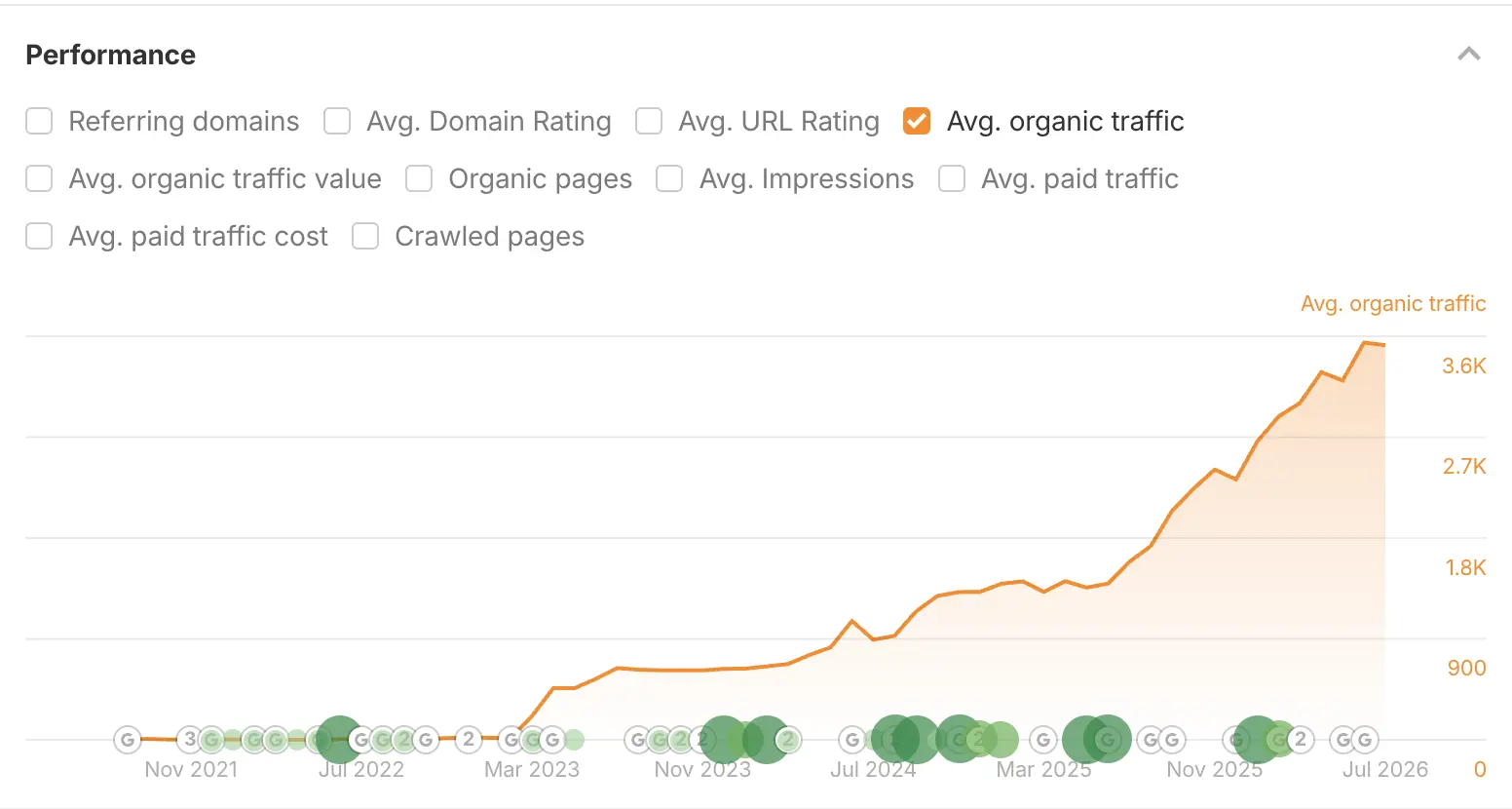
We helped Decentriq, a data collaboration and audience intelligence platform, increase traffic by 106% and boost AI citations by 435% in just 10 months (April 2025 to February 2026).
In this article, I’ll break down the exact SEO and GEO tactics we used. I’ve also asked 9 martech company founders to share their growth tips and insights.
Key Takeaways
- Audit and fix technical issues: check crawlability, indexability, page speed and structured data before anything else. At Decentriq, fixes lifted top-ranking keywords from 30 to 64 and AI citations 221% in six months.
- Build topical authority: own one clear category, target use-case intent keywords, tighten internal links and prune thin pages. Ketch’s use-case pages drew fewer visitors but higher conversion quality.
- Create something AI can’t replicate: educational content has lost ground to AI, so build interactive tools and original data. Linkbuilder’s tools beat its blog resources 4.8 times on sign-ups, and DataNumen’s reports drove 41 demos.
- Invest in product-led content: 83% of B2B buyers research before talking to sales, so publish comparison pages, case studies and interactive demos that show your product solving a real problem.
- Structure content for AI retrieval: answer buyer questions in plain language, not behind vague copy or “Contact Sales” forms, and publish pricing AI can read so it doesn’t rely on outdated third-party sources.
- Seed your brand across the web: AI needs consistent information from trusted sources, so claim your Knowledge Panel, join directories, Reddit and YouTube, guest post and win top-cited listicles.
Step 1: Audit and Fix Technical Issues
Every SEO campaign should begin with a comprehensive technical audit to identify issues affecting crawlability, indexability, page experience, and site performance.
Start by checking for:
- Crawl and indexing errors
- Broken links and redirect chains
- Slow page speed and Core Web Vitals issues
- Missing or incorrect canonical tags
- Duplicate content
- XML sitemap and robots.txt issues
- Structured data implementation
- Mobile usability problems
Fixing these technical issues provides a solid foundation for every tactic that follows, from content creation to link building and AI visibility.
You can use tools like Screaming Frog, Sitebulb, and Ahrefs to conduct a thorough audit on your site.
It’s also important to measure your AI readiness—how optimized your site is for AI crawlers and AI agents. Check out our GEO audit guide to learn more.
Case study
When Decentriq hired us as their SEO agency, the first thing we did was to check their technical health.
Our audit uncovered several technical issues that prevented search engines and AI systems from crawling and indexing content as efficiently as they could.
After prioritizing and resolving these issues, Decentriq’s performance began to rise within 6 months:
- Top ranking keywords jumped from 30 to 64
- Organic traffic went up by 61.23%
- AI citations increased by 221%
Read our technical SEO audit case study here.
Step 2: Build Your Topical Authority
Once you’ve established the technical foundation, the next step is building topical authority.
This is how you demonstrate to Google, AI search engines, and potential buyers that your martech company is a credible expert in your category.
Here’s how:
Define your main category
Before you publish any content, make sure you have clear and consistent positioning.
Unclear positioning makes it harder for prospects to understand what you actually do—and harder for Google and AI engines to associate your brand with the right topics.
As Erin Lutenski, Head of Marketing at Decentriq, puts it:
If our positioning is inconsistent, SEO won't work, and we may attract the wrong leads or confuse buyers.
 Erin Lutenski, Head of Marketing, Decentriq
 If your company offers multiple products or solves multiple use cases, you’ll need to make an important strategic decision:
Which category do you want to own?
Trying to position yourself as everything at once only dilutes your messaging. Instead, identify the primary category that best reflects your product and the problem you solve.
Generally, you have two options:
- Target an existing category. You’ll benefit from established demand and customer familiarity, which means faster adoption. The downside is that you’ll be competing against established players and risk being perceived as “just another tool.”
- Create a new category. You have the opportunity to define the market and become the category leader. However, you’ll need to invest more time and resources educating buyers, which typically results in slower adoption.
If you choose to compete in an existing category—as most martech startups do—your messaging needs to make your differentiation immediately obvious.
Prospects should understand not only what category you belong to, but also why they should choose you over every other product in that category.
Once you’ve defined your category, use it consistently across your homepage, product pages, blog content, metadata, PR campaigns, and sales messaging.
Case study
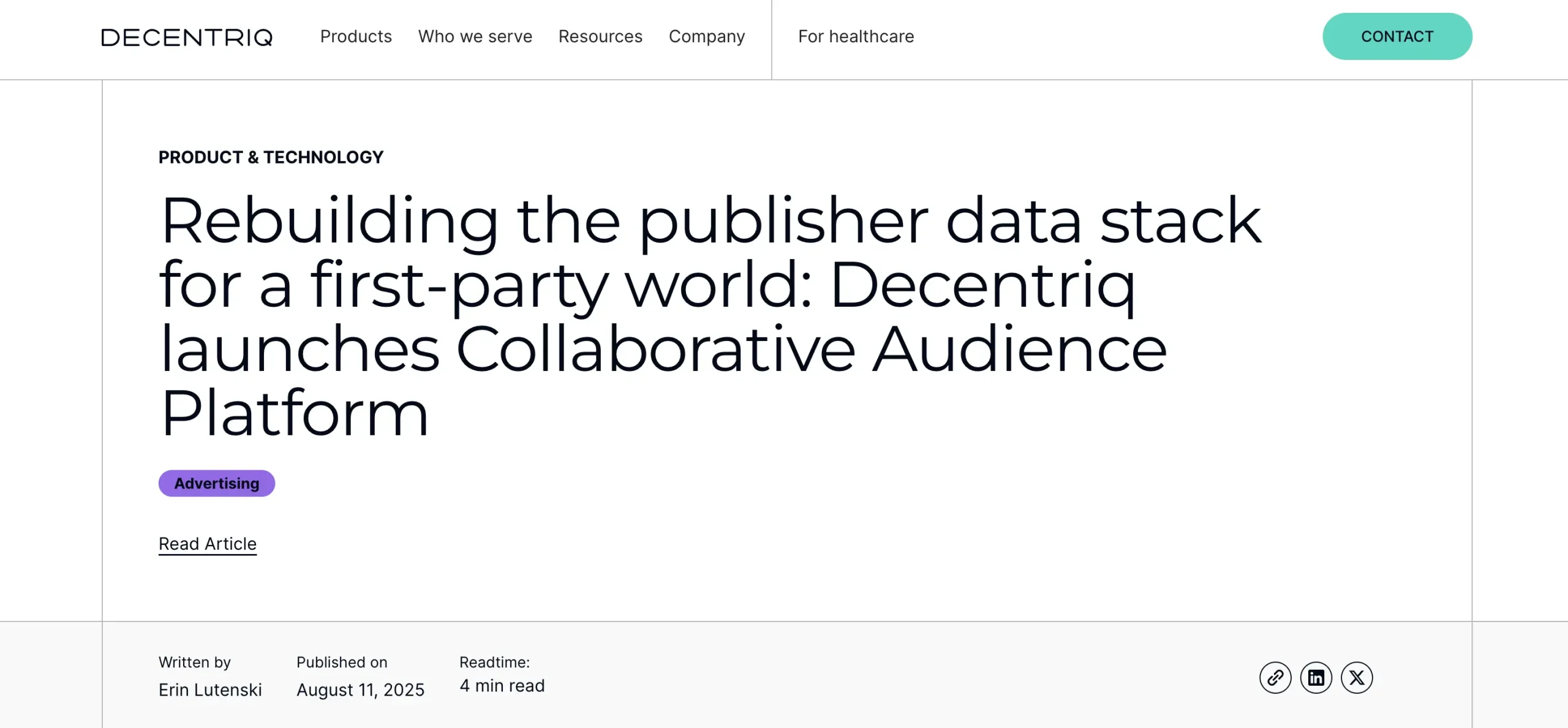
Decentriq originally positioned itself as a Data Clean Room (DCR) provider. But in 2025, the company expanded its platform by introducing a customer data management solution.
Rather than marketing the two products as separate offerings, the team decided to unify them under a single category: Collaborative Audience Platform.
This gave Decentriq a clearer market position while communicating that both capabilities are part of one integrated platform—not standalone products.
Because the category was unfamiliar to most buyers, the team also invested in educating the market.
They published a dedicated blog post explaining what a Collaborative Audience Platform is, why it matters, and how it differs from existing categories such as data clean rooms and customer data platforms.
Target use-case intent keywords
Don’t chase broad, high-volume keywords. Those are typically dominated by major players.
Instead, focus on use-case intent keywords—searches from people trying to solve a specific operational problem.
While these queries often have lower search volume, they typically attract visitors who are much closer to making a purchase.
As Mike Ibrahim, Founder & CEO of RewardLion, explained:
Focus less on broad keywords like “marketing automation” and more on use-case intent: “AI assistant for missed calls,” “local SEO for HVAC companies,” or “CRM automation for medical practices.” Those searches usually come from people with a real operational problem, not just curiosity.
 Mike Ibrahim, Founder & CEO, RewardLion
 Colleen Barry, Chief Marketing Officer at Ketch, also shared similar advice:
Instead of only targeting broad terms around data privacy, we created detailed pages around very specific use cases like consent management for Shopify, GDPR compliance for adtech, and first-party data strategies. Those pages brought in fewer visitors, but the conversion quality was much higher.
 Colleen Barry, Chief Marketing Officer, Ketch
 One of the best ways to uncover these opportunities is to listen to your customers.
Review support tickets, sales calls, demo recordings, community discussions, and search queries to identify the recurring problems prospects are trying to solve.
Each question or pain point can become a dedicated landing page or article targeting a high-intent search.
Another thing that helped was partnering with sales. We looked at actual objections from prospects and turned those into SEO content. That created pages that ranked and also shortened our sales cycle because buyers came in already educated.
Colleen Barry, Chief Marketing Officer, Ketch Create content for every decision maker
In B2B martech, you’re rarely selling to just one person.
A typical purchase involves multiple stakeholders—from the practitioner who will use the product every day to the manager evaluating solutions and the executive responsible for approving the budget.
Each stakeholder has different questions, concerns, and search behavior. If your content only targets end users, you’re leaving gaps in the buying journey.
As Paarath Sharma, SEO Specialist at Pixis, explains:
MarTech deals involve practitioners, managers, and economic buyers, so create content for each of them. The bottom of funnel pages should answer procurement and security questions, not just top of funnel education.
 Paarath Sharma, SEO Specialist, Pixis
 Create content that caters to each stakeholder. For example:
- Practitioners want tutorials, workflows, integrations, and feature documentation.
- Managers look for use cases, case studies, ROI, and implementation guidance.
- Economic buyers and procurement teams care about pricing, security, compliance, scalability, and vendor risk.
Optimize your internal linking
As your content library grows, it’s common for valuable pages to become orphaned or receive very few internal links. These pages are less likely to be crawled, pass less authority, and often underperform in search results.
Max Benz, Founder of ContentForce, emphasizes the importance of maintaining a disciplined internal linking strategy:
The part most SaaS founders skip is internal linking discipline. Once a site passes maybe 200 articles, orphaned pages start dragging the whole domain down, and nobody notices until traffic plateaus. We now run a linking pass on every update, not just new posts
 Max Benz, Founder, ContentForce
 Treat internal linking as an ongoing process rather than a one-time task.
Whenever you publish or update content:
- Link to relevant product, use-case, and comparison pages.
- Add links from older, high-authority articles to new content.
- Make sure every important page receives internal links from multiple relevant pages.
- Regularly audit your site for orphaned pages and broken internal links.
Prune thin & poor content
More content doesn’t always mean more traffic.
In fact, publishing thousands of low-value pages can dilute your site’s topical authority, waste your crawl budget, and make it harder for your best content to rank.
Viktor Bulanek, Founder & CTO of Penetrify, learned this the hard way after investing heavily in programmatic SEO.
We went hard on programmatic SEO, generating tens of thousands of pages across multiple languages off a content system we built. It felt like a growth hack. It wasn't. Google saw most of it as thin, and instead of ranking we diluted the pages that actually mattered.
 Viktor Bulanek, Founder & CTO, Penetrify
 As a result, the team shifted its strategy.
Right now we're doing the opposite of what every "scale your content" post tells you: we're aggressively pruning, cutting from tens of thousands of pages down to a few hundred that genuinely deserve to exist. Early signal is that fewer, stronger pages beat a huge thin footprint, but I'll be honest that we're still in the middle of it.
Viktor Bulanek, Founder & CTO, Penetrify His advice to other SaaS founders is simple:
- Only publish pages that provide genuine value. If a real visitor wouldn’t be glad they landed on the page, don’t publish it.
- Use data to guide content pruning. Review your performance in Google Search Console and remove, consolidate, or improve pages that receive little to no impressions, clicks, or engagement.
- Prioritize quality over quantity. A smaller library of comprehensive, helpful pages often outperforms a massive collection of thin content.
- Treat multilingual SEO as a real content investment. Don’t rely on machine-translated pages with little localization or unique value.
Step 3: Create Something AI Can’t Replicate
Educational content still works, but it’s become less effective due to AI Overviews and LLMs eating all the informational queries.
The better thing to do is create something AI can’t replicate, such as interactive tools and original data.
Interactive tools
Alex Karnaukh, Co-Founder of Linkbuilder, shared his approach:
We have recently changed our approach from spending large amounts of time producing a calendar filled with educational guides to creating free, interactive search assets such as an automated calculator for link values, a template for calculating the return on investment for outreach efforts and a side-by-side comparison of two different software programs.
 Alex Karnaukh, Co-Founder, Linkbuilder
 And these tools are performing much better than his blog posts:
Because these tools engage the decision-maker at the time they are looking for an operational solution, the direct sign-up conversion rate exceeded our typical blog resources by 4.8 times.
Alex Karnaukh, Co-Founder, Linkbuilder Original Data
Proprietary research, benchmarks, surveys, and industry reports are valuable because they offer unique insights that don’t exist anywhere else.
They’re also more likely to earn backlinks, media coverage, and citations from AI search engines looking for authoritative sources.
Chongwei Chen, President & CEO of DataNumen Inc., experienced this firsthand.
Instead of publishing generic SEO content, his team analyzed anonymized data from their own platform to uncover trends their audience couldn’t find elsewhere.
We published a series of ungated reports like 'What 1,247 Failed Marketing Automation Syncs Reveal About Data Decay in 2026,' pulling real (anonymized) stats from our incident logs. Nothing theoretical—actual timelines showing how stale data kills campaign ROI within 72 hours, with step-by-step recovery workflows.
 Chongwei Chen, President & CEO, DataNumen Inc.
 That tactic brought great success to Chongwei and his team:
Within three months, that cluster drove us to 2,700 monthly visits. By month nine, we hit roughly 8,200 organic sessions, with 41 qualified demos directly from those pages. Conversions weren't magic; the content worked because it solved a painful, specific problem our audience (other SaaS marketers) faces daily but rarely sees quantified.
Chongwei Chen, President & CEO, DataNumen Inc. Step 4: Invest in Product-Led Content
83% of B2B buyers conduct self-research before speaking to a sales representative.
They read tutorials, product pages, case studies, reviews, and comparison pages to determine which solution best fits their needs.
In other words, your content is now doing much of the selling before your sales team ever gets involved.
That’s why you should invest in product-led content—content that showcases your product’s capabilities while helping prospects solve a real problem.
Those include:
Listicles and comparison pages
Liran Blumenberg, Founder of Multigroup Poster, explained why comparison and alternatives pages work so well to attract highly-qualified leads:
The single highest-ROI SEO I've done is comparison and alternatives pages. Pages like "us vs [competitor]" and "[competitor] alternatives." The reason they punch so far above their weight: the person searching has already decided they want a tool like yours, they're just picking which one. That's the bottom of the funnel, the traffic that actually converts.
 Liran Blumenberg, Founder, Multigroup Poster
 Colleen Barry also shared a similar experience:
A lot of martech companies focus too much on top-of-funnel traffic, but in my experience, the real growth comes from owning the “decision stage” searches. We spent a lot of time building content around comparison keywords, compliance questions, integration pages, and pain-point searches that buyers were actively researching before making a purchase.
Colleen Barry, Chief Marketing Officer, Ketch You can use ListBrew to find listicles, comparison pages, and alternatives roundups that rank in Google and get cited by AI for your target keywords.
Case studies
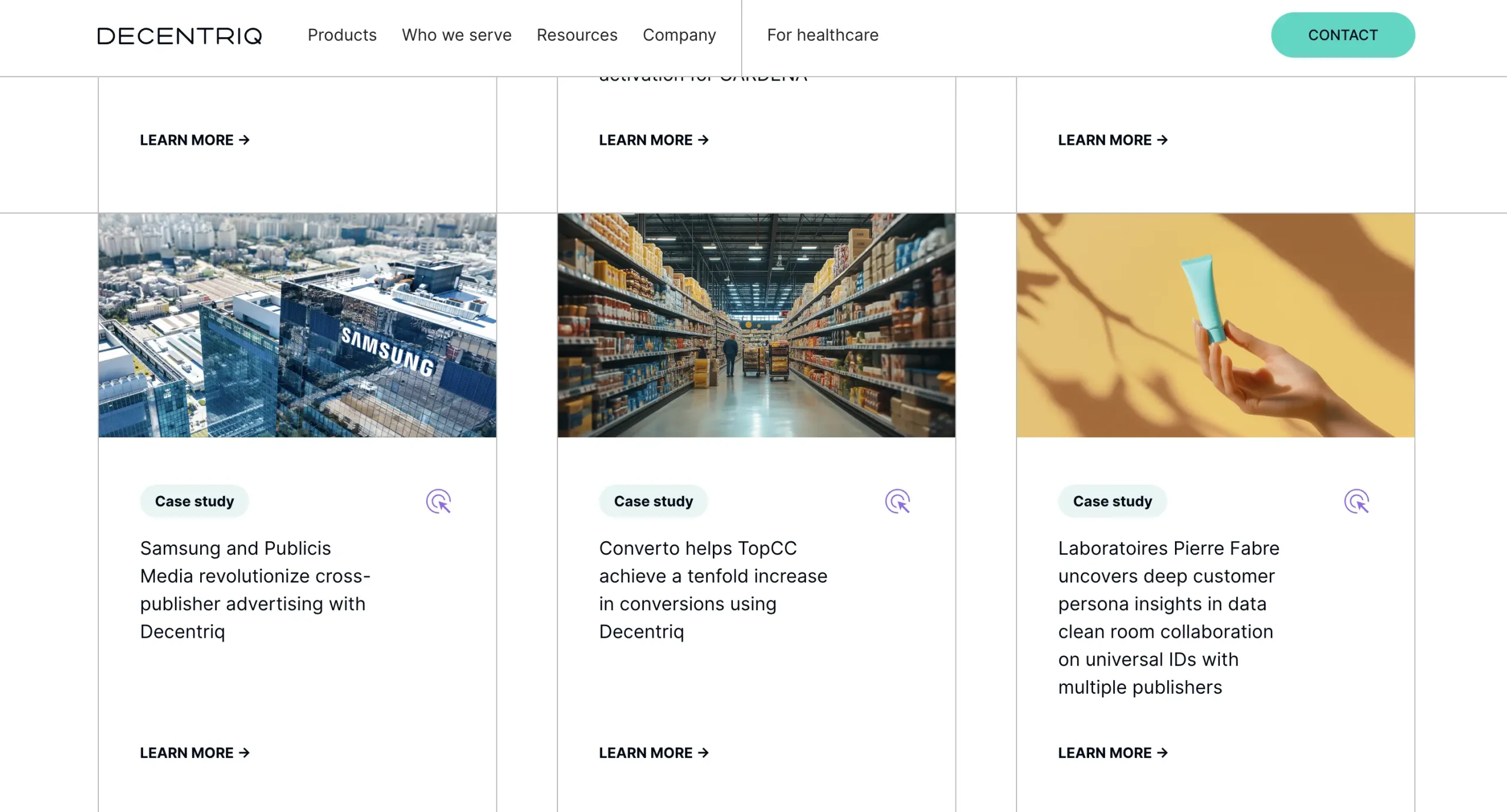
Case studies provide the proof buyers need before committing to your product.
While comparison pages help prospects narrow down their options, case studies answer the next question: “Has this solution worked for companies like mine?”
Show how a customer used your product to solve a specific problem. Include the challenge they faced, how they implemented your solution, and the measurable business outcomes they achieved.
Interactive product demos
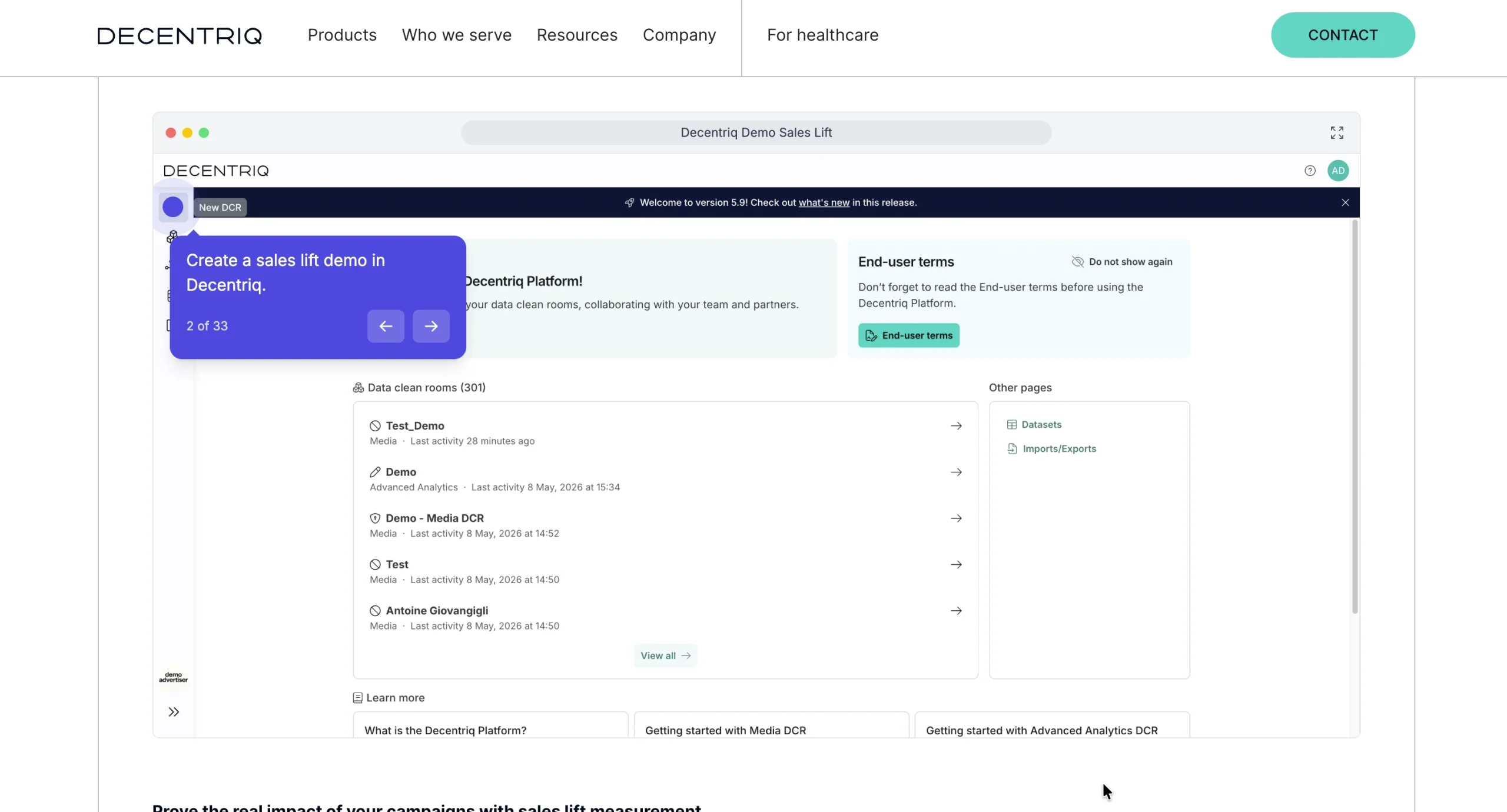
Interactive product demos allow visitors to explore your platform without booking a demo or signing up for a trial.
Instead of reading about features, they can see your product in action and understand how it solves their problem.
This not only improves the buying experience but also increases the likelihood that high-intent visitors convert after landing on your content.
Here’s a product demo example from Decentriq, showing how users can create a sales lift:
Step 5: Structure Content for AI Retrieval
Ranking in AI search isn’t just about publishing great content—it’s about making that content easy for AI systems to understand and retrieve.
That starts with answering the questions your buyers are actually asking in clear, straightforward language.
Avoid burying important information behind vague marketing copy, interactive elements, or “Contact Sales” forms.
As Logan Simmons, Founder of Simmons Solutions, explains:
Answer the real questions your buyers ask in plain language, put your pricing and specifics in writing instead of hiding them behind a contact us page, and mark it up with clean structured data so machines can read it. You do not need new software. You need your real answers written down where both people and AI can find them.
 Logan Simmons, Founder, Simmons Solutions
 Another tip is to make your pricing accessible by AI.
Why is it important? Because according to research by Mike Sonders, B2B buyers start their research by searching for pricing information.
The problem is, some pricing pages aren’t optimized for AI agents, making it difficult for those agents to retrieve the pricing information accurately.
When that happens, AI search engines may rely on third-party review sites, software directories, or blog posts instead.
Those sources can contain outdated, incomplete, or inaccurate pricing information, causing you to lose control of your messaging.
To reduce that risk, make your pricing page as transparent and accessible as possible.
Learn more on how to optimize your content for different AI engines in the following guides:
- How We Optimize Content for Google’s AI Overviews
- How to Rank in ChatGPT? Follow Our Process
- How I Structured Articles for Better GEO Rankings in 2025 (And What I’ll Change in 2026)
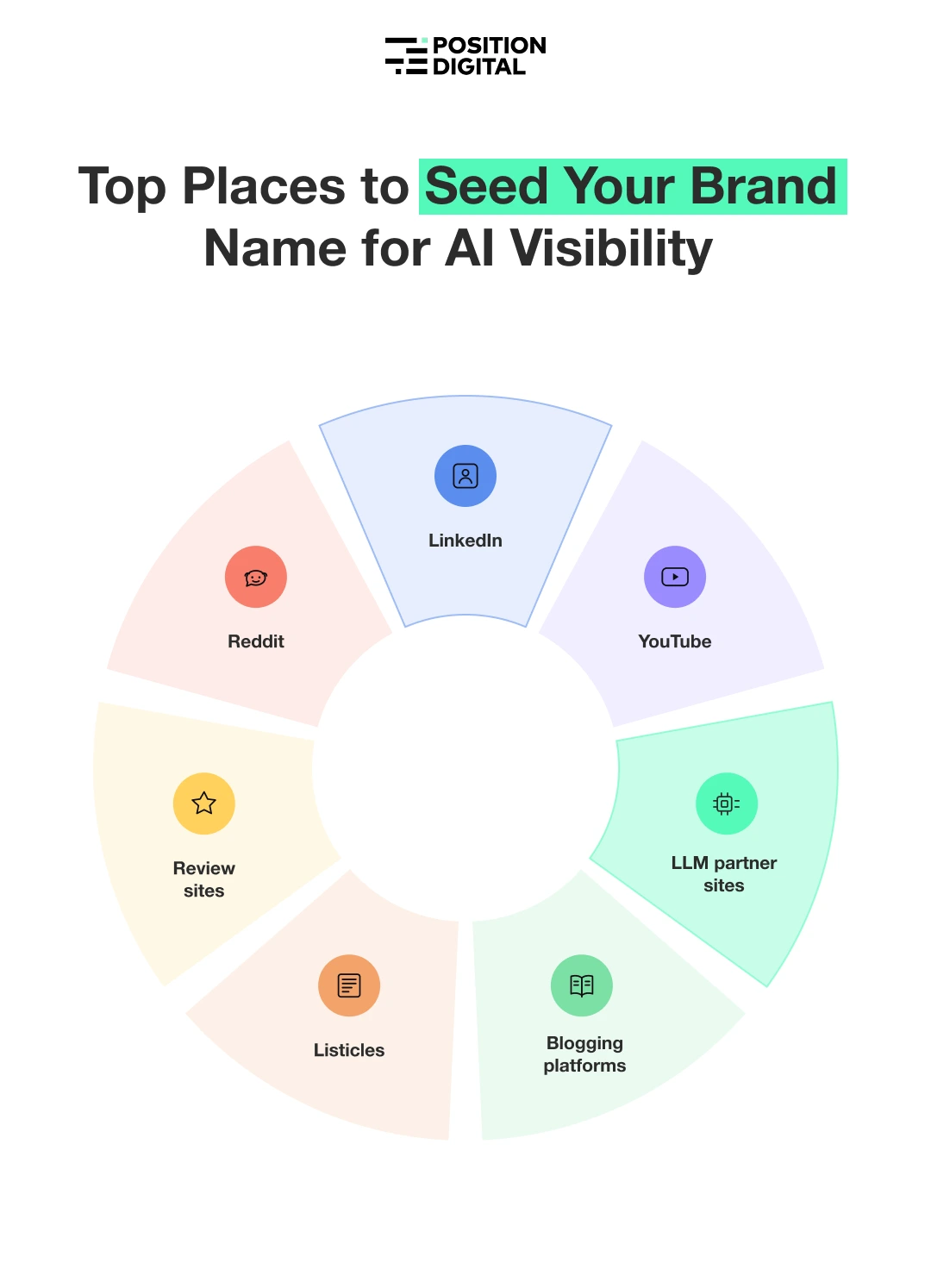
Step 6: Seed Your Brand Across the Web
Your website isn’t the only place search engines and AI systems learn about your company.
To confidently recommend your product, they need to see consistent information about your brand across trusted third-party sources.
Here’s how:
- Claim your Google Knowledge Panel
- Create a Google Business Profile
- Submit your product to SaaS review platforms and directories
- Contribute to relevant Reddit threads
- Partner with YouTube creators and influencers
- Write guest posts on other tech blogs
- Secure placements on top-cited listicles
Work With a Proven Martech SEO Agency
At Position Digital, we’ve helped martech companies like Decentriq and Data Poem increase their organic visibility and generate more qualified pipeline.
From technical SEO audits and product-led content to digital PR and AI visibility, our SaaS SEO services are tailored to how modern B2B software buyers discover and evaluate products.
If you’re looking to grow your martech company through SEO and GEO, we’d love to help. Get in touch to discuss your goals and learn how we can build a growth strategy tailored to your business.