
SEO is shifting. The question is no longer just “How do we rank on Google?”, but also “How do we show up as an answer in ChatGPT, Gemini, Perplexity, and other LLMs?”
If your brand is mentioned in those answers, you can win attention earlier, build trust faster, and influence buying decisions before a prospect ever hits your site.
The question is how?
In this guide, I’ll cover seven AEO best practices you can implement in 2026 to increase your chances of showing up in AI-driven answers.
Key Takeaways
- Audit what AI says about your brand: check how it describes you and which sources shape the answer
- Develop unique brand positioning: one clear line on who you serve and why you’re different
- Provide details about your company: make your own site the most quotable source about you
- Answer all user questions about your product or service: cover every follow-up a buyer might ask
- Get mentioned in LLM citations: appear in the listicles and reviews AI already cites
- Grow your YouTube visibility: YouTube mentions correlate most strongly with AI visibility
- Leverage UGC content: build proof on Reddit, Quora and review sites
Why We’re Qualified to Talk About AEO
At Position Digital, we’ve helped B2B and SaaS companies boost their brand visibility in AI search with our answer engine optimization services.
Here are some of our client results:
- Oriel Partners: featured in AI Overviews for 17 keywords for a single blog post
- Decentriq: 221% higher AI citations after a thorough technical SEO audit
- Don’t Panic: 809% increase in AI referral traffic and 169% increase in conversions
How do Answer Engines Work?
Before diving into AEO tactics, first you need to know how exactly AI systems work.
There are two ways Large language models (LLMs) answer a question:
Predicting patterns based on training data
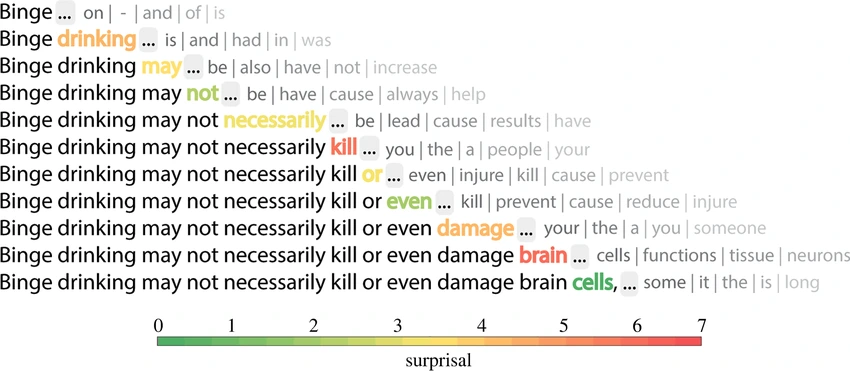
LLMs are essentially next word predictors.
These engines generate responses by predicting the most likely sequence of words based on patterns learned during training.
That’s why AI is great at answering basic knowledge questions, where there’s already a lot of information on the topic, such as:
- What’s the capital of France?
- What does GDP stand for?
The problem arises when there’s little or no information to draw from the training data. This is when LLMs hallucinate and start saying made up facts.
To keep answers grounded, AI engines need to find up-to-date information from the web.
Using RAG or live web search
Major AI chatbots today, like Gemini, ChatGPT, and Perplexity, combine their LLM with web search.
Instead of relying solely on what the model learned during training, it uses search engines (like Bing and Google) to retrieve the latest data from the web.

This approach is called Retrieval Augmented Generation (RAG).
Here’s how the process looks like:
- A user asks a question
- The system runs web searches using query fan-out to find relevant sources
- It extracts the most useful passages from each page and summarizes them into a cohesive answer (usually with citations)
Since RAG works more like traditional SEO, this is what we should be optimizing for.
Lily Ray, Vice President, SEO Strategy & Research at Amsive, sums it up perfectly in a SEOFomo survey:
As OpenAI and Google launched new models of ChatGPT and Gemini throughout 2025, I think one thing became clear: large language models are highly reliant on up-to-date information from search engines to provide accurate answers. Therefore, one of the best ways to drive visibility from AI search is to be among the chosen results when LLMs use web search – and that boils down to having solid SEO, strong brand awareness and a positive reputation.
 Lily Ray, SEO Strategy & Research, Amsive
 How do LLMs Choose Which Brands to Recommend?
LLMs form brand “preferences” through patterns in the information they ingest, whether it’s their training data or retrieved web sources.
When a brand consistently appears alongside certain topics, categories, and claims across multiple sources, the model is more likely to treat that brand as a relevant (and sometimes “best”) answer.
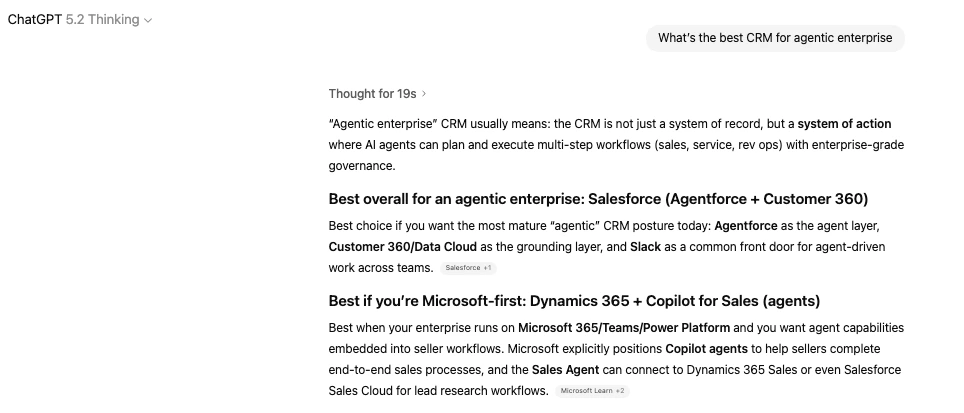
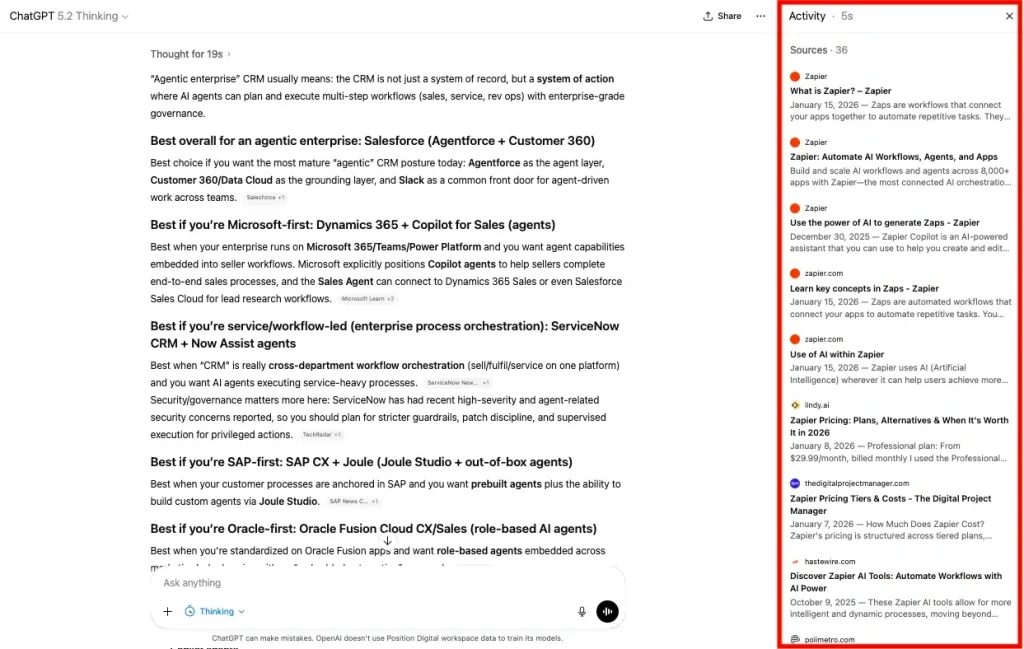
For example, when I asked ChatGPT to recommend the best CRM software for an agentic enterprise, Salesforce appeared as the top answer.
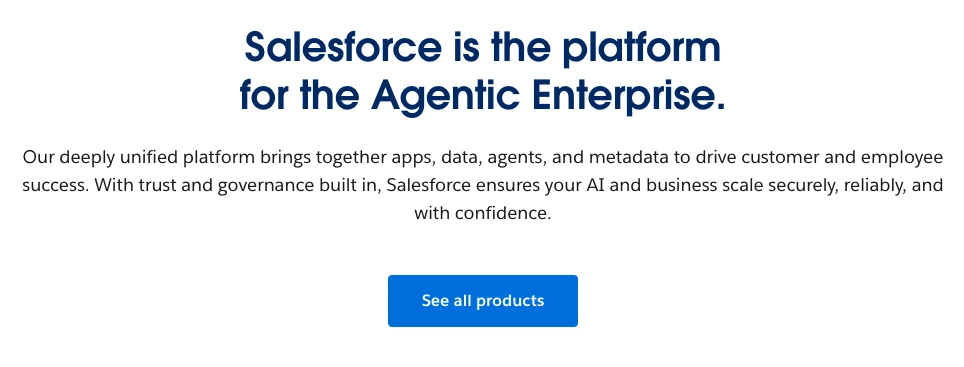
This is because Salesforce positions itself as “the platform for the Agentic Enterprise” on their website.
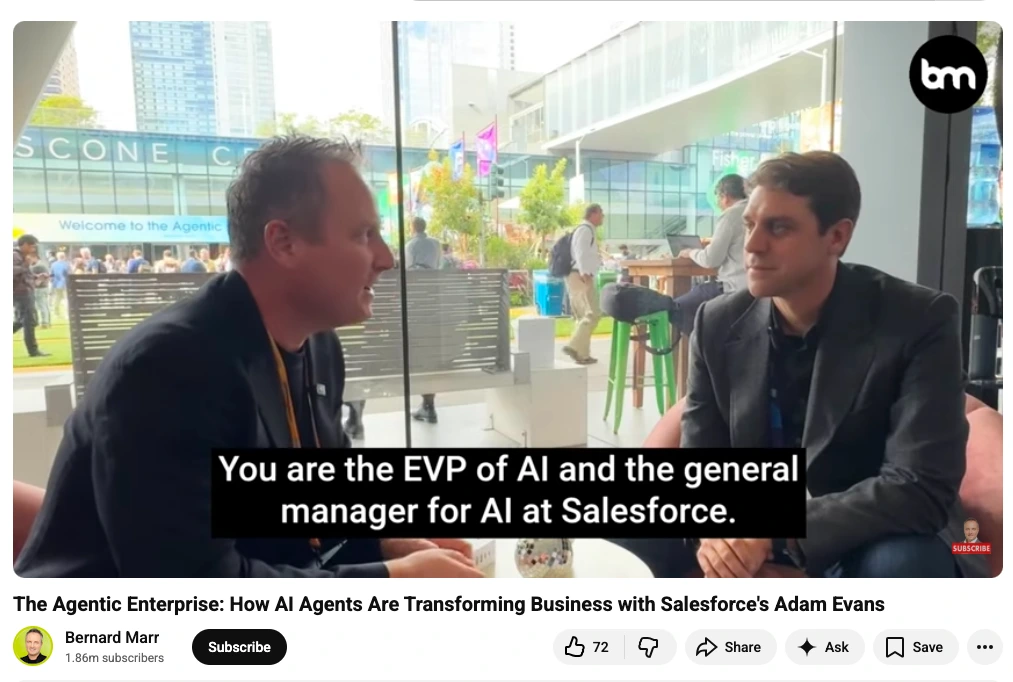
And they talk about this topic repeatedly on third-party platforms, such as blogs, review sites, and YouTube videos.
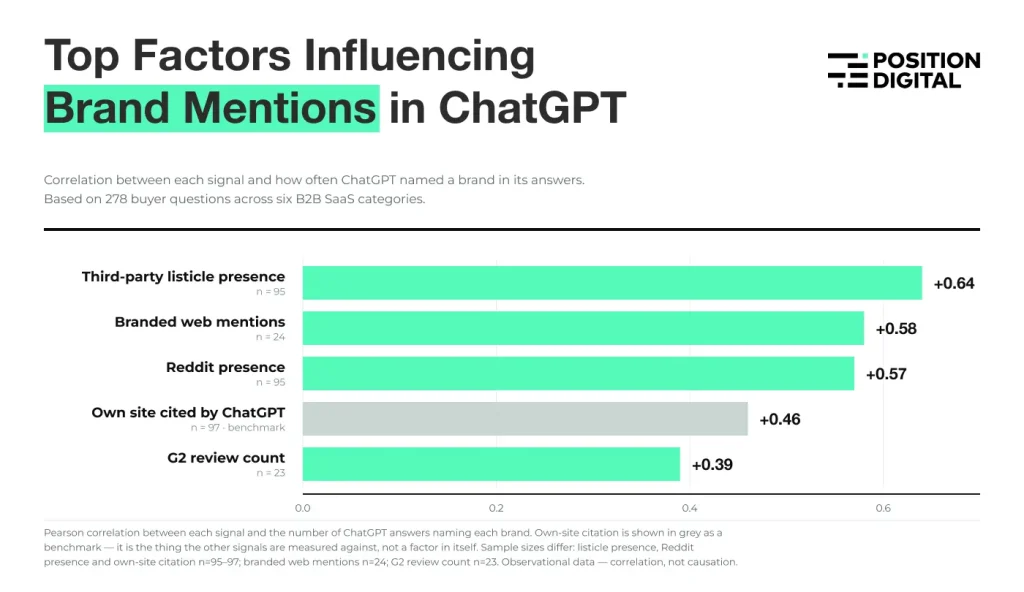
We’ve also recently conducted a study on ChatGPT ranking factors across six B2B SaaS niches.
We found that third-party listicle presence, branded web mentions, brand co-occurrence, Reddit and review platform presence are the biggest drivers of ChatGPT mentions and recommendations.
7 Best Practices for Answer Engine Optimization (AEO)
Based on what we know so far about answer engines, here are 7 things you can do to get your brand recommended by LLMs. The first four help you find your gaps and fix your own site. The last three build your reputation everywhere else.
1. Audit what AI says about your brand
Before you change anything, find out where you stand. Start with branded prompts. Someone asking AI about your brand is usually already evaluating or comparing you, so if the answer is outdated, inaccurate, or shaped by a competitor, you have a narrative problem, not just a visibility problem.
This approach builds on Mihir Naik’s framework for AI search visibility, which looks at how and why AI describes your brand, not only whether it mentions you.
Here’s how to run the audit:
- Write 10 to 15 branded prompts. Mix direct and comparison questions, such as “What is [brand]?”, “Is [brand] good for [use case]?”, “[Brand] vs [competitor]”, “[Brand] alternatives”, and “Who is [brand] best for?”
- Run them in each engine. Use ChatGPT, Gemini, Perplexity, and AI Mode. Answers change between runs, so repeat each prompt a few times.
- Check four things in every answer: whether your brand is named, which category AI puts you in, which differentiators it attaches to you, and whether the details (pricing, features, who you serve) are accurate and current.
- Find the sticky sources. Note the sources that keep shaping answers about you and your category, especially the ones where competitors appear and you don’t. Our free AI Citation Extractor lists the sources AI models cite for any prompt.
- List the gaps. A wrong category, a missing differentiator, an outdated claim, a source that only mentions your competitors. Each one becomes a to-do for the practices that follow.
Practices 2 to 4 help you fix what you find on your own site, and practices 5 to 7 cover the third-party sources. Re-run the audit every quarter or so to see whether the answers are changing.
2. Develop unique brand positioning
Your audit shows which category and differentiators AI links to you today. Now decide which ones you want it to repeat.
Don’t try to be everything to everyone. Instead, define the unique positioning you want LLMs to associate your brand with.
Ask yourself:
- Who is your audience? Don’t just say you’re the best “HR management software.” Be specific about the segment you’re serving, e.g. “HR management tool for healthcare companies.”
- What’s a specific problem you solve? Tie your positioning to a high-intent pain point your audience actively searches for. Example: “Best HR tool that streamlines compensation management for large organizations.”
- What makes you unique? Identify one or two concrete differentiators you can prove. Maybe you have features others don’t, maybe you’ve worked with Fortune 500 clients, or maybe you’ve built a breakthrough product.
Once you’ve nailed audience, problem, and differentiator, turn it into a repeatable positioning line:
[Brand name] + [product category] + [audience]
Example: Less Annoying CRM is a simple contact management tool for small businesses
[Brand name] + [product category] + [problem]
Example: Resource Guru is a resource management tool that helps teams efficiently plan workloads and manage capacity
[Brand name] + [product category] + [unique differentiator]
Example: HubSpot is a CRM platform that combines CRM, marketing, and sales functions in one app
Take your positioning line and reinforce it across your marketing channels, including your website, social media profiles, press releases, partner listings, etc.
3. Provide details about your company
Besides brand positioning, you also have to provide clear company details on your website, so AI won’t say the wrong things about you, like the inaccuracies you found in your audit.
Jayme Welch, CEO of Webvine Designs, shares this on LinkedIn:
AI systems decide what to say about you based on whatever sources they can treat as “evidence.” Some of that evidence is third-party. Some can be your own site. The goal is not “rank,” it’s become the most quotable, verifiable source about yourself so the model doesn’t have to improvise with 3rd party sources.
 Jayme Welch, CEO, Webvine Designs
 She then gives some valuable tips on how to do that:
- Write an “identity block” that’s impossible to misread
- Create a single canonical proof page
- Turn great mentions into grounding anchors (quote it, cite it, link it)
- Add a “how to describe us” line (one sentence you want repeated)
- Reduce ambiguity (same wording across key pages so AI stops guessing)
4. Answer all user questions about your product or service
AI chatbots like ChatGPT and AI Mode have given users the power to ask very long and specific questions—something that wasn’t possible with traditional search engines.
And if they aren’t satisfied with the answers, they can just ask more follow-up questions. Product research, vendor comparison, and decision-making processes now essentially happen in a single chatbot conversation.
That’s exactly why your website needs to answer every meaningful question a buyer might ask about your product—what it does, who it’s for, how it works, pricing, limitations, and more.
Find out what questions your target audience is asking
Start with the questions buyers already ask. Pull them from Google Search Console, “People Also Ask,” Reddit and other communities, sales calls, support tickets, and competitor FAQs.
Focus on questions that:
- Signal evaluation (“best”, “vs”, “pricing”, “how does it work”, “is it worth it”, “for X industry”)
- Relate to your products (“how to use X”)
Go beyond the main question
The first query usually only names the topic. Buyers keep asking, so for each main question, map what they’re likely to ask next. Cover at least these five types of follow-up:
- Clarify: “What does that mean?”
- Constrain: “What if I have a small budget?”
- Compare: “How is option A different from option B?”
- Validate: “What evidence supports that?”
- Act: “What should I do, buy, book, or ask next?”
Create a help center to answer those questions
Ethan Smith, CEO of Graphite, share some great tips on how to do it right on Lenny’s Podcast:
- Host your help center in subdirectories, not subdomains.
- Make sure you’re cross linking from one help center page to another.
- Create help center articles for very specific user questions you’ve gathered from your sales calls, support tickets, or customer interviews.
For that last piece of advice, Ethan shared an interesting example:
I wanted to track our sales calls and see who’s in the meetings and what the sentiment was, and I wanted to put that into Looker. So, I said (to an AI chatbot) “Which meeting transcription tool integrates with Looker?” and the answer is none of them. But you could use Otter because Otter has a Zapier integration. You could send a Zap to the meeting, put it into BigQuery, and then do Looker on top of that. But there wasn’t a help center article about that because it’s a very obscure use case, but it’s not a zero use case.
 Ethan Smith, CEO, Graphite
 By going that extra mile, you’ll have a huge competitive advantage when it comes to securing AI citations.
In many cases, there might be nobody talking about this at all. So, you could be the only citation for this.
Ethan Smith, CEO, Graphite 5. Get mentioned in LLM citations
In RAG, cited URLs are the ones influencing LLM answers.
And according to AirOps’ 2026 State of AI Search report (December 2025), brands are 6.5 times more likely to be cited through third-party sources than their own domains, and about 85% of brand mentions come from external domains.
So, if you want to appear in those answers, you need to make sure your brand or product is mentioned in the citations.
Your audit showed which sources shape answers about your brand. Now do the same for the category prompts you want to win, such as “best [category] for [audience].”
Here’s how:
- Go to ChatGPT, Gemini, AI Mode, or any other LLMs you want to target and enter your target prompt or topic.
- Check the sources the model uses to form a response.
- Prioritize pages you can realistically influence, such as listicles, educational blog posts, reviews, and comparison articles.
- Reach out to the author of those pages and ask them to include your brand or product—ideally with pre-written copy to make their job easier.
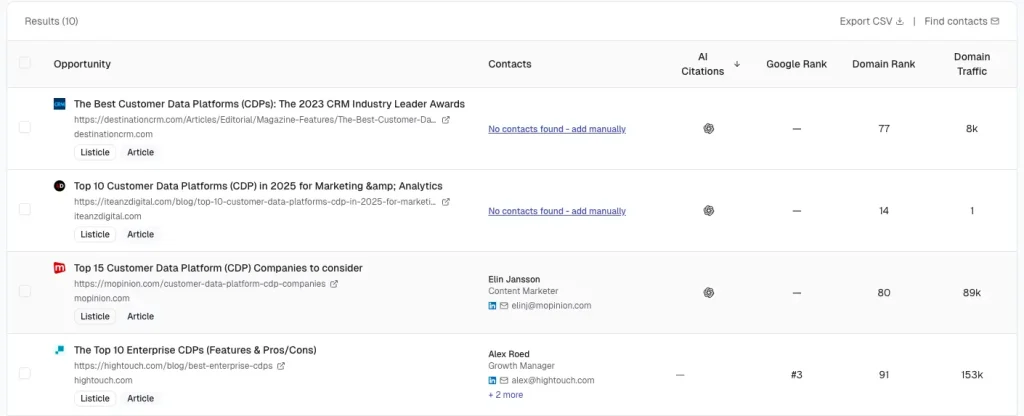
Alternatively, you can use a tool we developed to make the whole listicle outreach process easy: ListBrew.ai.
- Enter your business details and target keyword
- The tool will give you a list of listicle opportunities, along with their contact details
- You can filter by listicles that are already cited in LLMs
- After that, simply reach out to those listicles and ask for inclusion
To increase success rate, offer something valuable in return like a link exchange and guest post, or simply pay for the inclusion if you have the budget.
If you’re not sure where to start, we have an amazing outreach team with a proven track record of securing high-quality links and brand mentions for B2B and SaaS clients.
Explore our digital PR services to get started.
Listicles are only one place to earn mentions. Our guide to LLM seeding covers 11 off-site tactics in more detail, including review sites, directories, LinkedIn and podcasts. Practices 6 and 7 below cover two of the biggest ones: YouTube and community platforms.
6. Grow your YouTube visibility
A study by Ahrefs found that YouTube mentions show the strongest correlation with AI visibility across ChatGPT, AI Overviews, and AI Mode.
In other words, the more often your brand is mentioned in different YouTube videos, the more likely AI is to recommend it.
And it makes perfect sense:
- YouTube is a Google product, the same company that owns AI Overviews and AI Mode.
- Most YouTube video formats mimic real user prompts: “best X for Y”, “X vs Y”, “how to choose X”, “review of X”, “setup tutorial.”
So, how do you exactly grow your presence on YouTube? There are two ways to do that:
Make your own YouTube videos
Creating videos obviously takes far more effort and time compared to written content. But since not many brands are doing it, the competition might be less intense.
Ethan Smith points out that this is a big opportunity for B2B brands:
The interesting thing with this, especially for B2B, is that YouTube, Vimeo, and other video sites, the kinds of things people make videos for are food, traveling, fun, beauty—there’s not that many videos about AI-powered payment processing APIs, as interesting as that is, but it’s a great money term. So, if you make a video for these really specific, high LTV, maybe non-glamorous keywords, questions, or topics, that’s actually a big opportunity.
Ethan Smith, CEO, Graphite Here are some tips to keep in mind:
- Create videos that answer your audience’s questions: how to use your product, why it’s better than competitors, etc.
- Optimize for AI retrieval: add your keywords in the video title and description, create clear timestamps, and make sure the captions and transcripts are accurate.
Partner with YouTube creators
There are a couple of ways you get featured in other people’s videos:
- Do something interesting, like an original study or experiment. Then, reach out to relevant podcasts in your niche and ask them to invite you as a guest to talk about it.
- Ask creators to review your products or services. You can offer a paid sponsorship, a free access to your software, or an affiliate commission.
7. Leverage UGC content
Countless AI SEO studies have confirmed that social signals matter a lot in AI-driven search:
- Domains with millions of brand mentions on Quora and Reddit have roughly 4x higher chances of being cited than those with minimal activity. (SE Ranking)
- Domains with profiles on platforms like Trustpilot, G2, Capterra, Sitejabber, and Yelp have 3x higher chances to be chosen by ChatGPT as a source, compared to sites without such presence. (SE Ranking)
- Reddit is among the most cited domains in ChatGPT, AI Mode, and AI Overviews. (Ahrefs)
The more people “vouch” for you in social media, forums, and review sites, the more likely AI will see your brand as trustworthy and worth recommending.
A few tactics you can start right away:
- Create profiles on review platforms: Claim your Google Business Profile and create profiles on relevant review platforms (G2 for SaaS, Yelp for local businesses, etc). Then, ask your existing clients to leave positive reviews on those sites.
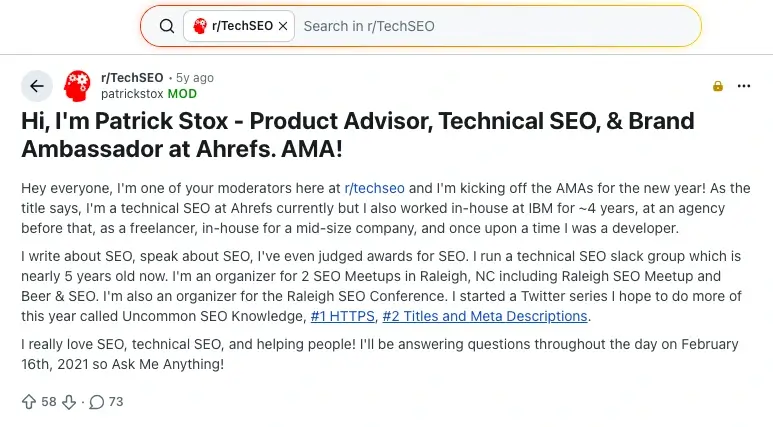
- Answer questions on Reddit and Quora: Set up a brand (or founder) profile, state what you do and what company you represent, and contribute genuinely helpful answers to relevant threads. You can also create an AMA (Ask Me Anything) thread like what Ahrefs did here.
- Seed “use case” mentions in relevant threads (ethically): Encourage customers (not your team) to share real experiences in appropriate communities when someone asks for recommendations. The goal is authentic, contextual mentions—never fake reviews or astroturfing.
How to Track Your AEO Progress
Your branded-prompt audit in practice 1 is your baseline. To see whether your work is paying off, remember that AI answers change from one run to the next, so a single check tells you very little. Track a fixed set of prompts over time instead:
- Build a prompt list of 20 to 50 questions your buyers ask, covering category searches (“best [category] for [audience]”), comparisons, and problem-led questions. Our Query Fan-Out Extractor helps you find the sub-questions AI actually searches for.
- Run them on a schedule in each engine you care about and record whether your brand is mentioned, whether your site is cited, and which competitors appear.
- Look at the sources. The pages that get cited are your outreach and content targets. Our free AI Citation Extractor lists the sources AI models cite for any prompt.
- Watch AI referral traffic in your analytics, and treat it as a lagging signal. Most AI answers don’t produce a click.
For automated, large-scale tracking, see our roundup of the best LLM visibility tracking tools. Whichever method you choose, report visibility as a share across many runs rather than a one-off screenshot.
Final Thoughts
Answer engine optimization is basically just good marketing: be crystal clear about your positioning (what you are, who you’re for, and what you’re not), and get as many people as possible to recommend your brand for that specific use case.
Of course, large companies would have the advantage here. They have years or even decades of people talking about them online. This means more mentions, more reviews, more press, and more third-party validation for answer engines to draw from.
But that doesn’t mean new and small businesses can’t compete. You can win by targeting a very specific niche that bigger brands tend to ignore, and build your way up from there.
If you want a reliable partner for your AEO journey, consider Position Digital. Our AI SEO services operate on a flexible retainer basis, which is perfect for growing SaaS startups.
One month you might need help with content creation. The next month may be focused on digital PR campaigns. Whatever you need, we’ll work closely with you until you achieve your goals.
Contact us today to explore how we can help you!
FAQs About Answer Engine Optimization
Here are answers to the questions we hear most often about AEO:
What is answer engine optimization (AEO)?
Answer engine optimization (AEO) is the practice of getting your brand cited by and recommended in AI-generated answers, such as those from ChatGPT, Gemini, Perplexity, Google AI Overviews and AI Mode.
It combines work on your own site with building the third-party mentions, reviews and other signals that AI engines draw on.
What’s the difference between AEO and SEO?
SEO earns you a ranked link in search results. AEO earns you a place inside the AI-generated answer itself.
AEO builds on SEO rather than replacing it. In our content study of B2B SaaS niches, the pages least visible in Google’s AI Overviews and AI Mode had zero top-10 rankings, zero traffic and zero backlinks.
What’s the difference between AEO and GEO?
In practice, they’re the same playbook. Both AEO and generative engine optimization (GEO) aim to get your brand cited and recommended in AI answers, and the tactics for one carry over to the other.
We use the terms interchangeably.
Does UGC help AEO?
Yes, user-generated content and AI citations go hand in hand. In SE Ranking’s study of 129,000 domains, domains with millions of brand mentions on Quora and Reddit averaged about 7 ChatGPT citations, compared with under 2 for domains with minimal activity.
That’s a correlation, not proof of cause, but it’s why practice 7 above focuses on communities and review sites.
How do I measure my AEO performance?
Track a fixed set of buyer prompts across ChatGPT, Gemini, Perplexity and Google’s AI. Record whether your brand is mentioned, whether your site is cited, and which competitors appear, then compare your share over time.
Our free AI Citation Extractor shows which sources AI models cite for any prompt, and our roundup of the best LLM visibility tracking tools covers automated options.
Are AEO tactics the same across all answer engines?
No, each engine prefers different sources. In our content study, AI Overviews and AI Mode mostly cited informational content, ChatGPT preferred product pages, and Gemini and Perplexity leaned on listicles.
Start with strong SEO and third-party mentions, which help everywhere, then adapt your content formats to the platforms your buyers use most.
Does AEO matter for B2B SaaS?
Yes. Buyers increasingly research and compare vendors inside AI chats, so being mentioned there can shape the shortlist before anyone visits your site.
Decentriq, a B2B martech company, saw its AI citations rise 221% (from 14 to 45) in six months after a technical SEO audit.
How long does AEO take to show results?
It depends on where you’re starting from, so be wary of any fixed timeline.
In our client work, Decentriq’s AI citations rose 221% within six months, and Don’t Panic’s AI referral traffic grew 809% (from 22 to 200) over one year. Both started from a small base.