Digital PR is the single most important strategy to win in AI search.
When AI chatbots like ChatGPT, Perplexity, and Google’s AI Mode answer a question about your category, they aren’t crawling your website. They’re drawing from multiple sources across the web.
According to several AI SEO studies, brands are 6.5x more likely to be cited through third-party sources than their own domains. Branded web mentions are also the top factor that correlates with AI brand visibility across ChatGPT, AI Mode, and AI Overviews.
I asked 20 founders and marketing leaders to share digital PR tactics that actually drive AI mentions and citations.
But before we dive into the tactics, you first need to understand how AI search actually works.
How AI Search Works
When answering a query, AI models use two main methods:
- RAG-based systems. LLMs like Perplexity and ChatGPT with browsing enabled, as well as Google’s AI Mode retrieve live web sources at the moment a query is made.
- Base models. Unlike RAG systems, base models rely on patterns baked into the model during training. When these systems answer a question, they’re drawing on associations learned from billions of web pages — not live retrieval.
Each system requires a different strategy. Bree Sharp, a seasoned SEO consultant, explained the difference between the two:
For RAG systems, traditional digital PR logic mostly holds: Earn placements on credible, crawlable domains, keep content fresh, and structure your claims clearly enough to be excerpted. Base model LLMs are a different problem entirely. It’s an entity establishment play: a consistent name, consistent descriptor, and consistent context, repeated across enough domains and sources that the association bakes into the model’s representation of who you are.

Bree Sharp, SEO Consultant
Below, I’ll walk you through the digital PR tactics for both systems.
How to Optimize for RAG Systems With Digital PR
RAG-based AI systems retrieve sources from pages that are ranking in traditional search engines.
So, the fastest way to improve visibility is to reverse-engineer those sources and become part of that citation ecosystem.
1. Gather sources AI already cites
The fastest way to boost AI visibility is to get included on pages that LLMs already use as sources. But before you can pitch those pages, you need to know what they are.
Here’s the process:
- Write down the 10–20 prompts your buyers are likely asking AI chatbots
- Run each prompt in ChatGPT, Perplexity, and Google AI Mode
- Record every URL and domain cited in the responses in a spreadsheet
You can also use dedicated AI visibility tracking tools like Peec AI or Writesonic to get the job done faster. We also have ListBrew, which surfaces listicles that already rank in LLM answers.
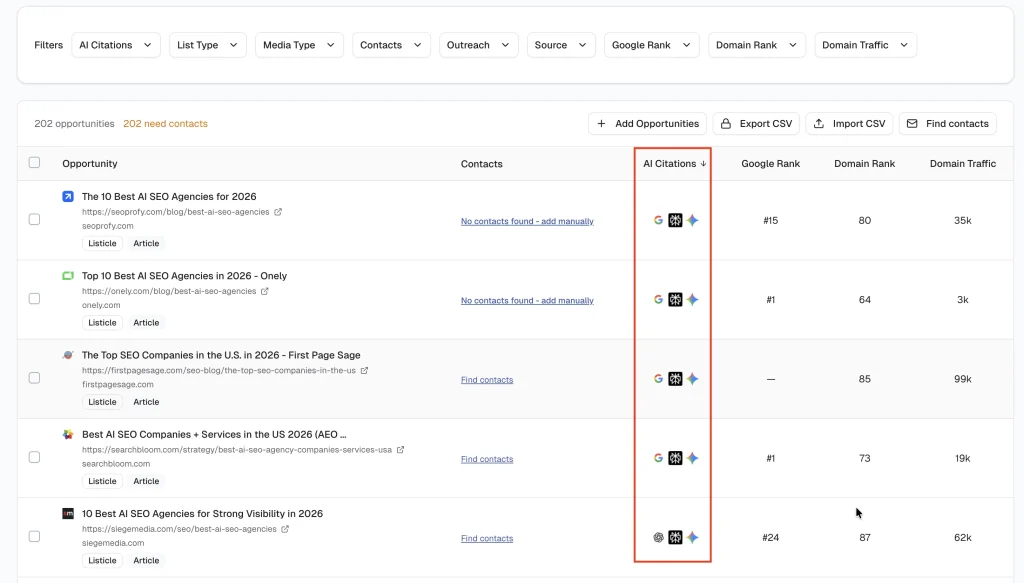
Repeat the process every week or every month. Remember, LLMs constantly change their answers and citations, so
Tim Filzinger, Digital PR Manager at Wise Relations, explained it brilliantly:
One tactic I’d zero in on: working with AI citation drift — the fact that the sources LLMs cite for the same prompt rotate week to week, with only a small stable core of domains repeating. Most digital PR reads that as noise. I read it as the actual game. AI citations behave less like rankings and more like weather: a stable atmosphere of domains the models keep returning to, and a daily turbulence of sources swapping in and out. A single citation is a snapshot, not a result — which is why tracking domain presence over rolling windows beats reporting one-off mentions.

Tim Filzinger, Digital PR Manager at Wise Relations
2. Get included in those citations
Once you know which sources AI is already pulling from, your outreach becomes much more targeted.
Now, the goal is simple: get your brand mentioned on those pages.
There are three main ways to do this.
Expert commentary
Contributing expert insights to journalists is one of the most reliable ways to earn placements in high-authority publications.
And if those publications are already cited by LLMs, each placement directly improves your AI visibility.
The challenge is that platforms like Connectively and Qwoted are competitive. For a single request, journalists often receive dozens of responses.
If you want your insights featured, your pitch needs to stand out immediately.
Dennis Shirshikov, Head of Growth and Engineering at Growthlimit.com, explained how to do that:
Pitch with one sharp answer, not a long bio. Give the reporter a specific claim, a practical explanation, and a clear reason your expert is qualified to say it.

Dennis Shirshikov, Head of Growth and Engineering at Growthlimit.com
Beyond being concise, your insights need to be genuinely distinct, as Pearly Chan, SEO Manager at One Search Pro, explained:
Journalists remember insights that challenge lazy assumptions, such as a trend growing for the wrong reason or a metric that looks positive but signals risk underneath. Those sharper observations are more likely to be cited, recirculated, and absorbed into AI-generated responses than safe, agreeable commentary.

Pearly Chan, SEO Manager at One Search Pro
Speed also matters. Journalist requests have short windows, and reporters typically pick from the first strong responses they receive.
That’s why Bilal Amin, Founder of Three Stripes Digital, suggested preparing for opportunities before they happen:
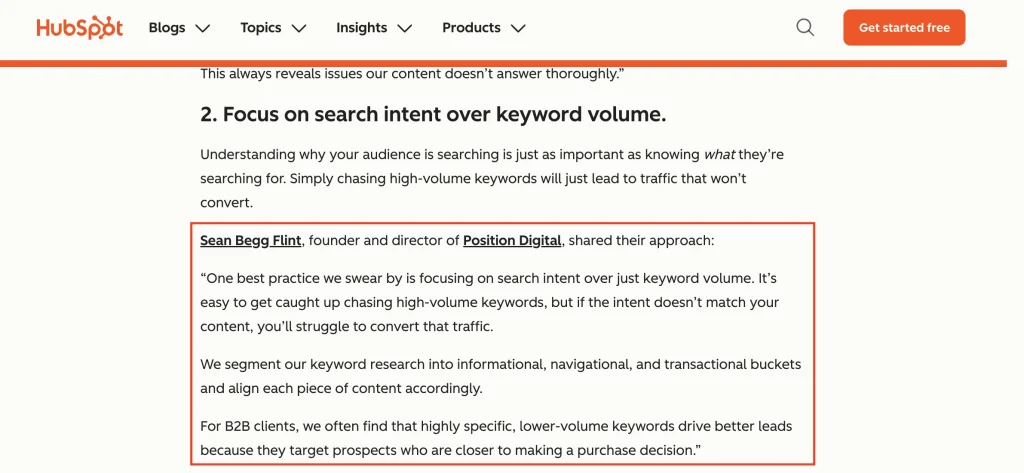
Create a ‘ready to use’ insight library prior to opportunities — short statements on trending topics in your space, common myths and misconceptions, emerging trends and shifting behaviours. This allows you to provide strong custom insights as opposed to scripted responses. As you earn placement after placement in reputable publications, it builds trust and strengthens brand associations in your niche.

Bilal Amin, Founder of Three Stripes Digital
Through expert commentary campaigns, I’ve managed to earn placements in Forbes, Ahrefs, and HubSpot — publications that AI systems cite heavily when answering questions about marketing and SEO.
Content refresh outreach
Many high-performing articles gradually become outdated as statistics, trends, and market conditions change.
Journalists know this—and they’re often happy to refresh older content if you provide timely, relevant information that improves the piece.
This creates a win-win situation:
- The publisher keeps their content accurate and up to date
- You earn a mention, citation, or backlink in an article that may already rank well in Google and AI search
One underused tactic is updating old successful stories with current market implications. Publishers appreciate fresh relevance without rebuilding an article from scratch. Supply a new statistic, sharper angle, and a direct consequence for buyers. I suggest revisiting previous coverage quarterly, because renewed context often earns secondary citations in AI results.

Marc Bishop, Director of Business Growth at Wytlabs
Simply go through each AI citation you’ve collected and look for old statistics or outdated examples. When you find one, reach out to the author and offer fresh data from your own study, research, or survey.
Listicle outreach
Listicles are the most cited content type in AI search, according to multiple AI SEO studies from Wix, Ahrefs, and Seer Interactive.
That’s because they do exactly what AI systems aim to do: summarize options, compare solutions, and help users make decisions.
As Konstantin Vashkevich, Head of Marketing at Redtrack, explained:
We prioritize being included in comparison-style and ‘best tools’ content across the web. These pages are heavily referenced by AI systems because they summarise options and decisions. Instead of just pitching stories, we actively work to get mentioned in these high-intent pages.

Konstantin Vashkevich, Head of Marketing at Redtrack
Here’s how you can approach listicle outreach:
- Find listicles that AI already cites. Use our proprietary listicle outreach tool ListBrew to surface listicles that already rank in Google and LLMs for your target keywords.
- Lead with value. When reaching out to listicle authors, lead with what makes your product distinctly useful for their readers — a specific use case, a differentiating feature, or a customer result — rather than a generic inclusion request.
- Offer something in return. Link to their site in your upcoming guest post, promote the listicle to your newsletter, or offer free access to your software.
Alternatively, let an expert do it for you. Explore our listicle link building services to learn more.
3. Publish citation-worthy assets
Citation-worthy assets are types of content designed to attract natural links and mentions, such as original research, benchmark reports, free tools, and case studies.
Victor Enselmann, Founder of Modeva, emphasized the importance of citation-first content:
One digital PR tactic that will matter far more in AI search is creating citation-first content: original research, proprietary data, or expert commentary designed to be referenced repeatedly. AI platforms and search engines increasingly reward brands that become trusted sources, so the goal is no longer just ranking your own page, but creating something journalists, publishers, and industry sites consistently cite.

Victor Enselmann, Founder of Modeva
When multiple credible sources point to your content over time, AI systems will treat it as a trustworthy source.

Joseph Riviello, CEO and Founder of Zen Agency, experienced firsthand the impact of creating a citation-worthy asset:
We published a full report on the shift from SEO to GEO, and that single asset became a citation anchor — other outlets referencing it creates a citation chain that AI search engines treat as strong topical authority signals.

Joseph Riviello, Founder of Zen Agency
Some tips to keep in mind:
- Publish original data. Run surveys, analyze internal product data, or compile industry trends. Even small datasets can be valuable if they reveal something new or surprising.
- Package insights into reports. Turn your findings into polished assets like “State of the Industry” reports or benchmark studies. These are highly shareable and often picked up by media and bloggers.
- Compile other studies. You don’t always need to create data from scratch to build a citation-worthy asset. Curating and synthesizing existing research can be just as powerful—if you do it right.
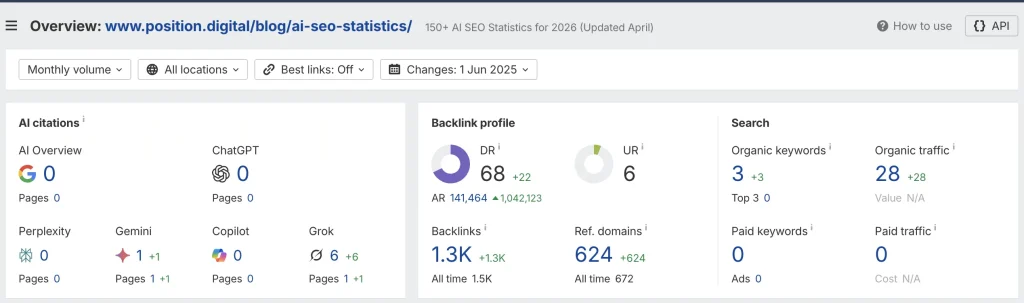
Our AI SEO statistics piece is a great example. It’s basically a compilation of research, studies, and experiments done around AI search.
Since it was published, this article has secured over 1,300 backlinks naturally and earned citations from Gemini and Grok.
4. Distribute those assets
Creating a strong piece of content is only half the job. Even the most insightful report or case study won’t gain traction if it isn’t seen by the right audiences.
That’s where distribution comes in.
As Lee Evans, Head of Marketing at Outbuild, explained:
One of the biggest missed opportunities in digital PR for AI visibility is content distribution, not just creation. A lot of teams publish great insights, but they don’t actively place them where AI models are likely to pick them up. We focus on ‘controlled amplification’ — taking one strong insight and intentionally seeding it across multiple formats and platforms.

One of our clients, Resource Guru, published a data-led report titled Agency Overworking Report 2025.
We then distributed the report to relevant, authoritative publications covering workforce trends, productivity, and agency life (including Forbes).
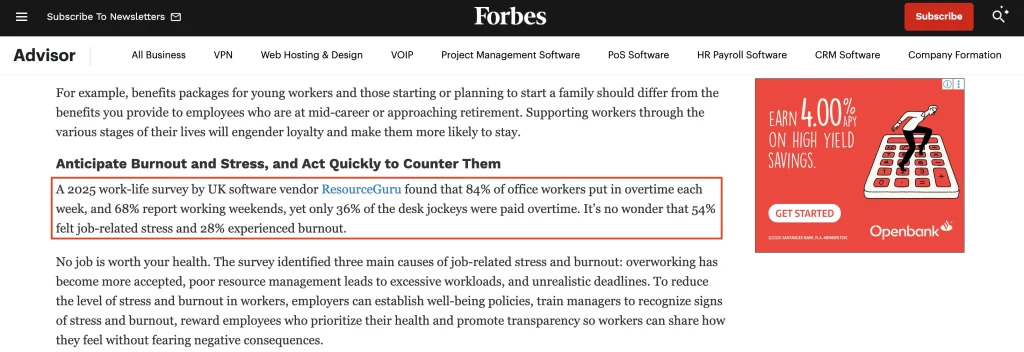
In just 3 months, the campaign generated 50+ backlinks, with a combined page views of 3+ million.
Read the full digital PR case study here.
How to Influence AI Training Data With Digital PR
Getting into AI’s training data is obviously a lot harder than earning a single citation in a RAG-based system.
You can’t simply publish a page and expect a base-model LLM to absorb it immediately.
These models are trained on massive datasets collected over long periods of time, which means visibility is built gradually through repeated exposure across the broader web ecosystem.
1. Build topic associations
When it comes to AI visibility, more mentions don’t automatically mean more authority. What matters is how consistently your brand is associated with a specific topic.
As Kristiyan Yankov, Co-Founder and Growth Marketer at Above Apex, put it:
It’s less about volume and more about owning a niche conversation so clearly that AI can’t ignore you when that topic comes up.

Kristiyan Yankov, Co-Founder and Growth Marketer at Above Apex
In practice, building these associations comes down to three methods:
Target topically aligned publishers
Instead of random placements, prioritize getting mentions in publications, blogs, and media outlets that are relevant to your niche.
Pushkar Sinha, Co-Founder & Head of SEO Research at VisibilityStack, explain why this is crucial:
Link context now matters exponentially more than link volume. AI models evaluate the semantic relationship between linking and linked content, so a backlink from a topically relevant page carries more weight than ten random domain authority plays.

Pushkar Sinha, Co-Founder & Head of SEO Research at VisibilityStack
Gregory Shein, CEO of Nomadic Soft, shared his approach:
One tactic we use for SaaS clients is “entity stacking.” Instead of chasing random placements, we secure 3 to 5 tightly related mentions across niche publications within a short window, all reinforcing the same topic cluster. The trick is consistency in language, not just links. AI models prioritize clarity of expertise over volume. Stop chasing authority, start engineering context.

Gregory Shein, Chief Executive Officer at Nomadic Soft
For a SaaS brand, being included in a TechRadar review is more valuable than Forbes or The New York Times.
Build brand co-occurrence
Co-occurrence is the practice of placing your brand name in close proximity to a target keyword, ideally in the same sentence or paragraph, across multiple credible editorial sources.
Large language models learn by identifying patterns in how words appear together. The more often your brand is mentioned alongside a specific phrase, the stronger that association becomes.
Oleksii Sosnovenko, Search Marketing Specialist at Mobal, explained it simply:
If your brand is consistently mentioned alongside ‘sustainable supply chain logistics’ on reputable industry sites, AI learns your brand is a core component of that topic.

Oleksii Sosnovenko, Search Marketing Specialist at Mobal
Tom Parling, Founder & CEO of growthvibe, gave a nice example:
For a B2B fintech client, I used entity-rich language. Instead of saying “our compliance software helps banks,” I wrote “JohnDoe Compliance uses real-time transaction monitoring to flag suspicious activity for UK challenger banks.” AI engines mapped those specific entities. Within three weeks, ChatGPT cited their brand in answers about financial crime prevention.

Tom Parling, Founder & CEO of growthvibe
Create a named framework
A named framework gives journalists, creators, and marketers something concrete to cite instead of a vague idea to paraphrase.
Each time someone references your framework by name, that association between the concept and your brand is reinforced across another editorial source. Over time, AI systems learn to surface your brand whenever that topic comes up.
Kristiyan Yankov described the dynamic:
Another tactic is creating highly quotable frameworks — simple models, named strategies, or unique terms. When other marketers start referencing your framework, it spreads organically, and AI systems pick up on it quickly.
Kristiyan Yankov, Co-Founder and Growth Marketer at Above Apex
The framework doesn’t need to be complex; it needs to be specific enough that citing it by name adds meaning for the reader.
Here’s how you can create a named framework that sticks:
- Go with something memorable. Name your framework in a way that is simple, distinctive, and memorable. Avoid overly technical labels. If people can’t recall it or say it naturally, it won’t spread.
- Reinforce it across the web. Consistency is what turns a framework into an entity. Whenever you write a guest post, talk in a podcast, or answer a Reddit question, always refer to your framework by name.
- Partner with influencers and media. Accelerate adoption by getting other credible voices to reference your framework. Collaborate with industry creators, journalists, and publications so they use your framework when explaining a concept.
The Skyscraper Technique is one of the most successful examples of a named framework.
Brian Dean of Backlinko coined the term in 2013. It’s a link building strategy that works in 3 steps:
- Find the most-linked content on a topic
- Create something demonstrably better
- Then reach out to everyone linking to the original
The named framework gave other SEO writers a shorthand to reference, and they did, across thousands of articles, guides, and courses.
A decade later, AI tools still mention Brian Dean and Backlinko whenever the Skyscraper Technique is mentioned.
2. Audit your brand positioning across the web
Large language models (LLMs) are pattern-recognition systems. When they repeatedly encounter the same description of your brand across multiple credible sources, they start to treat it as a reliable fact.
But when messaging is inconsistent, it creates ambiguity.
For example, if some sources describe your brand as a content writing tool while others position it as an AI visibility tracking platform, LLMs receive mixed signals and struggle to form a clear association.
That’s why you need to keep consistent messaging about your brand across the web.
Ronnie Katz, CEO of BullsEye Internet Marketing, explained it plainly:
Make sure the same positioning appears on your site, your profiles, and your business listings so AI systems keep seeing the same story everywhere.

Athena Kavis, Web Developer & Founder of Quix Sites, reinforced the same point:
My favorite digital PR tactic is message consistency across every mention. I make sure the same core description, service language, location signals, and branded phrases show up on the website, local listings, guest features, and partner mentions — so AI systems don’t get mixed signals about who the brand is or what it does.

Athena Kavis, Web Developer & Founder of Quix Sites
Chand Makwana, Founder and Managing Director of Solvara, shared her approach:
Before we chased press coverage for Solvara, we aligned our brand name, founder name and product descriptions across Google Business Profile, Wikidata and every third-party directory we could get listed on. Within three months, Solvara started appearing in AI-generated supplement comparisons without a single outreach email sent.

Chand Makwana, Founder and Managing Director of Solvara
Here are some best practices to follow:
- Update brand details on owned assets. Make sure your website, social media profiles, Wikipedia page, business directory listings, and YouTube descriptions all use the same positioning, wording, and category description.
- Audit third-party mentions. Search for your brand on Google or use tools like Ahrefs to identify how external sites describe you.
- Correct inconsistencies. If you find outdated or inconsistent positioning, then proactively request updates from site owners or administrators to align messaging with your current brand narrative.
3. Appear in sources AI uses for training
AI models learn from billions of web pages across the internet.
But not all sources influence training data equally. Large language models tend to rely more heavily on:
- Their partner sites. Many AI companies have licensing or publishing partnerships with major media organizations. You can find ChatGPT’s publisher partners in this spreadsheet.
- Wikipedia. According to Profound and Ahrefs, Wikipedia is the most cited source in ChatGPT and AI Overviews. Wikipedia also has partnerships with AI companies like Meta and Perplexity, allowing their models to be trained on its data.
- Social media & forums. It’s no secret that OpenAI and Reddit have a partnership, meaning the forum is used to train ChatGPT models. LinkedIn and YouTube are also consistently top-cited domains in LLMs.
- Review sites. G2 is the most cited software review platform on ChatGPT, Perplexity, and Google’s AI Overviews. (Radix)
That’s why it’s important to monitor your Wikipedia page, if you already have one.
Regularly review the page for accuracy, completeness, and neutrality. If there are any outdated details, incorrect claims, or broken links, ask the editor to update them.
ChatGPT and Perplexity lean heavily on Wikipedia as a trusted source. Getting your brand’s narrative accurately reflected there — or defending an existing page from hostile edits — can dramatically shift what AI engines surface about you.

John DeMarchi, CEO & Founder of SocialCzars
You also need to be active on social media and discussion forums.
Publish LinkedIn posts and YouTube videos. Engage on Reddit, Quora, and niche-specific forums in your industry like GitHub.
The more consistently your brand appears across trusted platforms, discussions, and publications, the stronger the credibility signals AI systems associate with your expertise.
Showing up across social media, long form content, podcasts, and press creates the volume of data points AI platforms need to recognize you as a credible source. The more places your name and expertise appear, the more confident AI becomes in recommending you.

Crissy Conner, Founder of The Visible CEO
How to Measure Your Digital PR Success
Here are two metrics that determine whether your PR campaigns are having any impact on your AI visibility:
AI mentions and citations
The most straightforward way to measure AI visibility is to track your brand mentions and citations in AI answers.
Use AI visibility tracking tools to monitor:
- How often your brand appears in AI answers
- Which queries trigger those mentions
- Whether your citations are increasing over time
This helps you understand if your digital PR efforts are actually influencing how AI systems perceive and surface your brand.
Here’s the step-by-step guide to monitoring your brand visibility in AI search.
Branded search and direct traffic
If you don’t have access to AI monitoring tools, you can still measure impact using indirect signals.
Start with Google Search Console to track growth in branded search queries. If more people are actively searching for your brand, it’s a strong indicator that your PR campaigns are increasing awareness.
Then, use Google Analytics to monitor direct traffic. An increase in direct visits often means users are remembering your brand and returning to it after encountering it in articles, listicles, or AI-generated responses.
Partner With an AI-First Digital PR Agency
The tactics in this article work. But executing them consistently takes time and expertise most teams don’t have in-house.
That’s where our digital PR services come in.
Position Digital helps B2B & SaaS companies turn digital PR into a repeatable engine for AI visibility—not just one-off campaigns.
From creating data-driven assets to placing your brand in high-impact publications and sources AI actually learns from, we focus on what moves the needle.
Book a free consultation session with us today, and let’s explore how we can help you!