ChatGPT can be your best salesperson.
It’s available 24/7, ready to answer any questions about your product or service, highlight what customers and reviewers are saying, explain how your pricing stacks up against alternatives, and so on.
So, when those prospects finally click through to your site, they’re more likely to buy.
But here’s the catch: none of that happens unless ChatGPT recommends your brand in the first place.
In this article, we’ll look at the data from our own results and third-party studies to answer one important question: what does it actually take to rank in ChatGPT?
Let’s dive in.
Why You Should Care About ChatGPT as a New Discovery Channel
Google remains your biggest traffic referral, but you can’t ignore ChatGPT. It’s the largest AI chatbot by far with over 80% market share.
Several AI SEO studies also suggest that visitors from ChatGPT convert at a higher rate than organic traffic:
- Semrush found that LLM visitors convert 4.4x better than organic search visitors.
- Ahrefs got 12.1% of its signups from AI search (with a vast majority coming from ChatGPT), despite AI referral traffic making up only 0.5% of its total traffic.
More often than not, visitors coming from ChatGPT have already done their homework. So by the time they arrive on your site, they’re already well-informed and close to making a decision.
2 Types of ChatGPT Visibility
There are only two ways you can earn visibility in ChatGPT:
- Being cited as a source
- Being mentioned directly in the answer
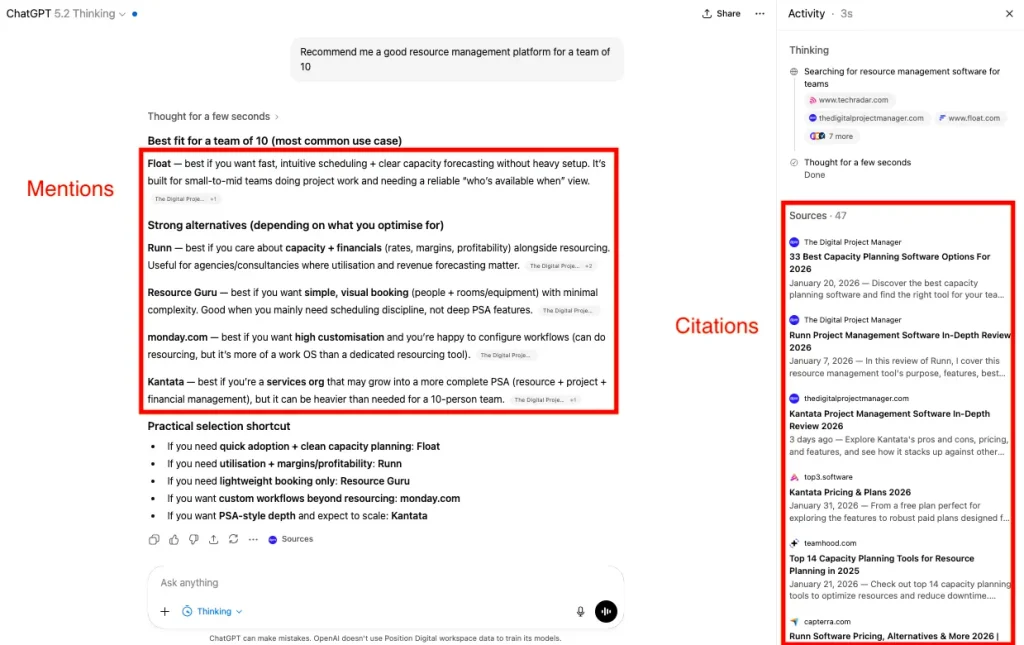
Which one should you pursue? Well, it depends on your business model.
If you’re a publisher, blogger, affiliate marketer, or review site owner, citations are a great way to earn AI referral traffic back to your site.
But if you run a brand that offers products or services, being recommended as the answer would bring more awareness and business opportunities.
Below, I’ll cover the tactics for both strategies.
How to Get Cited as a Source in ChatGPT
ChatGPT doesn’t always cite sources. It only does so when retrieving information via web searches.
Here’s an excerpt from OpenAI’s official help center:
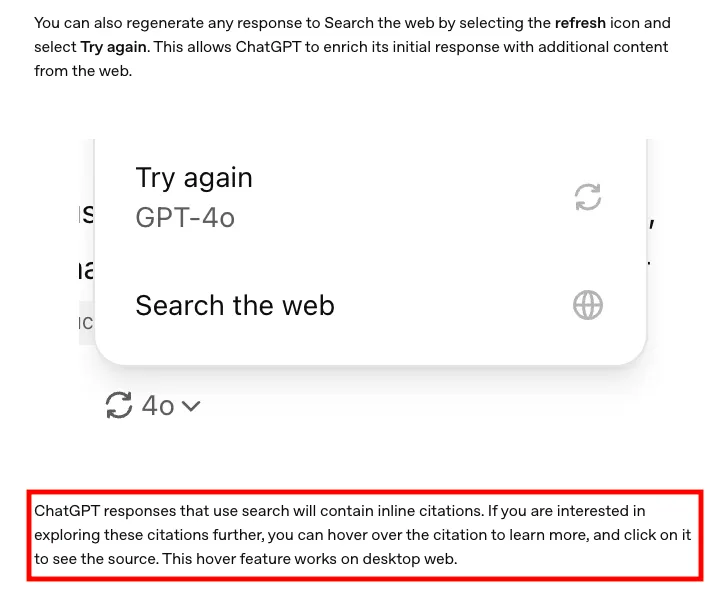
So, if you want to be cited, first you’ll have to make sure to target queries that trigger ChatGPT’s web search functionality.
1. Target commercial intent queries
A study by Josh Blyskal found that commercial intent prompts are much more likely to trigger web search in ChatGPT (53.5%) compared to informational queries (18.7%).
Nectiv’s analysis points to the same conclusion: the keywords most associated with ChatGPT search are overwhelmingly buying and evaluation terms, such as:
- Reviews
- 2025
- Free
- Features
- Comparison
The problem is, OpenAI still doesn’t give us user prompt data, so we don’t know for sure what customers are typing into ChatGPT.
But you can gather insights from your existing prospects and customers:
- Sales calls and support tickets
- Forums like Reddit and Quora
- User interviews and surveys
Alternatively, you can take your keyword data from Ahrefs or Google Search Console, feed it into ChatGPT, and ask the chatbot to turn it into prompts.
2. Create listicles (that are actually helpful)
ChatGPT loves citing listicles, especially for commercial intent queries like:
- What’s the best solution for [X problem]?
- Top alternatives for [brand Y]?
- How do [brand A] and [brand B] compare?
- Best [product] options for small teams?
This is because listicles provide clear structure and scannable units of information that ChatGPT can easily extract and reuse in answers.
In fact, “Best X” listicles are the most cited page types in ChatGPT responses, accounting for 43.8% of all page types.
That being said, you need to be extra careful when publishing listicles.
Don’t be overly self-promotional or publish too many of them, or you might erode user trust and hurt your Google performance as pointed out by Lily Ray in this article.
Listicles work best when they’re genuinely helpful, well-researched, and written with clear criteria (not as disguised promotion).
Case study
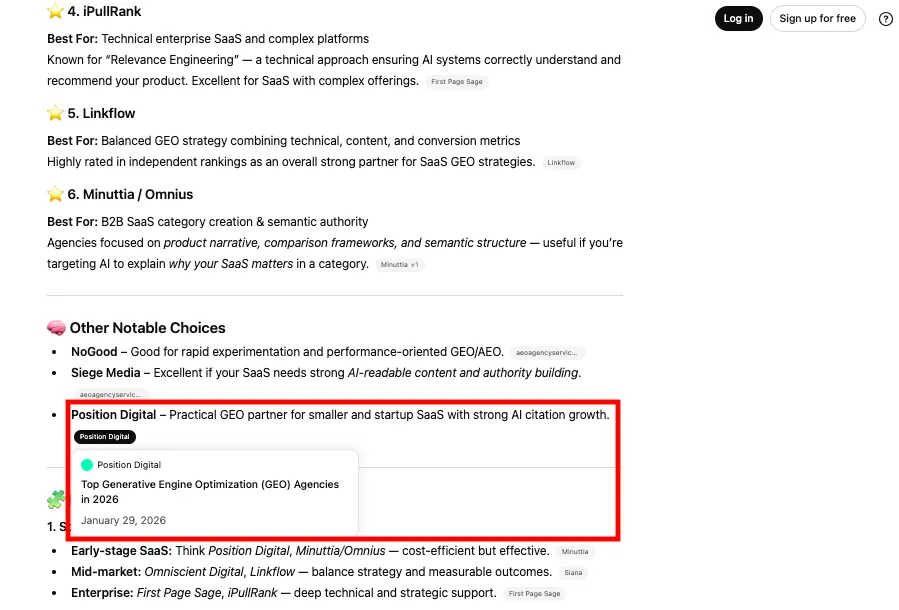
Our top GEO agencies listicle was cited by ChatGPT because it provides genuinely helpful and unique information.
We didn’t simply repeat the same list of big-name agencies mentioned in most roundups.
Instead, we ran extensive research to find specialist GEO agencies that:
- Operate in very specific niches
- Have clear proof of client results in their respective niche
3. Publish original research
As a content marketer, I frequently ask ChatGPT to find relevant research to support my arguments for topics I’m writing about.
But there are times when ChatGPT couldn’t give me what I’m looking for, simply because there’s no study on that particular topic.
For example, when writing a blog post about SEO for recruitment, I was trying to find statistics on:
- How many job searches Google currently processes per month
- How many job seekers start their job search on Google/LLM
And I hit a wall. There wasn’t a recent, trustworthy study that answered those questions directly.
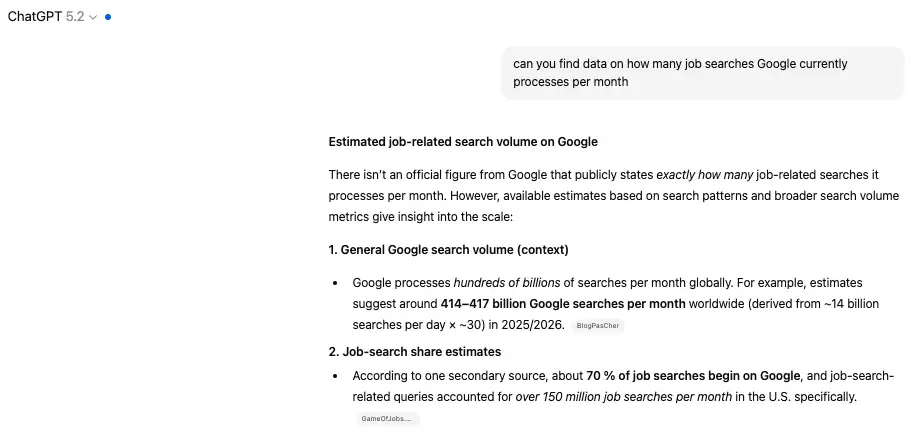
The claim that “70% of applicants start their job search on Google”? I couldn’t find the exact study—it seems to be one of those stats that gets repeated without a clear original source.
That gap is your opportunity.
If you could find these topics that your audience cares about and publish original data about them—surveys, benchmarks, experiments, or even a well-documented internal analysis—you give ChatGPT something it can’t get elsewhere.
And when your content becomes the best available source for a specific question, it’s far more likely to be cited.
Case study
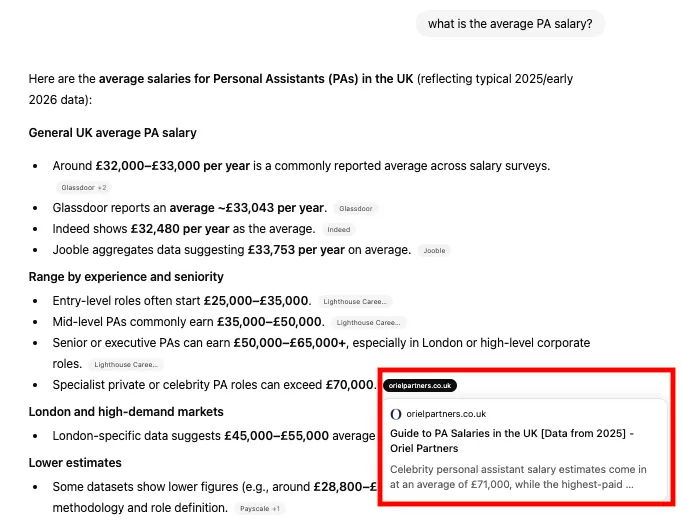
Oriel Partners, one of our B2B clients operating in PA recruitment, published a PA salary survey in London for 2025.
And it actually got cited by ChatGPT:
4. Optimize for fan-out queries
Traditional Google Search gives you a list of blue links. You scan, click a few results, and refine your keywords until you find what you need.
ChatGPT Search works differently. When a user asks a question, it expands the original prompt into multiple related searches behind the scenes, and then synthesizes the answer.
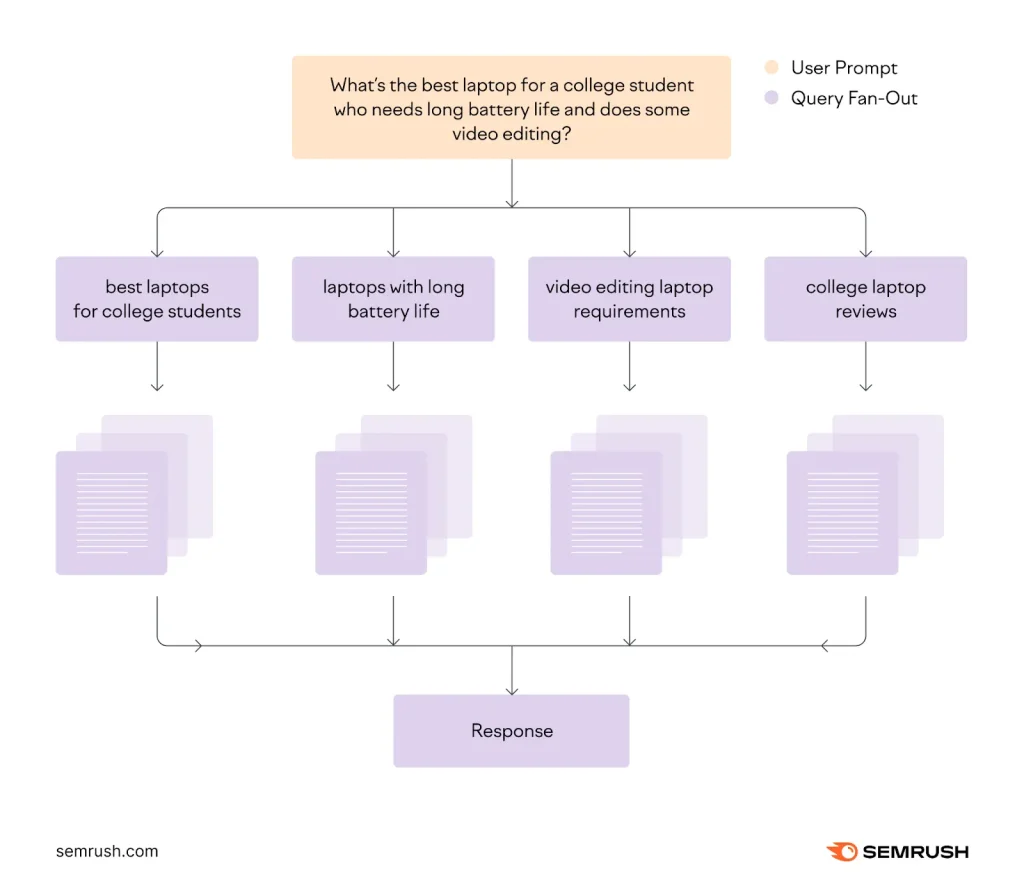
That’s why optimizing for a single keyword is no longer enough.
To show up consistently, your content needs to anticipate the “fan-out” and cover the related questions users would naturally ask next.
Map the primary query → secondary questions
For every target keyword, think about what follow-up questions users might ask.
Here are several places you can gather that information:
- Google SERPs: Type your target keyword on Google, look at the People Also Ask box, and document the most relevant questions.
- Forums: Find relevant threads on Reddit, Quora, LinkedIn groups, or niche communities. Paste them into ChatGPT and ask it to extract the most common questions, objections, and comparison points people raise.
- Sales and support conversations: Go through call transcripts, chat logs, and help tickets to find recurring questions about your products.
- Keyword research tools: In tools like Ahrefs and Semrush, you can take your primary keyword and explore related questions, comparison terms, and modifiers.
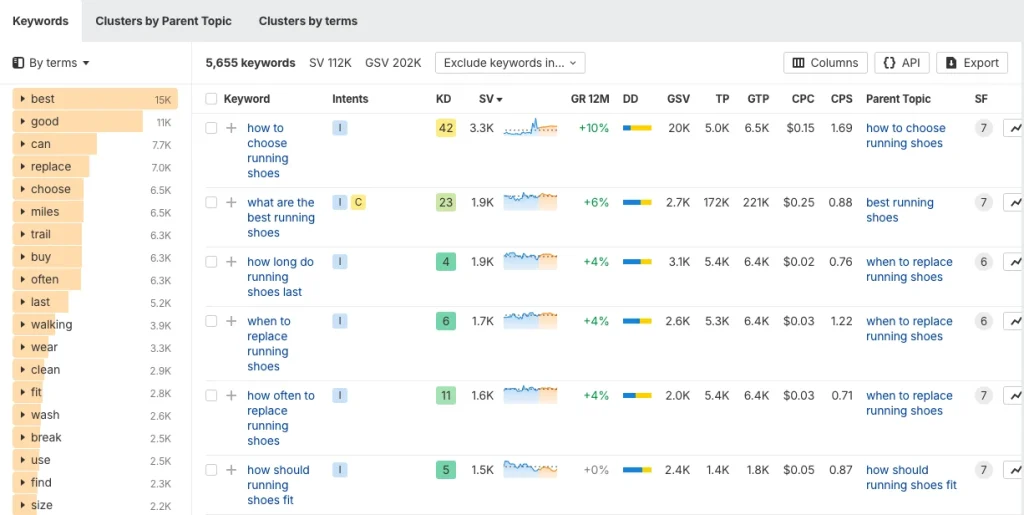
You can also reverse-engineer ChatGPT’s fan-out queries using our free Query Fan-Out Extractor tool.
Answer all user questions in your content
Now you know what your audience is asking. The next step is to make sure you answer all those questions in your content.
Follow these best practices:
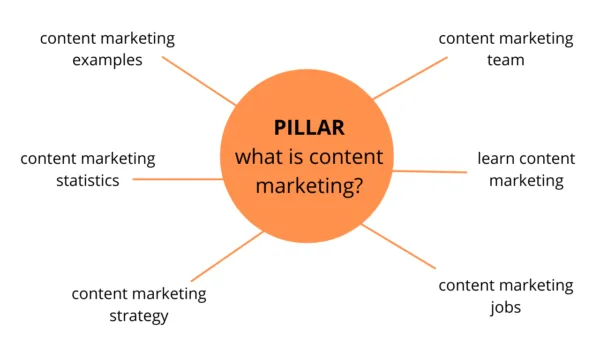
- Create topic clusters: Group similar questions and keywords into topics. Each topic should have one pillar page that answers the main intent, plus supporting pages that cover specific angles in depth.
- Update your existing content: Audit your current pages and identify missing follow-up questions. Add new sections, refine headings to mirror real prompts, improve structure, and expand thin areas. Often, improving what you already have is faster than starting from scratch.
- Create new content to fill the gaps: If your research uncovers questions you don’t cover at all, create new pages for them.
- Use a Q&A format: Use question-based headings that mirror how people actually phrase their prompts. Include a FAQ section where appropriate.
Case study
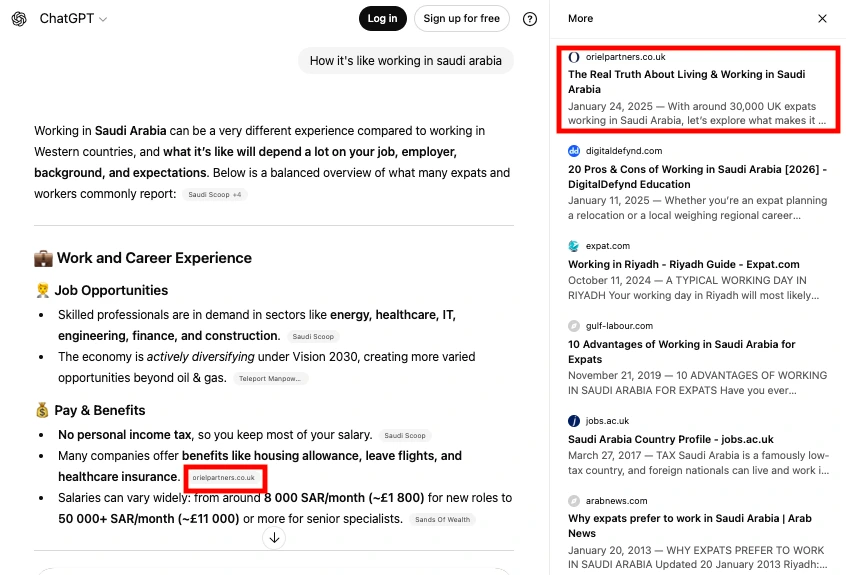
When refreshing a blog post about “Working and Living in Saudi Arabia” for Oriel Partners, we expanded the content based on relevant questions users were asking, such as:
- Is Saudi Arabia safe to work in?
- What’s life like for expats in Riyadh?
- Can a UK citizen live and work in Saudi Arabia?
- What is a good expat salary in Saudi Arabia?
After the update, the article was getting citations from AI Overviews and ChatGPT.
5. Make sure your content is accessible to ChatGPT bots
OpenAI has different crawlers for different purposes:
- GPTBot for training OpenAI’s foundation models
- OAI-SearchBot for ChatGPT’s web search features
- ChatGPT-User for visiting specific web pages or apps based on user requests
If you want to be included in ChatGPT’s search results, make sure to allow OAI-SearchBot in your robots.txt file.
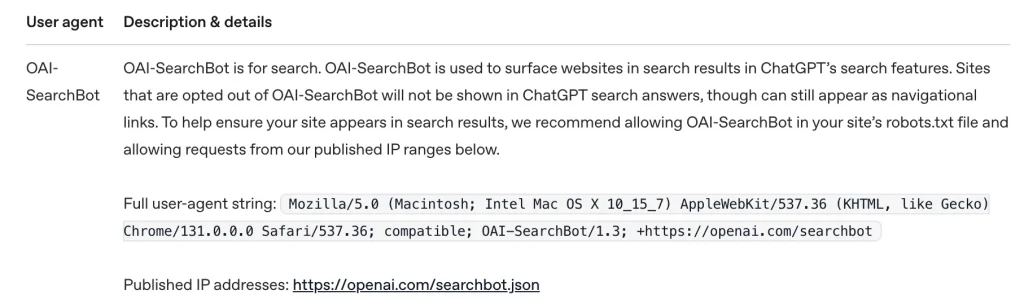
You can find more information about the full agent string and published IP addresses on OpenAI’s official documentation. Here’s a guide from Google on how to create and submit your robots.txt file.
There are also other technical requirements you need to keep in mind:
- Serve content in clean HTML: ChatGPT still can’t render JavaScript when browsing websites.
- Avoid using CAPTCHAs: If key content is blocked behind authentication, it won’t be retrievable.
- Ensure fast loading times: Fast-loading pages are 3 times more likely to be cited by ChatGPT compared to slower ones.
Case study
Learn how we helped a MarTech company secure 221% more AI citations through a series of technical SEO audits and fixes.
6. Keep your content fresh
Content freshness is a major ranking factor in ChatGPT’s search algorithms.
This is because the AI chatbot already knows “older” information from its training data. ChatGPT does web search only to fill the gap with fresh, current data.
There are many studies that confirm this:
- Metehan Yesilyurt dug deep into ChatGPT’s production settings and found that freshness is used as a scoring system.
- SE Ranking analyzed ChatGPT citation patterns and found that content updated in the past three months averages 6 citations versus 3.6 for outdated pages.
- Ahrefs studied different AI platforms and found that ChatGPT shows the strongest preference for fresh content.
- RESONEO dissected ChatGPT’s internal architecture and found that the model uses recency filters when scraping Google search results.
Here’s how to approach it strategically:
- Prioritize high-impact pages: Focus on “best X,” comparisons, alternatives, pricing pages, and product-led content first. These are most sensitive to recency.
- Update substance, not just timestamps: Don’t change the publish date without improving the content. Add new data, refresh screenshots, update examples, and expand sections to reflect current realities.
- Add a visible “last updated” date: This reinforces recency signals for both users and AI bots.
- Update regularly: Dedicate time every quarter to update your most important and high-performing pages to maintain (and improve) performance.
Check out my comprehensive content refresh guide here.
Case study
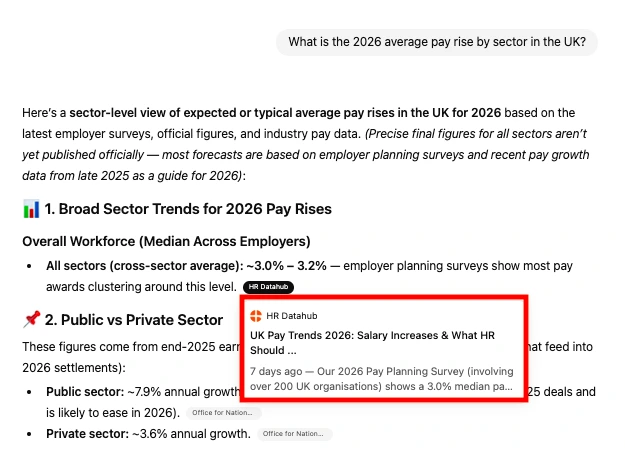
After refreshing HR Datahub’s article with fresh data, the article jumped from position 35 to 1 on Google.
It was also cited in several AI platforms, including AI Overviews, Gemini, Perplexity, and ChatGPT.
How to Get Your Brand Recommended by ChatGPT
Getting cited in ChatGPT is often a content and on-page optimization game: publish the right formats, answer the right prompts, and make your pages easy to retrieve.
But being recommended as the best solution for a problem is a different ball game.
It requires strong off-page signals—clear positioning, consistent third-party validation, and a recognizable reputation in your category—so ChatGPT has a reason to trust your brand over the alternatives.
Below, I’ll walk you through 3 proven answer engine optimization tactics that move the needle.
1. Become a recognizable entity in ChatGPT
According to RESONEO research, ChatGPT is currently building its own knowledge graph.
They found the following entity format in ChatGPT’s internal system:
- entity[“people”,”Elon Musk”,”tesla spacex ceo”]
- entity[“company”,”Bugatti”,”french hypercar brand”]
If you’re a new business, the first step is making sure ChatGPT can recognize your brand as a distinct, clearly defined entity.
Otherwise, you won’t be associated with a specific category—and you won’t be recommended when users ask for solutions in that space.
Here’s how:
Build brand associations
The more often your brand name appears alongside a specific topic, service, or industry, the stronger the association becomes.
Repetition builds recognition.
Make it absolutely clear:
- Who are you?
- What do you offer?
- Which audience do you serve?
- Where are you located?
Repeat those associations across your marketing channels
Keep consistent wording about your business across all your marketing channels.
If your website says “AI visibility tracking tool” but your social media profile says “AI content writing tool,” you’ll create confusion for both users and AI models.
The goal is to have one clear identity, repeated everywhere.
Actionable tips:
- Audit your website: Crawl your entire site using tools like Screaming Frog and check if your homepage, about page, service pages, and blog posts say the same things about your brand. If not, fix them.
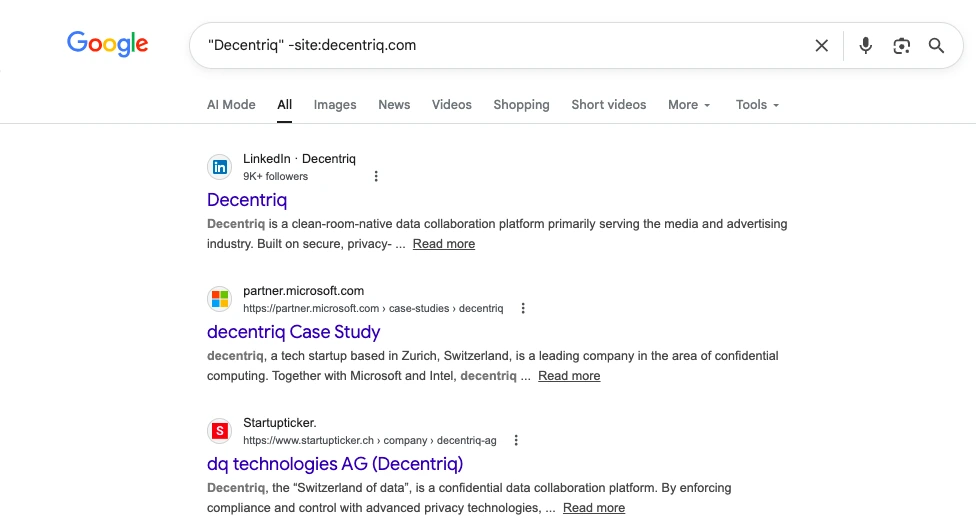
- Check third-party mentions: Use the “[your brand name] -site:[your domain]” format on Google to see all the pages that mention your brand. Make sure your positioning is accurate. If not, reach out to the site admin to change it.
2. Get mentioned in the top-cited pages
Having a clear and consistent brand identity isn’t enough—you also need third-party validation, especially from domains that ChatGPT already trusts and cites.
Follow these steps:
Conduct prompt research
To rank in ChatGPT, you first need to understand what ChatGPT is saying about you today. Start with prompt research to identify the top 50 questions people are asking about your brand, products, and category.

David Wilson, EVP of Digital Marketing & AI at Zozimus Agency
Find out what your target audience is typing into ChatGPT when looking for your solutions.
Here are a few great sources of information:
- Sales calls: Ask the leads how they find you. If they answer ChatGPT, ask the exact prompts they used and document the answers.
- Forums like Reddit: Find the most frequently asked questions in your category. Look for recurring “how do I…”, “can you compare…”, and “is it worth…” questions. These often mirror ChatGPT prompts.
- Your keyword data: Take your commercial intent keywords and turn them into questions.
Identify the top citations for your target prompts
Once you’ve got the prompt data, the next step is to identify the top-cited pages for each prompt. These are the ones influencing ChatGPT answers.
Here’s how:
- Run your prompts manually on ChatGPT (use incognito to avoid bias), or use our AI Citation Extractor.
- Document the most cited domains and page types.
- Filter by content types you can realistically influence: blog posts, listicles, reviews, news, etc.
If you prefer an automated approach, you can also use AI visibility tracking tools like Peec AI, OtterlyAI, and Writesonic.
Find a way to get your brand mentioned there
For each question, review the sources ChatGPT uses for that query, then use outreach and digital PR to earn inclusion on those pages.
David Wilson, EVP of Digital Marketing & AI at Zozimus Agency
The quickest way to secure ChatGPT mentions is to be included on pages it already cites.
Here are some tactics that work for us:
- Contribute expert quotes to educational blog posts (how-tos, guides, etc)
- Ask for inclusion in “best X” listicles and comparison articles in exchange for something (paid placements or link exchanges)
If that’s not possible, another method is to publish new content on domains that ChatGPT frequently use as sources:
- Write guest posts that are relevant to your business, and link back to your site
- Publish press releases on news sites that ChatGPT is partnering with
Case study
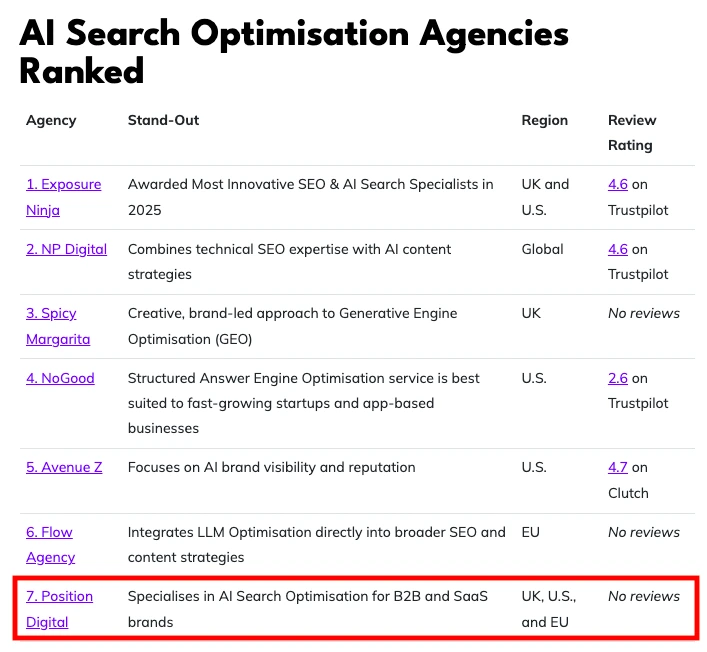
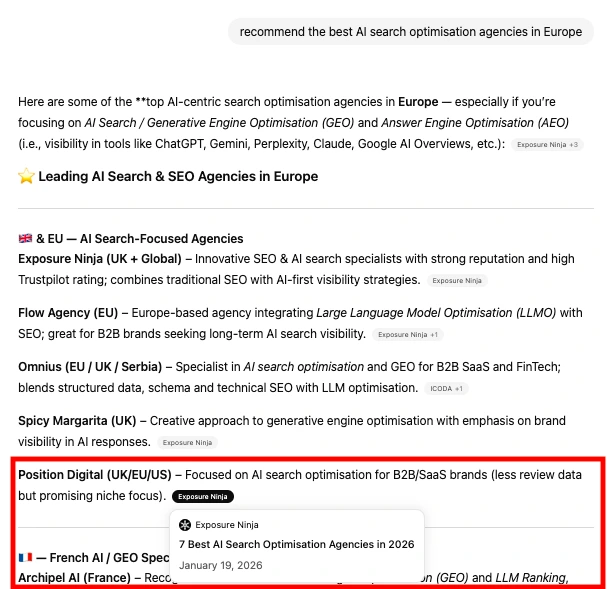
We managed to secure an inclusion in Exposure Ninja’s listicle on “The Best AI Search Optimisation Agencies in 2026.”
And since that listicle is cited by ChatGPT, our agency is recommended as one of the answers.
3. Build a positive online presence
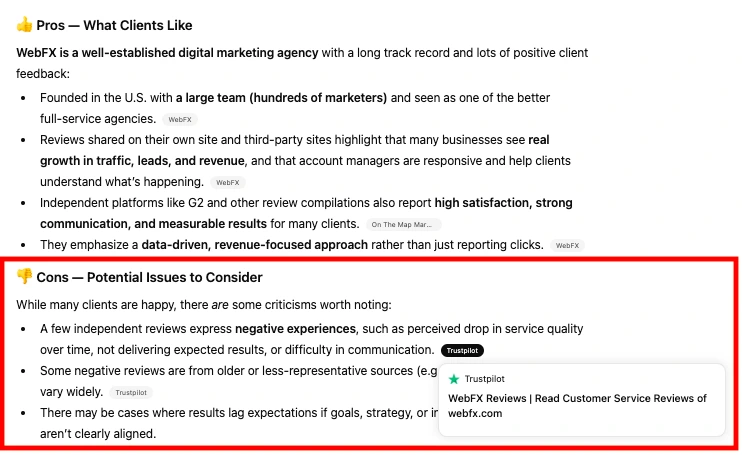
Once users have narrowed down the options and entered the decision-making stage, they often ask ChatGPT:
- Should I hire [X agency]?
- Should I buy [X product]?
- What’s the pros and cons of [X brand]?
For those kinds of questions, ChatGPT typically pulls reviews and ratings from sites like TrustPilot, Clutch, and forums like Reddit.
In the era of AI search, brand reputation management is more important than ever.
Collect positive reviews
Encourage your existing clients to leave reviews on platforms like:
- Google Business and Yelp (for local businesses)
- Clutch (for agencies and B2B service providers)
- Trustpilot (for general consumer brands)
Be active on Reddit
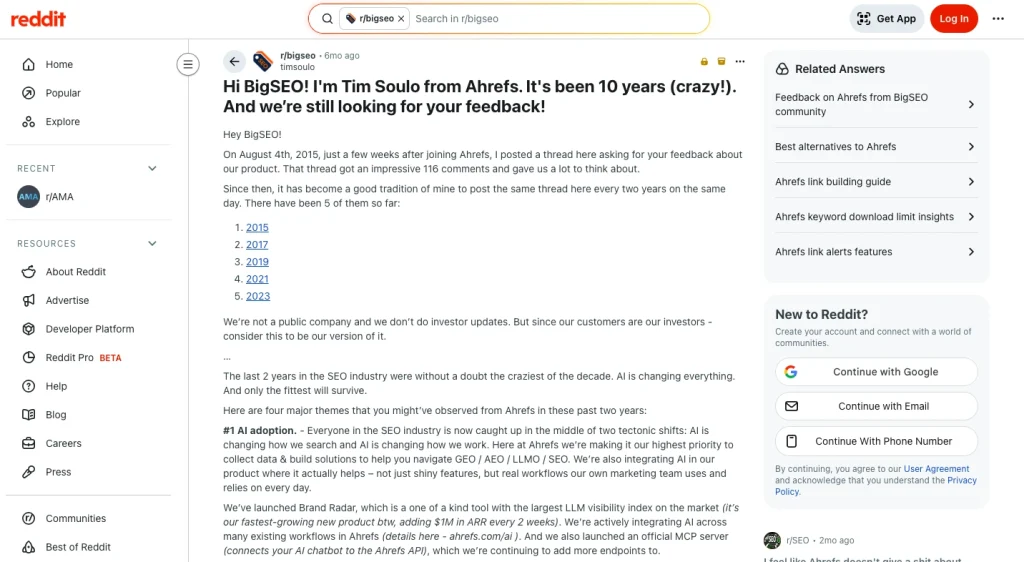
Reddit is the most cited domain in ChatGPT.
And it’s not surprising: OpenAI and Reddit have struck a partnership that allows the AI company to train on Reddit’s data.
But be careful. Redditors are allergic to self-promotion.
If you show up just to drop links or pitch your service, you’ll get downvoted (or banned) and do more damage than good.
The right approach is to earn trust first:
- Be transparent about who you are and which company you represent
- Share helpful answers in at least 3 relevant threads each week
- If your brand is well known enough, you can create a thread to ask people for feedback
Partner with YouTubers
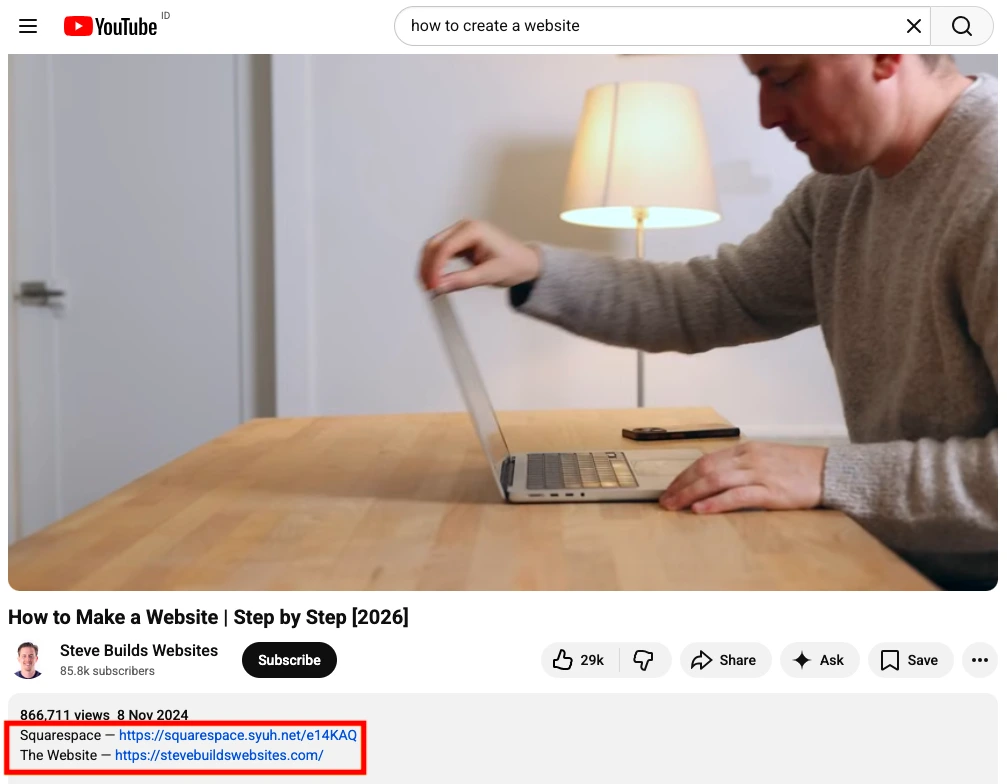
YouTube mentions show the strongest correlation with brand mentions in AI platforms like ChatGPT, according to an Ahrefs study.
The more your brand is mentioned across different YouTube videos, the more likely ChatGPT will recommend your brand.
Here are several ways you can partner with YouTube creators:
- For eCommerce businesses: Send free products to be reviewed or offer affiliate commissions.
- For tech or SaaS brands: Appear as a guest speaker in relevant podcasts or sponsor videos where your software can be a solution.
Let’s Build a Brand ChatGPT Recommends
The key to ChatGPT visibility boils down to one simple advice: build a better brand.
The more often your name appears across the web and the more people say good things about you, the more likely ChatGPT will recognize, trust, and recommend you.
But it’s easier said than done, especially if you’re a solo founder or a lone marketer wearing many marketing hats.
Let us help.
At Position Digital, we offer end-to-end AI search optimization services that include:
- Brand audit: We find out what AI currently knows and says about your brand
- Brand positioning: We train AI on what you really want to be known for
- Content optimization: We create well-structured and helpful content that LLMs want to cite
- Technical GEO audit: We make sure that AI bots can crawl and index your pages
- Outreach & digital PR: We spread the word about your brand across the internet
The best part? We offer a money-back guarantee. If you don’t see meaningful progress, you can walk away—we’ll refund you.
Interested? Let’s talk!