
Key Takeaways
- OpenLens: Best AI visibility tools for marketing agencies that need multi-client dashboards.
- Amplitude: Best free AI visibility checker for monitoring brand visibility in ChatGPT and AI Overview responses.
- Ahrefs Brand Radar: Best AI visibility platforms with SEO capabilities.
- GEO Toolbox: Best AI visibility software with GSC and AI answer data unified.
The best AI visibility tracking tools in 2026 depend on your needs.
Some tools focus on tracking how often your brand appears in AI-generated answers. Others go deeper into citation analysis, AI bot activity monitoring, and content recommendations.
And if you’re an agency, features like multi-client dashboards, white-label reporting, and integrations can be just as important as the visibility data itself.
In this guide, I’ll break down the best AI visibility tracking tools and what each one is best suited for, so you can find the right fit for your team, clients, and GEO strategy.
A Few Considerations Before Buying LLM Trackers
Before comparing LLM visibility tools, keep these limitations in mind.
They affect how you should interpret almost every visibility score, ranking, and share of voice metric you’ll see in an AI tracking platform.
We still don’t know exactly what users prompt
Unlike traditional Google search, we don’t have a complete first-party database of the questions people type into ChatGPT, Claude, Gemini, or other LLMs.
That creates a fundamental problem for AI visibility tracking: how do you know the prompts you’re tracking actually represent what your target audience is asking?
Most LLM trackers solve this by letting you create your own prompts, suggesting prompts based on keywords and topics, or generating synthetic prompts.
These are useful proxies, but they aren’t the same as having access to the actual prompts used by your audience.
AI answers are never the same
Ask an LLM the same question five times and you may get five different answers.
The brands mentioned can change. Their order can change. The number of recommendations can change. Even the reasoning and sources behind the answer can vary.
In fact, a SparkToro study found that you’d have to ask ChatGPT the same question more than 1,000 times to get two answers with just the same list of brands in the same order.
There’s no way to measure prompt volume
People ask the same question in a million different ways. One person might ask “what’s the best capacity planning tool for a team of 200 people?” while another one simply tells AI to “recommend the best capacity planning tools.”
Same intent, totally different phrasing.
AI responses differently to each user
The response you get isn’t necessarily the same response another person gets.
AI systems can take previous interactions and available context into account, meaning two users asking what appears to be the same question may receive different answers.
For example, if a marathon athlete and a regular person who loves running ask ChatGPT for “running shoe recommendations,” they’ll get two different responses.
Despite these limitations, LLM trackers are still useful
None of this means AI visibility tracking is pointless.
You just need to use the data differently from traditional SEO rankings.
Instead of asking:
- “Are we #1 in ChatGPT?”
Ask:
- How often does our brand appear across relevant prompts?
- Which competitors appear more frequently?
- Which websites and pages does AI cite?
- Which topics are we visible or invisible for?
- Is our visibility increasing over time?
- Does AI-referred traffic convert once it reaches our site?
Used this way, LLM trackers can give you a useful directional view of your presence in AI search and, more importantly, help you identify where to focus your GEO efforts.
The Best LLM Visibility Trackers at a Glance
| Platform | Best for | Starting price |
|---|---|---|
| OpenLens | Marketing agencies that need multi-client dashboards | Free; paid plans start at $39.99/month/seat |
| Amplitude | Small teams looking for a free tool to monitor ChatGPT and AI Overview visibility | Free; paid plans require custom pricing |
| Ahrefs Brand Radar | SEO teams and agencies that want AI visibility and SEO data in one place | $50/month for custom prompt monitoring; $199/month/platform for full AI visibility index |
| GEO Toolbox | Companies that want AI visibility, Google Search Console, and AI traffic data in one dashboard | $99/month |
OpenLens
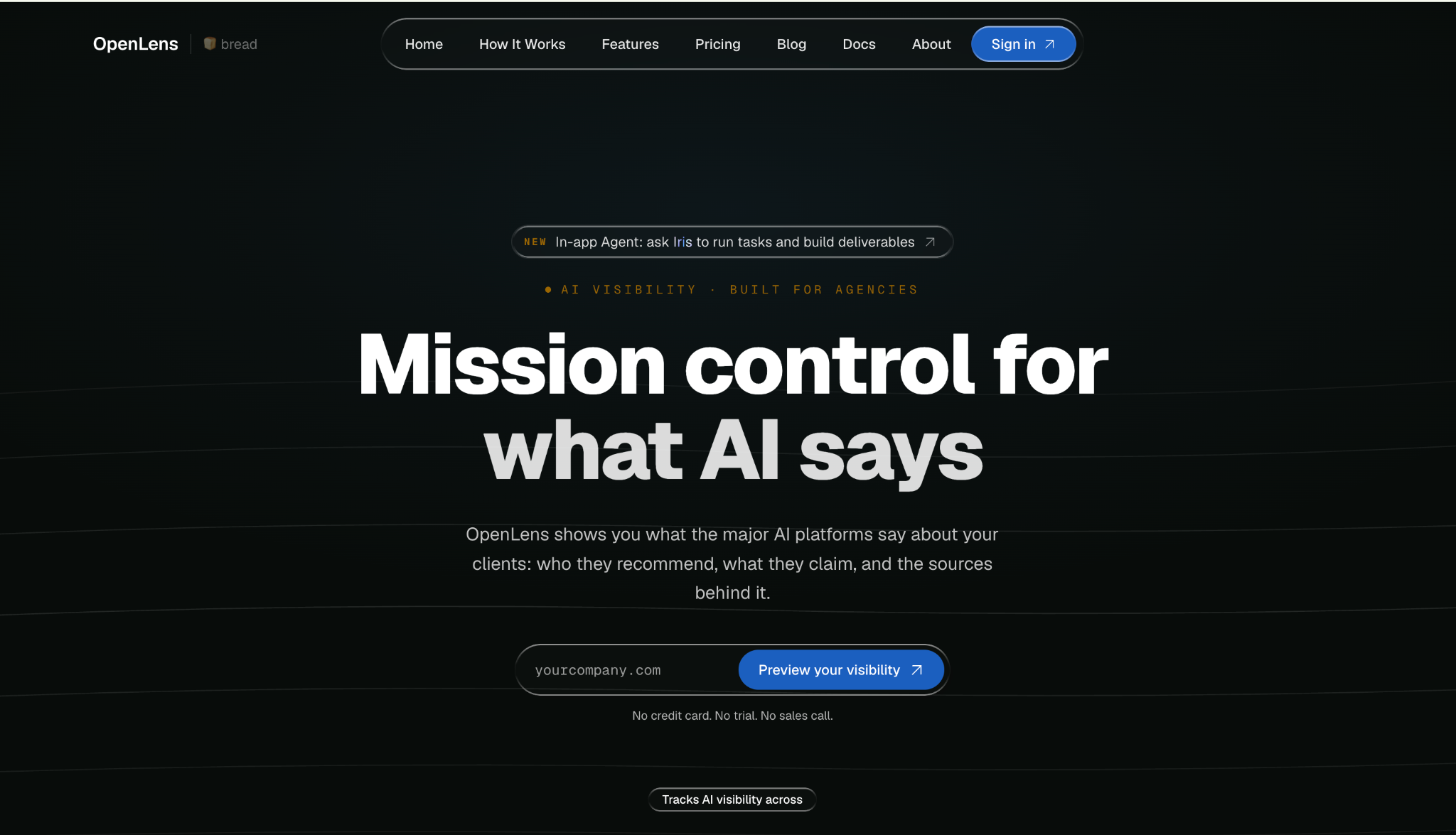
Best for: Marketing agencies that need multi-client dashboards.
Standout features:
- Forever free plan. Start tracking your visibility in Google AI, ChatGPT, and Perplexity without spending a penny.
- Multi-client dashboard. Get a dedicated AI visibility dashboard for your whole client roster, with unlimited client logins/views.
- Automated prompt tracking. Add your prompts and run them across the selected AI platforms daily, weekly, or monthly (depending on your plan).
- In-app AI agent. Open the agent from any project and ask about your AI visibility in plain language.
- AI Indexing. Check whether AI can access and cite your clients’ pages.
- AI readiness checks. Run scheduled AI readiness checks on specific URLs.
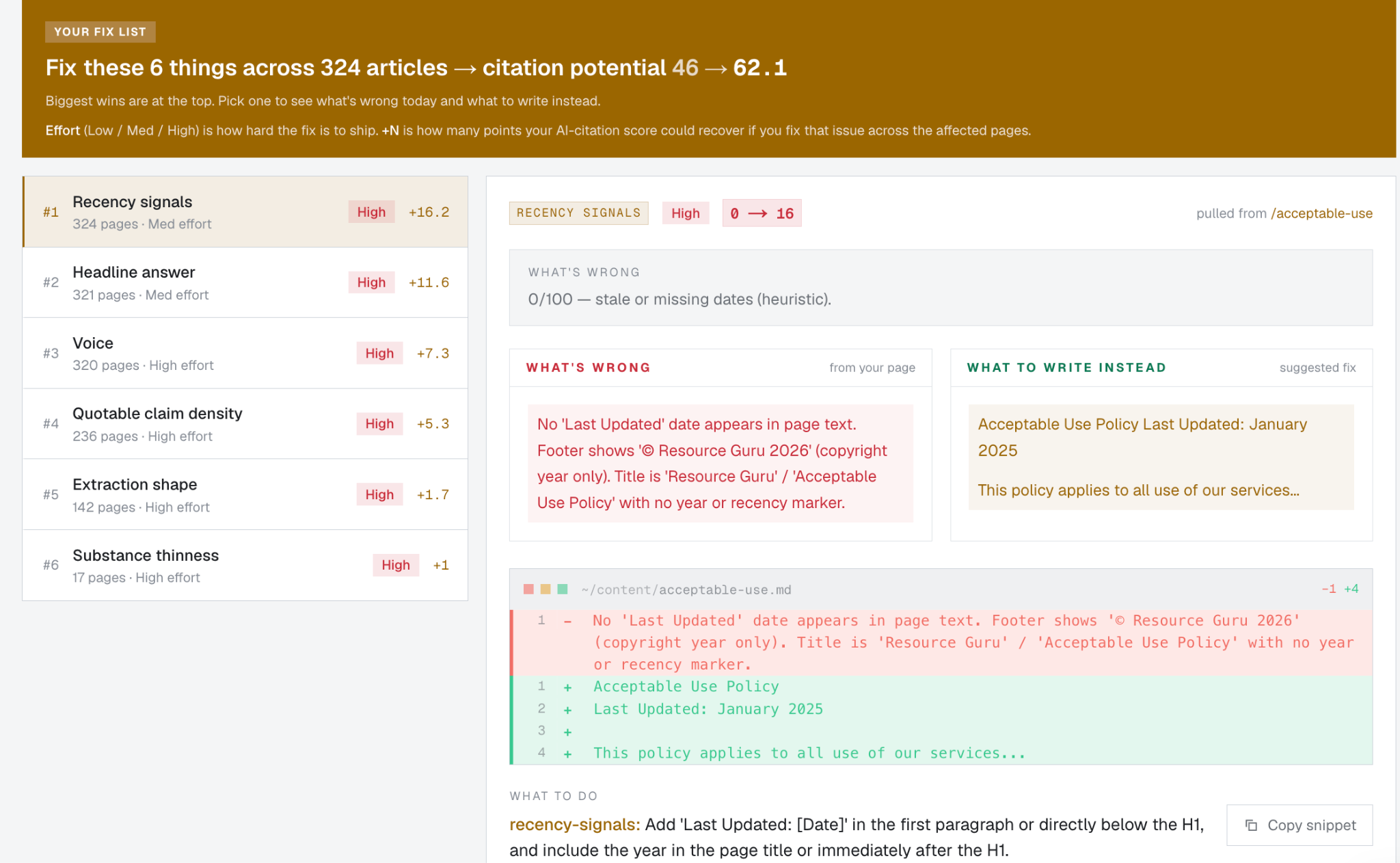
- AI content optimization. Audit your content and get a list of actionable recommendations to improve your citability.
Drawbacks:
- Still a fairly new tool
- No citation analysis per prompt
As an AI SEO agency handling multiple clients, we find OpenLens to be very helpful. You can create a project for each client, monitor their AI visibility in a dedicated dashboard, and invite them to view the report.
Within each project, you can add prompts and organize them into topics, then run them across your selected AI platforms daily, weekly, or monthly, depending on your plan.
This makes it easy to see which topics your clients already have visibility in and where there are opportunities to improve.
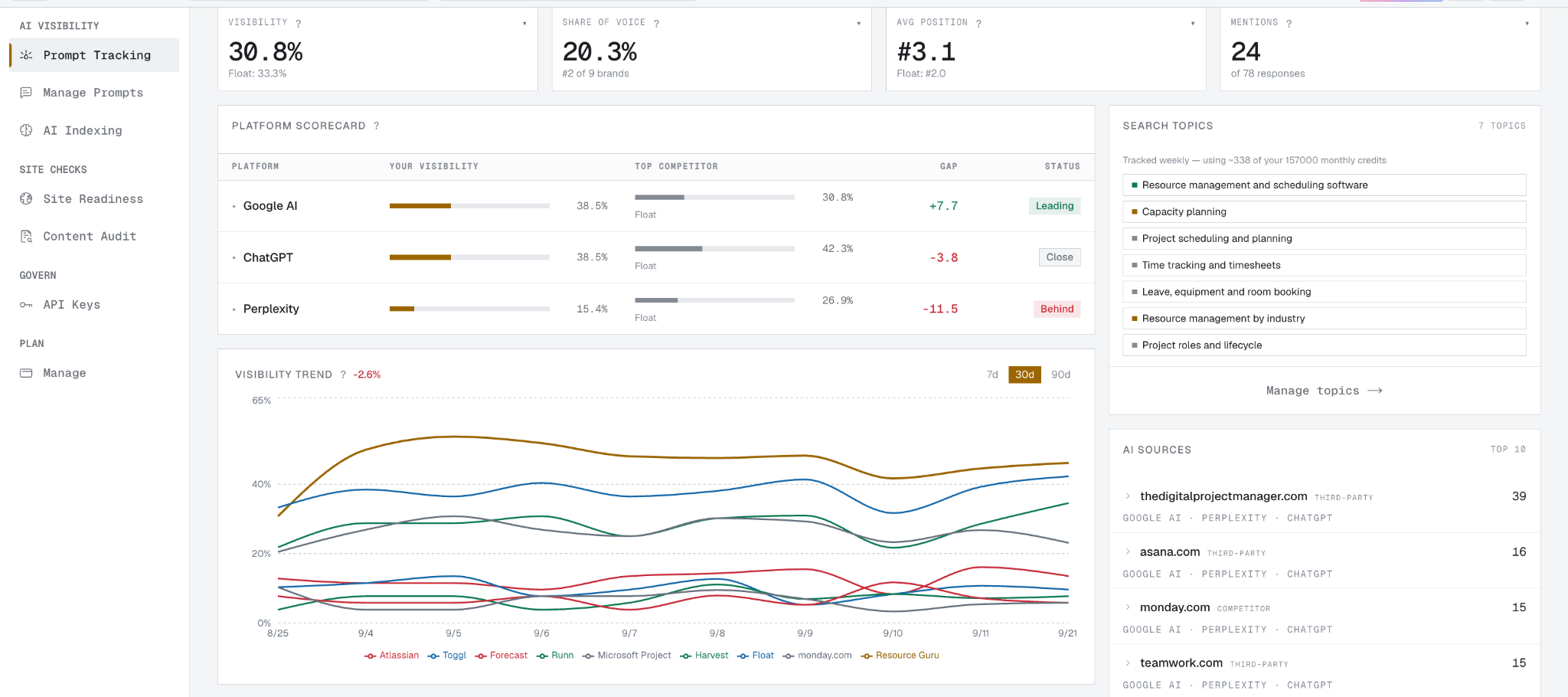
The Prompt Tracking dashboard gives you a clear overview of key visibility metrics, including:
- Visibility score: How often your brand is mentioned across all prompts and tracked AI platforms.
- Share of voice: How often AI recommends your brand relative to competitors.
- Average position: When AI mentions your brand, this tells you which position your brand appears in the recommendations list on average.
- Visibility trend: Track your AI visibility performance over time (last 7, 30, and 90 days).
- AI sources: Which pages are used by the AI platforms to form the responses.
Another useful feature is Content Audit, which evaluates how easy it is for AI platforms to understand and quote your marketing pages. It also provides actionable recommendations for improving your content’s citability.
The main limitation is the lack of citation analysis at the prompt level. OpenLens shows the top AI sources across your tracked topics, but you can’t drill down into an individual prompt to see exactly which sources influenced that specific AI response.
Supported AI platforms
ChatGPT, Perplexity, and Google AI on the Free plan. DeepSeek is included in the Starter plan, while Gemini, Claude, and Grok are only available in the Agency plan.
Does it offer API and MCP?
Yes. OpenLens provides both API and MCP access, although the limits depend on your plan.
The Free plan includes 50 MCP calls and 100 API calls per month. Starter increases this to 500 MCP and 500 API calls, while Agency includes 2,000 MCP calls and 2,500 API calls per month. Enterprise plans are available if you need higher or custom limits.
Data reporting & integrations
All plans include unlimited client logins, so you can invite your clients to view the AI visibility reports. There’s also white-label reporting in the Agency plan, as well as dedicated onboarding and flexible invoicing in the Enterprise plan.
OpenLens also integrates with Google Search Console and Google Analytics, allowing you to bring AI visibility data together with your existing organic search and website performance data.
Pricing
- Free ($0): 2 seats, 3 projects, 1,000 credits a month (plus 75 per project), weekly and monthly tracking, 50 MCP calls and 100 API calls each month, 10 manual runs a day per user, 150 AI Indexing pages a month, supports ChatGPT, Perplexity, Google AI
- Starter ($39.99/month/seat): Max 5 seats and 5 projects, 8,000 credits per seat (plus 200 per project) each month, 500 MCP calls and 500 API calls each month, 10 manual runs a day per project, 1,000 AI Indexing pages per seat each month, supports ChatGPT, Perplexity, Google AI, DeepSeek
- Agency ($299.99/month/seat): Unlimited seats and unlimited projects, 50,000 credits per seat (plus 500 per project) each month, daily tracking, 2,000 MCP calls and 2,500 API calls each month, 10,000 AI Indexing pages per seat each month, supports ChatGPT, Perplexity, Google AI, DeepSeek, Gemini, Claude, Grok
Amplitude
Best for: Small teams looking for a free tool to monitor ChatGPT and AI Overview visibility.
Standout features:
- Forever free plan. Every Amplitude account includes AI Visibility at no cost, with the Free plan providing 2 million events per month and no time limit.
- AI visibility tracking. Track your visibility score, mentions, rankings, and share of voice across ChatGPT and AI Overviews.
- Competitor tracking. See where competitors appear in AI answers and identify the prompts and topics where they outperform you.
- Prompt and source analysis. Review the prompts generating AI responses and the sources that influence how AI describes your brand.
- Sentiment tracking. See whether AI describes your brand positively, negatively, or with mixed sentiment, and identify the themes driving that perception.
- AI visibility recommendations. Get recommendations for improving content coverage, fixing crawl/access issues, addressing negative sentiment, outperforming competitor content, and earning third-party mentions.
- Connect visibility to revenue. Because AI Visibility sits inside Amplitude, you can connect changes in AI visibility with AI-referred traffic, conversions, and revenue.
- MCP integration. Amplitude’s MCP lets you bring Amplitude data into AI tools such as Claude and Cursor, and AI Visibility data can be used through MCP.
Drawbacks:
- Currently only tracks ChatGPT and AI Overviews
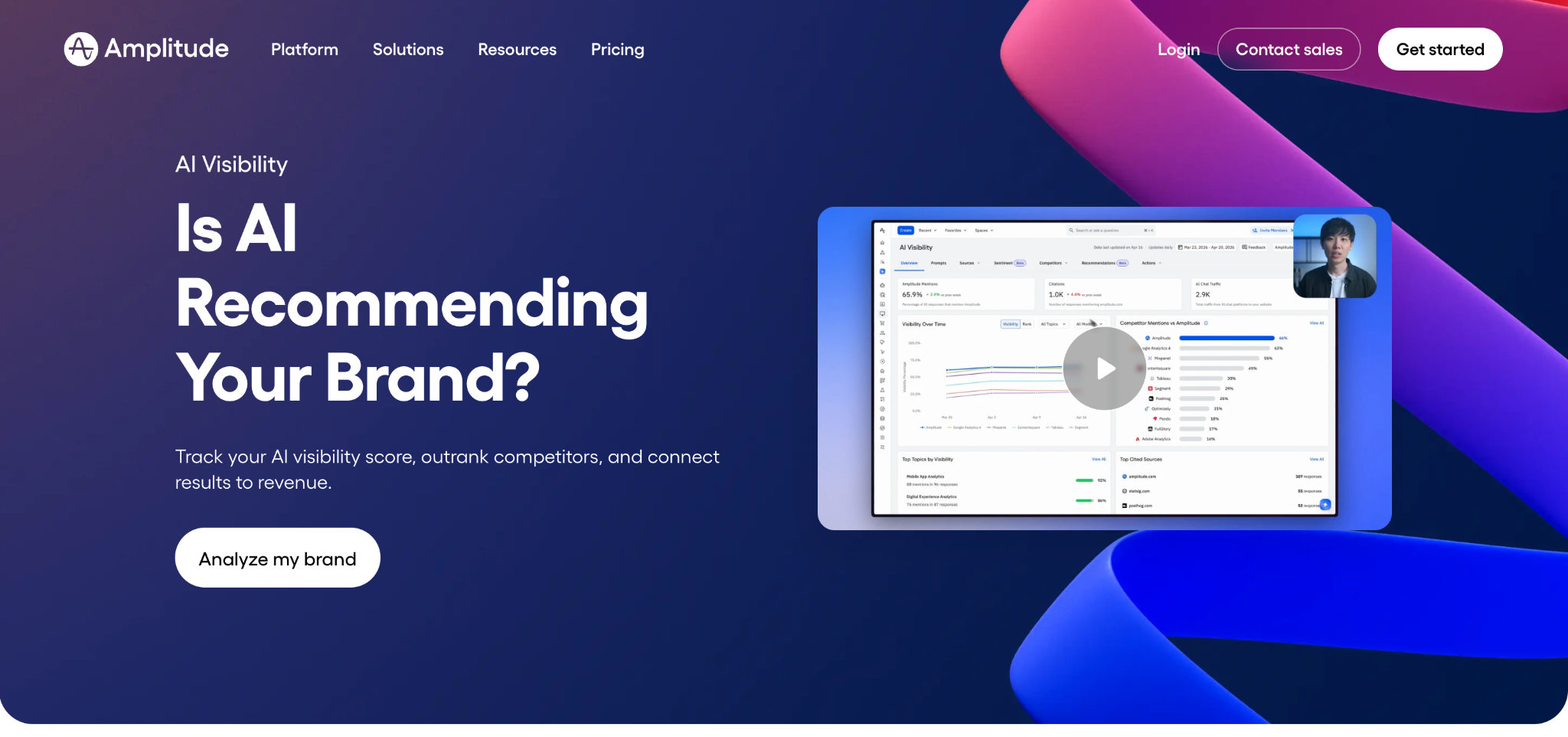
Amplitude is a web analytics tool at heart, similar to Google Analytics. But the platform has recently launched an AI visibility platform, allowing you to see how your brand appears in AI-generated answers.
The AI Visibility dashboard lets you monitor how frequently your brand appears in AI-generated answers and how it compares with competitors.
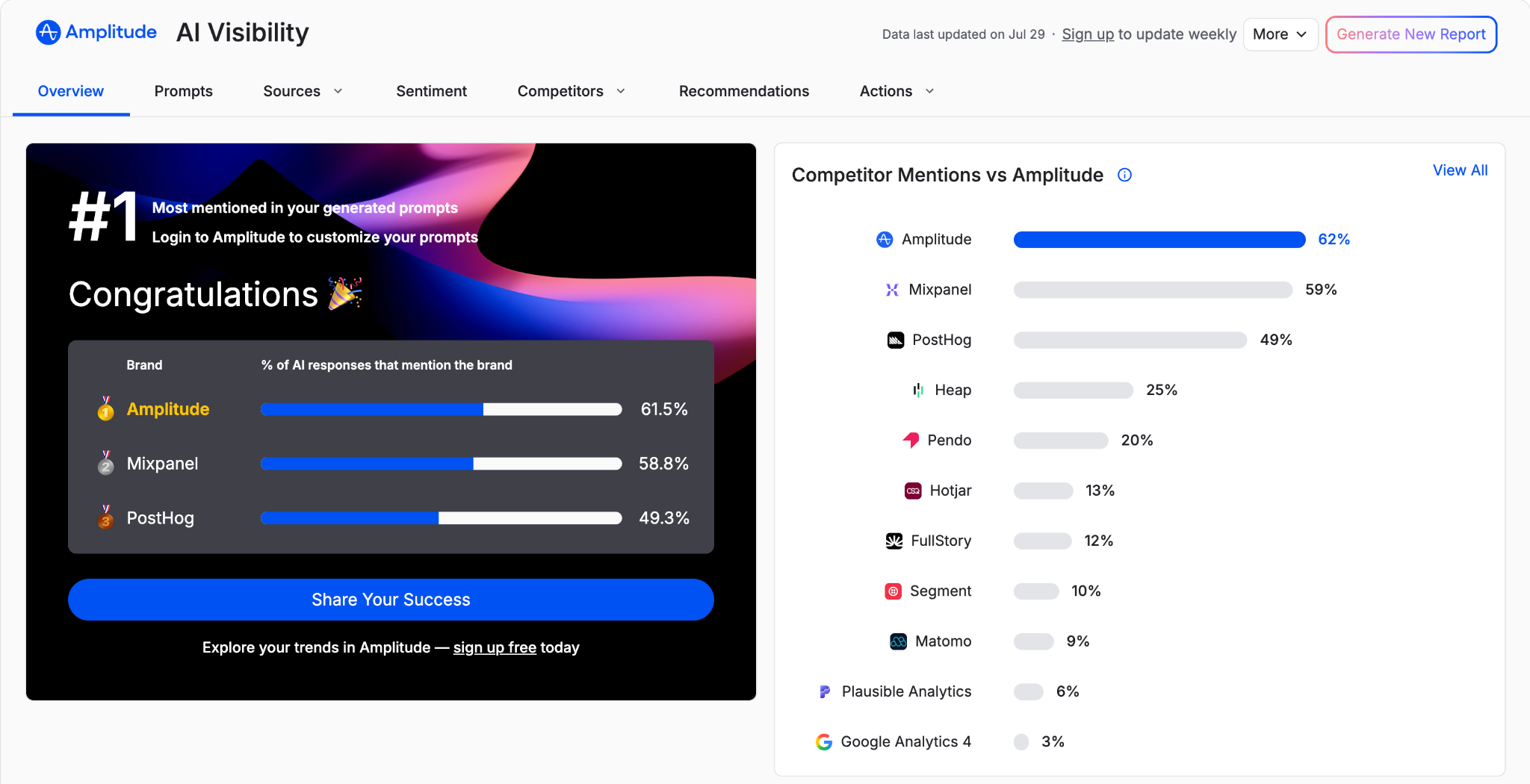
You can also see other valuable reports such as:
- Prompt tracking: Monitor a set of prompts to track your brand mentions, average position, and citations for each topic.
- Cited sources: See which websites and pages AI platforms cite in their responses.
- Sentiment: Analyze how AI platforms describe your brand when it appears in their answers.
- Competitor comparisons: Head-to-head AI visibility comparisons between your company and competing brands.
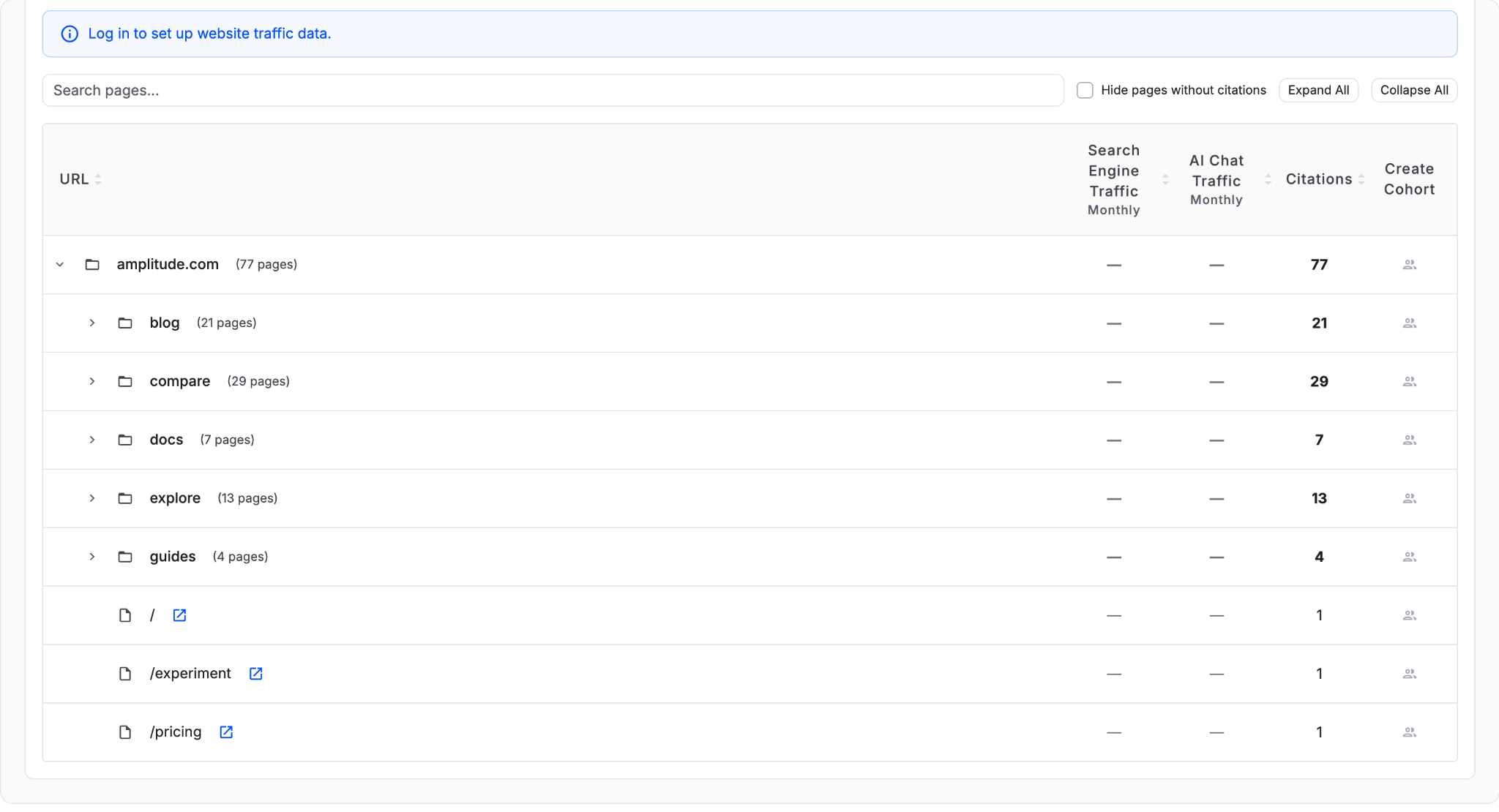
While Amplitude’s AI Visibility features and supported AI platforms aren’t as comprehensive as dedicated tools like Profound, they offer an interesting advantage:
You can connect AI visibility data with your website analytics (organic traffic and AI referral traffic), giving you a clearer picture of what happens after someone discovers your brand through AI.
For example, you can identify users who arrived through an AI platform, analyze what they did on your website, and connect that behavior to downstream conversions or revenue.
This makes Amplitude particularly useful for teams that want to move beyond simply tracking mentions and understand the commercial impact of AI search.
The main limitation is that Amplitude’s AI Visibility currently focuses on ChatGPT and Google AI Overviews, rather than offering the broader AI engine coverage available in dedicated AI visibility platforms.
Supported AI platforms
ChatGPT and AI Overviews.
Does it offer API and MCP?
Amplitude provides an MCP server that lets AI tools such as Claude and Cursor access Amplitude data. AI Visibility data can also be surfaced through MCP.
Amplitude also provides APIs as part of its broader analytics platform, although the AI Visibility product is better thought of as an integrated analytics workflow rather than a standalone GEO API.
Data reporting & integrations
Amplitude’s biggest advantage is its native connection to its analytics ecosystem. You can combine AI visibility data with traffic, conversions, revenue, Session Replay, Experimentation, and Activation data.
This lets you investigate what happens after users arrive from AI search, rather than stopping at visibility and citations.
Pricing
- Free ($0): 2 million events per month forever, with AI Visibility included. No credit card required.
- Plus/Growth/Enterprise (custom pricing): Paid plans with higher usage limits and additional analytics functionality.
Ahrefs Brand Radar
Best for: SEO teams and agencies that want large-scale AI visibility alongside traditional SEO data.
Standout features:
- Massive AI visibility database. Brand Radar analyses hundreds of millions of search-backed AI prompts, giving you a much broader view of AI visibility than a tool that only tracks a small set of manually added prompts.
- Search-backed prompts. Instead of relying entirely on synthetic prompts, Ahrefs builds its AI visibility indexes from real search behaviour and its keyword database.
- AI visibility benchmarking. Compare your brand’s mentions, citations and AI Share of Voice against competitors.
- Citation analysis. See which domains and individual pages AI systems cite when discussing your brand and competitors.
- Custom prompt tracking. Track the exact questions your customers ask, including niche or commercial prompts that may not be covered by the broader AI Visibility Index.
- Search demand data. Connect AI visibility with the underlying search demand behind the prompts, helping you prioritise topics based on actual search behaviour.
- Historical data. Brand Radar lets you investigate historical AI visibility data rather than starting from the day you create your project.
- AI + SEO data in one platform. You can connect AI visibility with Ahrefs’ traditional SEO data, including keywords, backlinks, content and web visibility.
- Emerging-channel visibility. Brand Radar also includes YouTube, Reddit and TikTok-related visibility features, with some currently in beta/free on eligible plans.
Drawbacks:
- Pricing can be quite expensive for smaller teams; full access to all AI platforms starts at $699/month, while individual AI platform indexes start at $199/month
If you’re tired of coming up with your own custom prompts, Ahrefs Brand Radar can be a good alternative solution.
Instead of relying entirely on a list of prompts you create yourself, Ahrefs uses its large web index to identify the questions people are asking and analyze how brands appear in the resulting AI answers.
Some of the key metrics and features include:
- AI visibility: See how frequently your brand appears in AI-generated answers for relevant searches.
- Web visibility: The total number of brand mentions across the web.
- AI Share of Voice: Compare your brand’s visibility with competitors across your tracked AI prompts.
- Brand mentions: Monitor when and where your brand is mentioned in AI responses.
- Citation analysis: Identify the domains and pages that AI platforms cite when generating answers.
- Search demand: Understand the potential demand behind the prompts you’re appearing for.
- Competitor analysis: Compare your AI visibility and citations against competing brands.
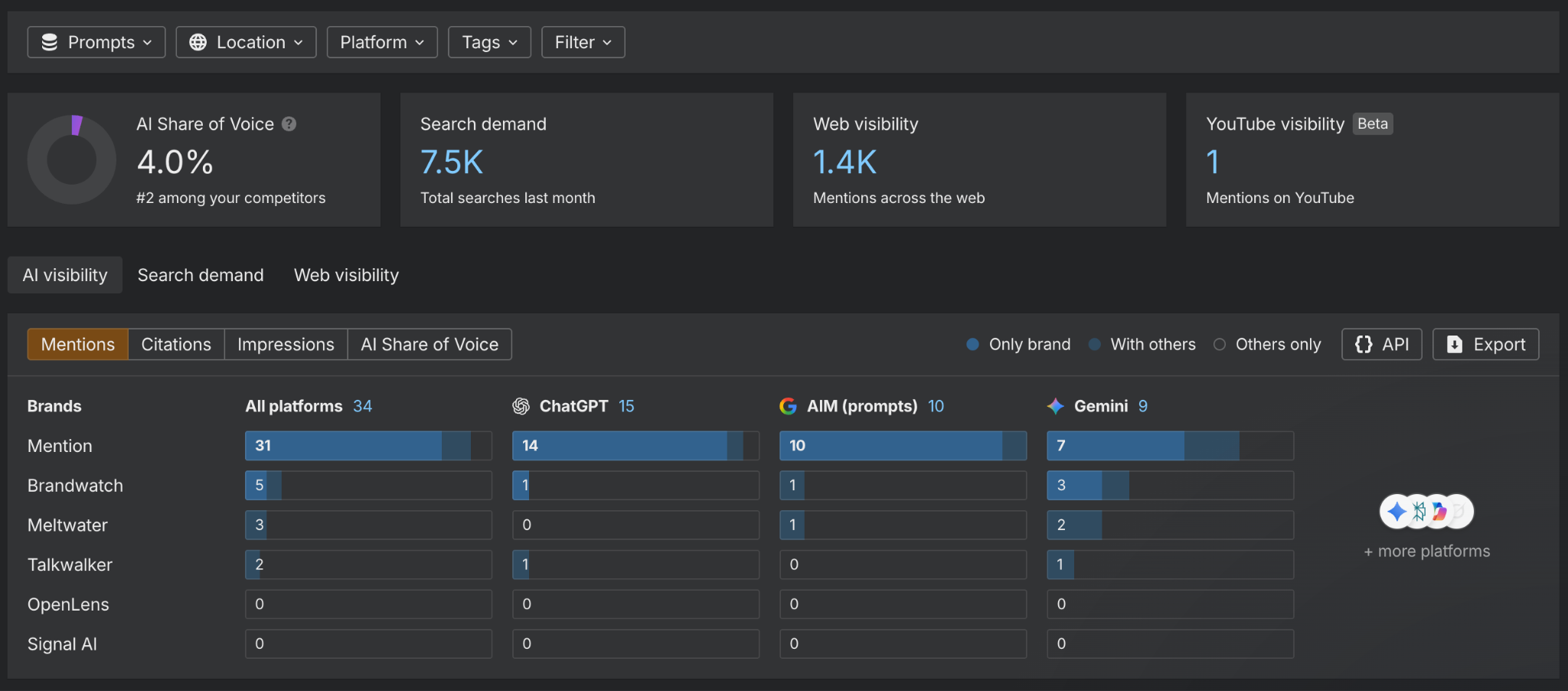
Another advantage is that you can connect your AI visibility data with traditional SEO data, so you don’t need to invest in separate tools.
The main limitation is that Brand Radar can be more than you need if you’re simply looking for a lightweight AI visibility tracker.
Its broader dataset and SEO functionality make it particularly useful for teams already using Ahrefs, but the platform can be relatively expensive compared with dedicated GEO tools.
Supported AI platforms
The AI Visibility Index currently covers:
- Google AI Overviews
- Google AI Mode
- ChatGPT
- Perplexity
- Gemini
- Microsoft Copilot
Custom prompts support these platforms as well as Claude.
Does it offer API and MCP?
Yes. Ahrefs provides both API access and an MCP server on its paid plans. Its MCP server allows AI tools such as Claude and ChatGPT to retrieve live Ahrefs data directly.
Data reporting & integrations
Brand Radar connects AI visibility with Ahrefs’ wider SEO ecosystem. You can analyze AI mentions and citations alongside search demand, web visibility, keywords, backlinks, content and competitor data.
Ahrefs also provides reporting functionality and integrations through its broader platform. Standard and Advanced plans include additional reporting capabilities, while Enterprise offers expanded API access and custom endpoints.
Pricing
- Custom Prompts ($50/month): 2,500 checks/month.
- Custom Prompts Growth ($100/month): 7,000 checks/month.
- Custom Prompts Scale ($250/month): 25,000 checks/month.
- AI Visibility Index ($199/month per platform): Access to an individual AI index.
- AI Visibility Index ($699/month for all platforms): Access to all AI platforms supported.
GEO Toolbox
Best for: Companies that want AI visibility, Google Search Console, and AI traffic data in one dashboard.
Standout features:
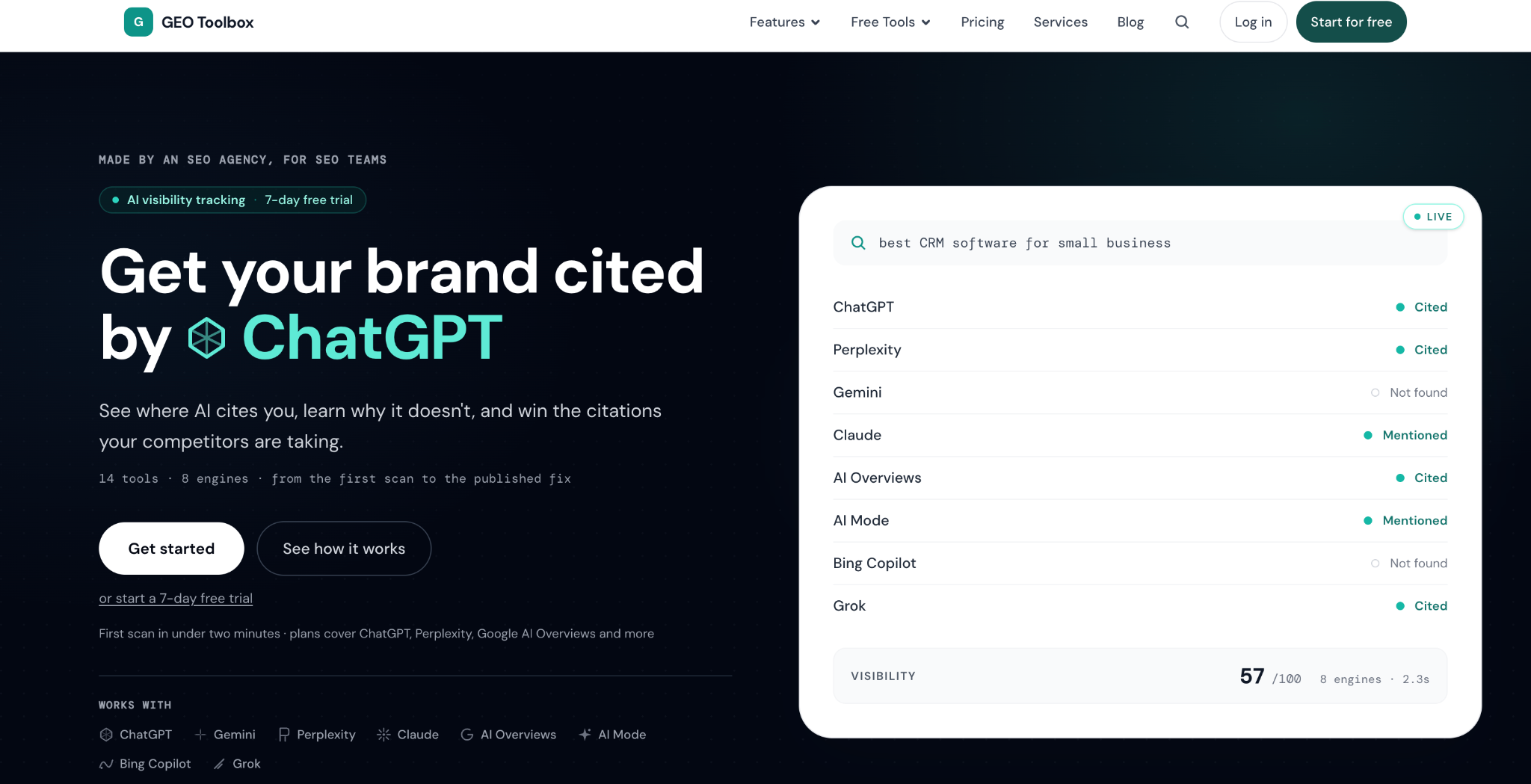
- AI visibility tracking across 8 engines. Track your brand across ChatGPT, Perplexity, Gemini, Claude, Google AI Overviews, Google AI Mode, Bing Copilot, and Grok.
- GSC + GA4 integration. Connect Google Search Console and Google Analytics 4 to see your AI visibility alongside organic search performance and AI-driven traffic.
- Citation and competitor analysis. Find the pages AI engines cite, identify competitors taking your citations, and uncover content gaps where you are being left out.
- Query Fan-Out. Analyze the related questions AI engines generate around a search query to understand the broader topics and sub-questions influencing an answer.
- GEO and AI-readiness audits. Scan your pages for factors affecting their ability to be understood and cited by AI systems, with recommendations for improvement.
- AI traffic attribution. Connect AI citations with actual sessions in GA4 to see whether being cited is translating into website traffic.
- Content optimization tools. Use the Content Analyzer and Content Studio to identify weaknesses and turn GEO insights into content briefs and articles.
Drawbacks:
- No forever-free plan, although there is a 7-day free trial
- AI visibility tracking is credit-based, with different AI engines consuming different numbers of credits
- API and MCP access are not currently available
Rather than treating AI visibility as a completely separate channel, GEO Toolbox connects data from Google Search Console and Google Analytics 4 with AI answer data.
This gives you a more complete picture of how your website performs across traditional and AI search.
The platform tracks your brand across eight AI search engines, including ChatGPT, Perplexity, Gemini, Claude, Google AI Overviews, Google AI Mode, Bing Copilot, and Grok.
Within the AI visibility dashboard, you can monitor metrics such as:
- AI visibility: Track how frequently your brand appears across your selected AI engines.
- AI citations: See which pages and domains are being cited in AI-generated answers.
- Competitor visibility: Compare your brand’s presence in AI answers with competing businesses.
- Query fan-out: Discover related queries that AI search engines may generate when researching a topic.
- AI traffic: Connect AI visibility with traffic data from GA4 to see how much website traffic is coming from AI platforms.
- AI opportunities: Identify queries and pages where there’s potential to increase your visibility.
GEO Toolbox also includes GEO audits and content optimization features. You can analyze your pages for AI readiness and get recommendations for improving their chances of being understood, cited, and surfaced by AI search engines.
For agencies, the platform also supports multiple brands and white-label reporting, making it possible to monitor AI visibility across different clients from a single account.
The main limitation is that GEO Toolbox doesn’t currently offer an API or MCP integration.
Supported AI platforms
ChatGPT, Perplexity, Google AI Overviews, Google AI Mode, Gemini, Bing Copilot, Claude, and Grok.
Does it offer API and MCP?
Not currently. API and MCP access are listed as coming soon on the pricing page.
Data reporting & integrations
GEO Toolbox’s Analytics dashboard combines GSC search performance with AI citation and GA4 traffic data, including 13 different views covering opportunities, content decay, click potential, cannibalization, page performance, queries, clusters, and AI traffic attribution.
The Growth and Scale plans also offer white-label client reports, making the platform more suitable for agencies managing multiple clients.
Pricing
- Starter ($99/month): 1 brand, 50 tracked prompts, 3 AI engines, weekly scans, 12,000 monthly credits, and 180-day history.
- Plus ($199/month): Up to 3 brands, 100 pooled prompts, 5 of 8 AI engines, 30,000 credits/month, and 1-year history.
- Pro ($399/month): Up to 5 brands, 150 pooled prompts, all 8 AI engines, 50,000 credits/month, and 1-year history.
- Growth ($499/month): 15 brands, 50 prompts per brand, 80,000 credits/month, and unlimited history.
- Scale ($799/month): 25 brands, 50 prompts per brand, 130,000 credits/month, and unlimited history.
Start Improving Your AI Visibility With Position Digital
Tracking your AI visibility is only the first step. The next is turning those insights into a strategy that improves your visibility over time.
If you want help understanding where your brand stands and building a strategy to increase your presence across AI search, Position Digital can help.
Explore our AI SEO services to see how we approach AI search optimization, or get in touch with our team to discuss your goals.
FAQs About Best LLM Trackers
1. What are the best free AI search monitoring solutions?
The best free AI visibility checkers are OpenLens and Amplitude, which both provide a forever free plan.
OpenLens is more geared towards agencies looking to track AI visibility of their clients, while Amplitude is best if you want to connect AI visibility with your web analytics data.
There are also other AI visibility tracking tools that offer a limited free version of their main product, including Omnia and Ahrefs.
2. What are the top options for knowledge graph visibility tracking?
If you want to track whether Google and AI systems recognise your brand as an entity, rather than simply tracking AI mentions, the tool landscape is a little different from standard AI visibility platforms:
- Kalicube Pro monitors whether an entity has a Google Knowledge Graph ID, tracks Brand SERPs and Knowledge Panels, and lets you monitor changes over time.
- InLinks tracks entity relationships, topical coverage, internal linking, and semantic structure of your website.
- WordLift builds an internal Knowledge Graph around a site’s content.
3. Which is the best AI Mode tracking software?
Ahrefs Brand Radar is an excellent choice, as it tracks both traditional search queries that trigger AI Mode, as well as the potential prompts people may use when researching a topic in Google.
4. What tools integrate AI visibility data with SEO and marketing workflows?
If you want AI visibility data alongside your existing SEO and marketing data, look at Ahrefs Brand Radar, Semrush, GEO Toolbox, and Amplitude.
Ahrefs and Semrush connect AI visibility with traditional SEO data, while GEO Toolbox combines AI answer data with Google Search Console and GA4.
Amplitude takes a more analytics-focused approach, allowing teams to connect AI visibility with traffic, conversions, and revenue.
5. What are the best tools for monitoring AI Overviews?
Most established AI visibility platforms now offer some form of Google AI Overview tracking. But if you want a platform that focuses on AI Overview rank tracking, then Advanced Web Ranking can be a good solution.