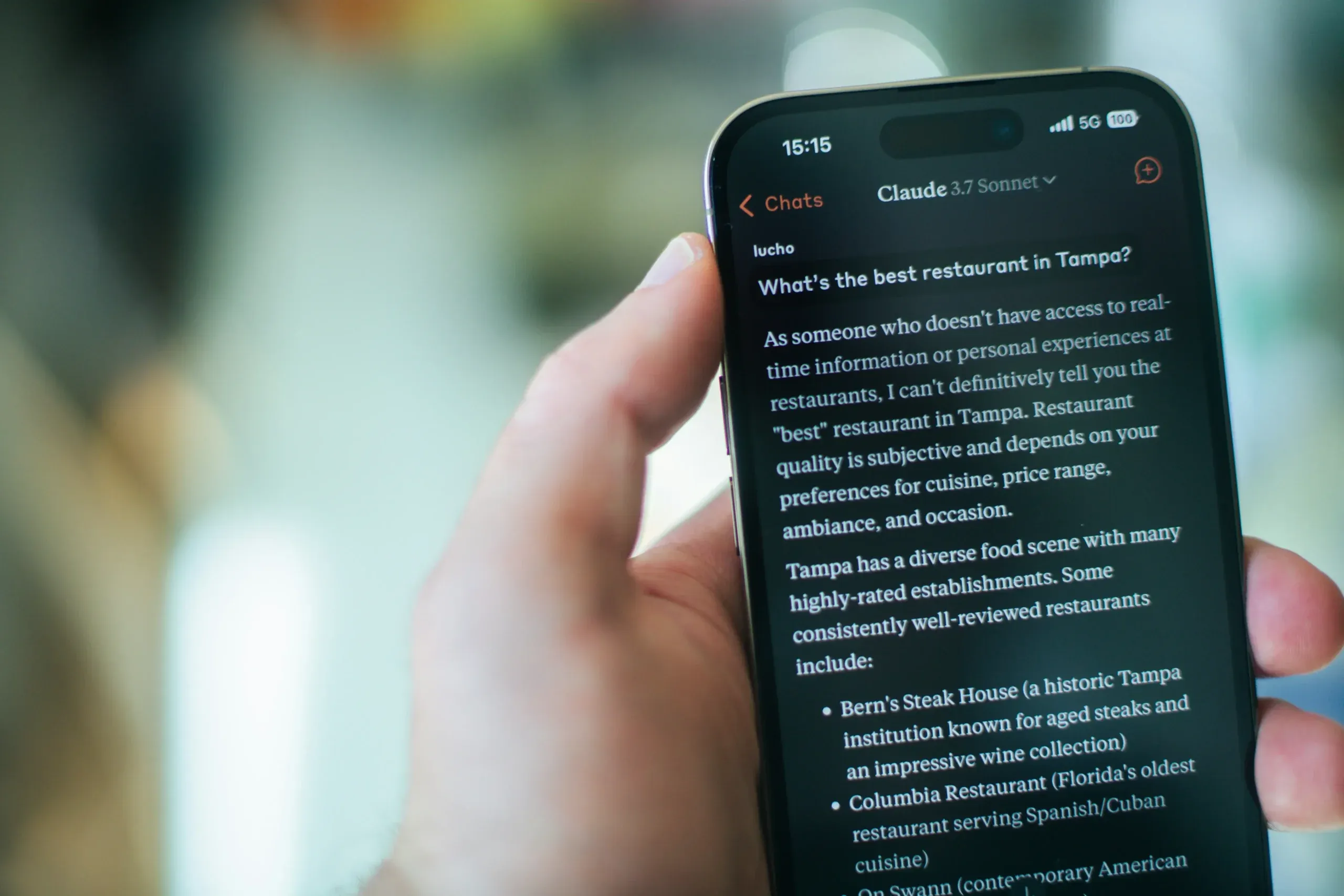

84% of AI citations come from third-party pages, not your own content, according to the latest AI SEO studies. When a buyer asks ChatGPT for the best tool in your category, it reads dozens of pages and summarizes the brands it sees most often.
AI citation outreach is how you get onto those pages. The more often you appear in the sources AI already cites, the more likely AI is to recommend your brand. Below is the six-step process we use, the scoring rubric we use to choose targets, and the way we measure whether a placement worked.
Key Takeaways
- AI citation outreach starts from the answer. It earns your brand mentions on the third-party pages AI platforms already cite for your buyers’ questions.
- Prompts come before pages. Build a buyer prompt set first, then map every page each AI platform cites for it.
- Relevance beats authority. Score pages on recurrence, relevance, and feasibility, since Domain Rating correlated only 0.15 with AI Overview citations in our research.
- Fix first, ask second. Pitch a correction or update to the page instead of asking to be added.
- Measure against a baseline. Re-run the same prompts weekly, several times each, because AI answers change from run to run.
What is AI citation outreach?
AI citation outreach is the process of finding the third-party pages that ChatGPT, Gemini, Perplexity, Claude, and Google’s AI Overviews cite for your buyers’ questions, then earning your brand a mention on those pages. Instead of chasing high-authority domains, it starts from the AI answer and works backward to the sources behind it.
What you need before you start
AI citation outreach needs three inputs in place before the first pitch goes out. You need a set of prompts your buyers ask, a way to see which pages AI cites for those prompts, and enough time to run outreach every week.
Prepare these inputs for AI citation outreach:
- A buyer prompt set. A few dozen real questions buyers ask AI tools when they compare options in your category.
- A way to see citations. A tool or a spreadsheet that records which pages each AI platform cites for each prompt.
- Outreach time. Practitioners in one r/SEO thread describe spending 4 to 7 hours a week on citation outreach, so plan the hours before you start.
How to run AI citation outreach in six steps
AI citation outreach runs as a loop of six steps, from building a prompt set to measuring whether a placement changed the answer. Each step below opens with what it produces, so you can see where it fits before you start, and then explains how to do it.
Step 1: Build a buyer prompt set
A buyer prompt set is the list of questions your target customers actually ask AI when they research your category. Every later step depends on it, so build it from real buyer language rather than keyword exports.
These are the best places to find the questions buyers ask:
- Sales calls. On a first call, buyers describe their problem in their own words and ask the same questions they’d ask AI, such as how a tool compares with a competitor or whether it suits a team their size. Read your call notes or search recorded transcripts for questions, and copy them word for word.
- Google Search Console. Long, specific searches that already bring people to your site read a lot like AI prompts. In Performance → Search results, add a Query filter, choose Custom (regex), and paste this expression to see only question queries. Sort by impressions to find the questions that come up most.
^(who|what|when|where|why|how|which|is|are|can|do|does|should|will)\s - Forums. Reddit, Quora, and industry communities show the questions buyers ask each other, often with the details they’d also give AI, like team size or budget. Search for your category plus words like “recommend”, “alternative”, or “vs”.
- Google’s People Also Ask. Search your main category terms and open the People Also Ask box. Each question you expand loads more, so a few clicks give you a long list of related questions.
Focus on prompts close to a decision. In our analysis of SaaS buyer prompts, 48% of commercial prompts contained “best” or “top”, and the average prompt ran to 13 words.
Step 2: Extract citations for each prompt
Run your prompts across the AI platforms you want to track, such as ChatGPT, Gemini, Perplexity, Claude, and Google’s AI Overviews, and record every citation: the URL, the platform, and which brands the answer names.
ListBrew, our own AI citation outreach tool, speeds up the process. It shows which pages each AI platform already cites for a keyword, alongside Google rank and traffic, and finds contact details for the people behind each page.
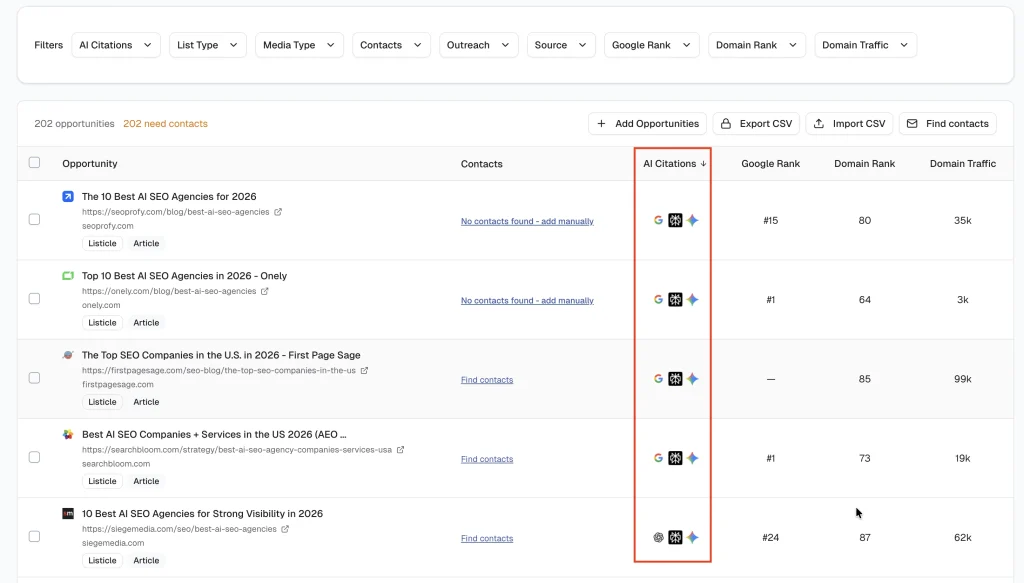
You can also filter the cited pages by source type, such as listicles, comparison pages, review sites, directories, editorial articles, and community threads. Then flag every page that names a competitor but not you, because those pages are your citation gaps.
Step 3: Score each page and pick your targets
Scoring stops you from spending weeks on pages that don’t move AI answers. Rank pages on these three factors, not on domain authority:
| Factor | What to check | Why it matters |
|---|---|---|
| Recurrence | How many of your prompts and AI platforms cite the page | A page cited again and again is worth more than a one-off. |
| Relevance | How closely the page matches your category and use case | Our AI Overview study found that AI chooses citations based on relevance, not authority. |
| Feasibility | Whether an editor can realistically add you | Skip service pages, feature pages, and other sources you can’t get onto. |
Our scoring rubric below turns these factors into a score out of 10, so you can work from the top.
Step 4: Match each source type to the right play
Each source type needs a different approach, and one pitch template sent to every page is the fastest way to get ignored. These are the main plays in AI citation outreach:
- Listicles and “best X” roundups. Pitch a specific reason you fit the list, and keep the pitch short.
- Editorial articles. Offer original data, an expert quote, or a correction the author can use.
- Directories and resource lists. Submit or update your listing, and keep your details consistent everywhere.
- Community threads. Answer the question honestly where you have real expertise, and never post as a fake customer.
For the full listicle pitch, follow-up, and email template, read our listicle outreach guide. Our guide to LLM seeding covers review profiles, podcasts, and the other places AI pulls from.
Step 5: Send a personalized pitch
A pitch that improves the editor’s page gets more replies than one that asks for a spot on it. Editors want their pages to stay accurate and useful, so lead with what you can fix or add, and bring in your brand as part of that improvement, not as the point of the email.
Before you write, read the page and find one concrete improvement:
- Outdated details. Prices or plans that have changed, tools that have been discontinued or rebranded, and broken links.
- Missing information. A use case, team size, or buyer question the page doesn’t cover. Your prompt set from Step 1 shows which questions people are asking AI.
- Fresh data. A recent statistic, survey result, or benchmark the author can cite to back up a claim.
- A gap in the list. A type of tool the page leaves out, such as an option for small teams or a specific industry.
Keep every pitch to a few short sentences, in this order: what you noticed, how to fix it, and why your brand fits. Put the page title or the fix in the subject line, so the editor knows it’s about their page and not a generic request.
Use the template that matches your improvement.
Template 1: Correct outdated details
Subject line: Quick fix for your [listicle title]
Hi [First name],
I was reading your [listicle title] and noticed that [specific outdated detail, e.g. “Tool X’s starter plan is now $79 a month, not $49”]. Here’s the current [pricing page / source]: [link].
While you’re updating it, [your brand] could also fit your [section name] section. We [one-line reason it fits, e.g. “built our scheduling tool for agencies under 50 people”]. I can send a short write-up in the same format as the other entries.
Either way, I hope the fix helps.
[Your name]
Template 2: Fill a missing question
Subject line: A [use case] angle for your [article title]
Hi [First name],
Your article on [topic] covers [what it covers well]. One question it doesn’t answer yet is [buyer question], which comes up a lot when [audience] research [category].
I’d be happy to write a short section on it, with [data / an example / a quote from our team]. [Your brand] does this for [type of customer], so I can include a real example if it’s useful.
Would that work for your next update?
[Your name]
Template 3: Offer fresh data
Subject line: New [year] data for your [article title]
Hi [First name],
Your [article title] cites [old statistic or source] from [year]. We just published [study name], which found [one key finding, with the number]. Here’s the full study: [link].
If you’re refreshing the piece, it could replace or sit alongside the current figure. I can also send a chart you’re welcome to use.
[Your name]
Send one follow-up after about a week, two at most, and stop when someone says no. Make the follow-up add something new, such as a second fix, rather than repeating the first email:
Subject line: Re: Quick fix for your [listicle title]
Hi [First name],
Following up in case my last email got buried. I also noticed [second improvement]. Happy to send both fixes in one note if that’s easier.
[Your name]
Step 6: Measure whether each placement moved the answer
Measurement tells you which placements actually boost your AI visibility, so you can double down on what works. For each live placement, log the date it went live and the prompts it should influence, then compare your brand mentions for those prompts before and after.
AI visibility tracking tools can automate this. They re-run your prompts on a schedule and record which brands each answer mentions, which matters because AI answers change from run to run.
Our citation target scoring rubric
Our citation target scoring rubric rates each cited page from 0 to 2 on five criteria, for a total out of 10. It’s the same rubric we use to decide which pages get a pitch first, and it fits in a spreadsheet next to your citation map.
| Criterion | What to check | 0 points | 1 point | 2 points |
|---|---|---|---|---|
| Recurrence | How many of your prompts cite the page | None | One prompt | Two or more prompts |
| Platform spread | How many AI platforms cite the page | None | One platform | Two or more platforms |
| Relevance | How closely the page matches your category | Unrelated topic | Adjacent topic | Exact category and use case |
| Feasibility | Whether an editor can realistically add you | No contact, or a page you can’t get onto | Contact found, but not updated in the last 12 months | Named editor, updated in the last 12 months |
| Buying intent | How close the prompts are to a decision | Early research | Comparing options | “Best,” “top,” or “alternatives” prompts |
Pitch pages scoring 7 or more first, and revisit the rest when you re-score each month.
Common pitfalls and how to handle them
AI citation outreach breaks down in predictable places, and most of them show up in the first month of a campaign. These are the three problems we see most often, with the way we handle each one so it doesn’t stall the rest of the program.
The site asks you to pay
Some editors will only add you for a fee, and practitioners in an r/SEO thread on citation outreach report asks of $50 to $180 per placement. If you have the budget, paying can work. Be careful, though: Google’s spam policies only allow paid links that carry a rel="sponsored" or rel="nofollow" attribute.
We never pay for placements. If you’re looking for an AI citation outreach agency that focuses on earned, editorial placements, get in touch.
You’re asking the wrong person
A pitch sent to a general inbox or a marketing manager rarely reaches anyone who can change the page. Write to the author or editor who actually updates it. The byline is the best place to start, followed by the site’s team, contributors, or editorial page.
If the page has no byline, look on LinkedIn for the site’s content lead or editor. ListBrew finds contact details for the people behind each page, which saves you this search.
AI stops citing the page
A placement can land on a page that AI stops citing a few weeks later. Citations rotate, so a single page is never a safe bet.
Protect against this by favoring pages cited across several prompts and platforms over one-off sources. Keep a reserve list from your scoring sheet, and re-score every month so new sources replace the ones that drop out.
Need help running AI citation outreach?
AI citation outreach is simple to describe and slow to run well inside a busy marketing team. The prompt research, scoring, pitching, and weekly tracking all compete for the same hours, and for most in-house teams they land on top of an existing SEO roadmap.
If you’d rather hand it over, our AI citation outreach services cover the full process, from mapping the sources AI cites to pitching editors and reporting on what changed.
FAQs about AI citation outreach
How long does AI citation outreach take to work?
AI citation outreach takes as long as the placements do, plus the time AI platforms need to see the updated page. Platforms that search the web in real time, like Perplexity, ChatGPT search, and AI Overviews, can pick up a change once the page is recrawled. That’s why we track prompts weekly rather than waiting for a quarterly report.
Do unlinked brand mentions help AI visibility?
Unlinked brand mentions can help AI visibility, because AI platforms read the text on a page, not just its links. A mention on a page that ChatGPT cites puts your brand into the source an answer is written from. We still ask for a link where it fits naturally, since links also support your rankings in Google.
Which AI platforms should you track?
AI platforms worth tracking for most B2B brands are ChatGPT, Gemini, Perplexity, Claude, and Google’s AI Overviews and AI Mode. Each one cites different sources for the same question, so map them separately and prioritize the pages that appear on more than one. Add Grok if your buyers use it.