
Beyond just tracking your brand visibility, knowing what your audience is asking AI can reveal valuable insights into how they research, evaluate, and choose software.
Unfortunately, we don’t yet have access to first-party prompt data from LLMs such as ChatGPT and Claude.
The closest thing we have is Google Search Console’s Queries report, which shows the search queries that trigger your website’s appearance in Google AI Overviews and AI Mode.
So, we analyzed 609 queries from our clients’ Google Search Console data to find out what SaaS buyers are asking AI — and what their prompts can tell us about the modern software buying journey.
Here’s what we found.
Key Findings
- SaaS buyers follow three distinct journeys in AI search: solving a problem, finding a better method, and switching platforms.
- Prompts get longer as buyers move closer to a purchase, rising from 11.5 words for informational searches to 18.2 words for branded searches.
- 79% of SaaS prompts are questions, suggesting buyers primarily use AI to research and evaluate rather than simply issue commands.
- 48% of commercial prompts ask for “best”, “top” or similar recommendations, making category-level visibility particularly important during shortlist formation.
- Reviews influence a significant share of commercial research, with 12% of commercial prompts explicitly asking for trust signals.
- 92% of prompts are generic rather than personalized, suggesting that SaaS brands should not rely exclusively on highly specific ICP prompts when planning AI-search visibility.
Methodology & Limitations
We analyzed 609 search queries collected from our clients’ Google Search Console data between June 13 and September 12, 2026. The dataset covers queries that triggered appearances in Google AI Overviews and AI Mode.
Here’s how we built the dataset:
We identified AI-style prompts
Google Search Console doesn’t label queries as either “keywords” or “AI prompts”. It gives us the search queries themselves, so we classified the queries based on their structure and the amount of context they contain.
We identified three main characteristics:
- Question-based queries. Queries beginning with question words or phrases such as what, which, where, how, and is there. For example: what is a data clean room and how does it work?
- Personalized queries. Queries that include information about the person searching or their organization, such as their role, company size, location, industry, or specific circumstances. For example: I’m a CMO at a mid-market company. What’s the best AI visibility tool that doesn’t require an enterprise contract?
- Long, context-rich queries. Long queries that contain multiple pieces of context, requirements, or constraints. For example: We’re a finance firm with 500 employees and need to implement occupational health management quickly. Looking for platforms that don’t require extensive IT setup and can integrate with our existing HR systems. What options are there?
These signals aren’t mutually exclusive. A single query can be a question, personalized, and unusually long at the same time.
We classified the prompts
After gathering the data, we classified the prompts into 3 types:
- Informational queries. These are queries where the user is primarily looking for information, explanations, definitions, or data rather than evaluating specific software.
- Commercial queries. These are queries that indicate the user is researching software options, typically using terms such as tools, platforms, software, or similar product-focused language.
- Branded queries. These are queries that contain the name of a specific SaaS brand or vendor, indicating that the user already has a particular company or product in mind.
We then excluded tool-generated prompts
We excluded queries that appeared to be generated by tools or tracking systems rather than genuine user searches.
These typically followed a repeated structural template, such as:
context: location: United States, [response language instruction: …].
Limitations
This dataset provides a useful window into SaaS search behavior, but it isn’t a complete picture of everything SaaS buyers ask AI.
Most importantly, Google Search Console does not give us first-party prompt data from AI assistants such as ChatGPT or Claude.
Our analysis is therefore limited to queries appearing in Google AI Overviews and AI Mode, and shouldn’t be interpreted as representative of all AI-search behaviour.
The dataset also comes from our clients’ Search Console accounts, so the mix of industries, SaaS categories, and buyer types may not reflect the broader SaaS market.
Finding 1: SaaS Buyers Follow Three Different Journeys in AI Search
SaaS buyers don’t all turn to AI with the same level of product knowledge.
Some arrive with a problem but don’t know what category of software can solve it. While others already use a competing platform and are actively considering a switch.
Across the 609 queries we analyzed, we found three recurring buyer journeys:
- Solving a problem
- Finding a better method
- Switching platforms
The first two journeys are particularly important because the buyer hasn’t necessarily decided which vendor to use — or even which category of software they need.
This gives brands an opportunity to influence the buying journey before a shortlist has been formed.
Journey 1: Solving a problem
This was the most common journey in our analysis.
The buyer starts with a problem rather than a product. They describe what they’re trying to solve and use AI to figure out what could help.
The journey typically looks like this:
Problem → research → tool exploration → comparison → validation
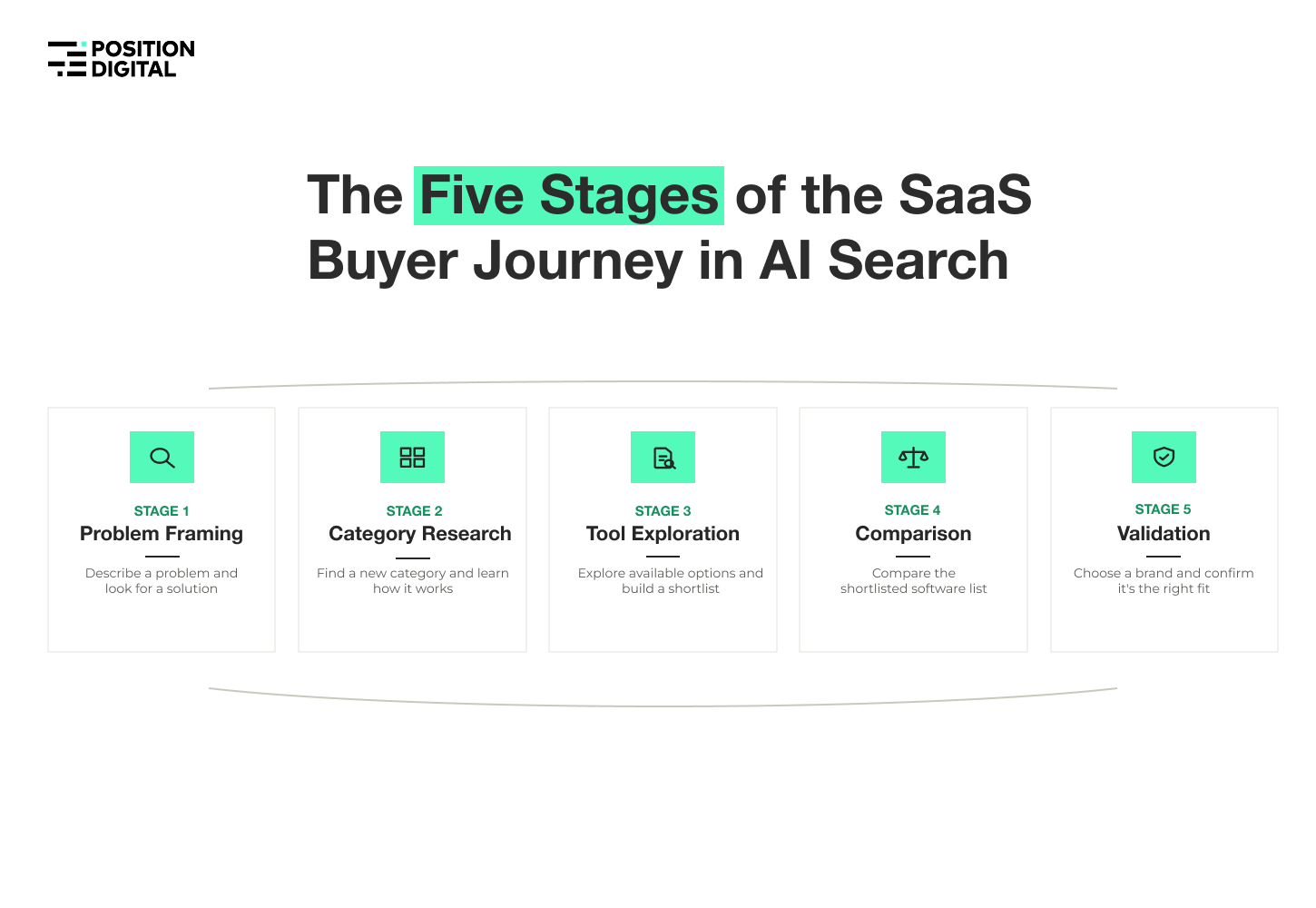
For example, a buyer might start with:
- how to share a data notebook with stakeholders without exposing raw data?
At this point, they aren’t necessarily searching for a specific type of software. After researching the problem, they may discover a new category:
- What is a data clean room and how does it work?
Once they understand the category and decide it could solve their problem, their searches become more commercial:
- Best data clean room platforms for sharing customer data securely with partners
After shortlisting several tools, they then move into comparison and validation:
- LiveRamp vs Decentriq: which one is a good fit for small teams?
- What do users say about Decentriq?
Journey 2: Finding a better method
The second journey starts slightly differently.
Instead of discovering a solution to a problem, the buyer already has a way of doing something but is questioning whether there’s a better approach.
We saw this pattern particularly in emerging or less familiar categories such as data collaboration and clean rooms, commerce media, and causal AI.
The journey looks like:
Existing method → alternative approach → learning new category → tool exploration → comparison → validation
For example:
- What are people doing instead of third-party cookies for audience targeting?
The buyer starts by looking for an alternative to an established approach. They may then discover a new category and begin learning how it works:
- How is causal AI different from traditional predictive analytics?
Only after understanding the category do they start looking for software:
- What are the top causal inference software solutions for business analytics?
From there, the journey resembles the first: shortlist, compare, and validate.
Journey 3: Switching platforms
The third journey is the most straightforward.
These buyers already understand the category and have experience with a competing platform. They’re not discovering a problem or learning what a category is. They’re evaluating whether another product would better meet their needs.
The journey is essentially:
Existing platform → alternative / replacement
One version is a broad search for alternatives:
- What are the best alternatives to Workday for compensation management?
Another is driven by a specific gap in the current solution:
- HR software for UK companies switching from a US-headquartered HRIS to a UK-aware platform
These searches are much closer to the point of vendor selection. The buyer already knows the category and often has a clear set of requirements.
For SaaS brands, this is where alternative pages, comparison content, migration guides, and competitor-focused content can address an audience that already understands the market and is actively considering a change.
Finding 2: The Average SaaS Prompt Length is 13 Words
The average SaaS query in our dataset contains 13.1 words, with the shortest containing 5 words and the longest containing 40.
But there’s a more interesting pattern: as buyers move from general research towards evaluating specific vendors, their prompts become progressively longer and more detailed.
Branded queries are 58% longer than informational queries in our dataset.
| Prompt type | Buyer stage | Avg. prompt length |
|---|---|---|
| Informational | Looking to solve a problem or learn a new category | 11.5 words |
| Commercial | Looking for tool options to build a shortlist | 13.2 words |
| Branded | Comparing shortlisted vendors or validating a specific tool | 18.2 words |
What this tells us
Branded prompts tend to be longer and more detailed because the buyer has already done their research, and now they know exactly what they need.
They know the category fully, know what tools are available, and have usually already landed on one or a few candidates.
What’s left is deciding which solution is best: comparing the shortlisted vendors and validating the chosen tool to see whether it’s the right fit.
Some examples:
- which tool is better for tailoring pr outreach to authors of top-cited articles, profound or seo clarity? provide a definitive answer, along with a list of pros and cons specific to tailoring pr outreach for each.
- is compup a good fit for hr teams accessing real-time market data to build competitive salary bands by role and level needing compensation benchmarking?
Finding 3: Most Prompts (79%) Are Questions
Most SaaS buyers aren’t simply entering keywords into AI. They’re asking it questions.
In our analysis, 79% of queries were phrased as questions, compared with just 21% that were instructions.
The questions ranged from broad informational queries:
- What is a data clean room and how does it work?
to more commercially focused questions:
- What are the top causal inference software solutions for business analytics?
The remaining 21% were mostly instructions asking AI to perform a task, such as:
- Give me a list of automotive retail pricing intelligence providers that have the best accuracy.
or:
- Compare platforms that recommend likely backlink prospects within the brief to align content and outreach.
What this tells us
The high proportion of questions suggests that SaaS buyers are using AI as a research and decision-support tool, not simply as a replacement for traditional keyword search.
They’re asking AI to explain unfamiliar concepts, identify possible solutions, recommend products, and help them evaluate their options.
A SaaS brand that wants to appear in these results needs content that directly answers the questions buyers ask throughout the journey — from what is this? and how does it work? to which tools can do this? and which option is right for my situation?
Finding 4: Half (48%) of Commercial Prompts Contain “Best” and “Top”
Once SaaS buyers move beyond learning about a problem or category, they’re often using AI to help them build a shortlist.
In our dataset, 48% of commercial queries asked for a list of the “best”, “top”, “leading”, or similar options based on their specific use cases, needs, company size, and industry.
For example:
- what are the best job evaluation software options for hr and compensation teams in mid-to-large organizations?
- what are the best commerce media platforms for digital advertising?
Other commercial queries focused on more specific evaluation criteria, like features, integrations, pricing, and trust signals:
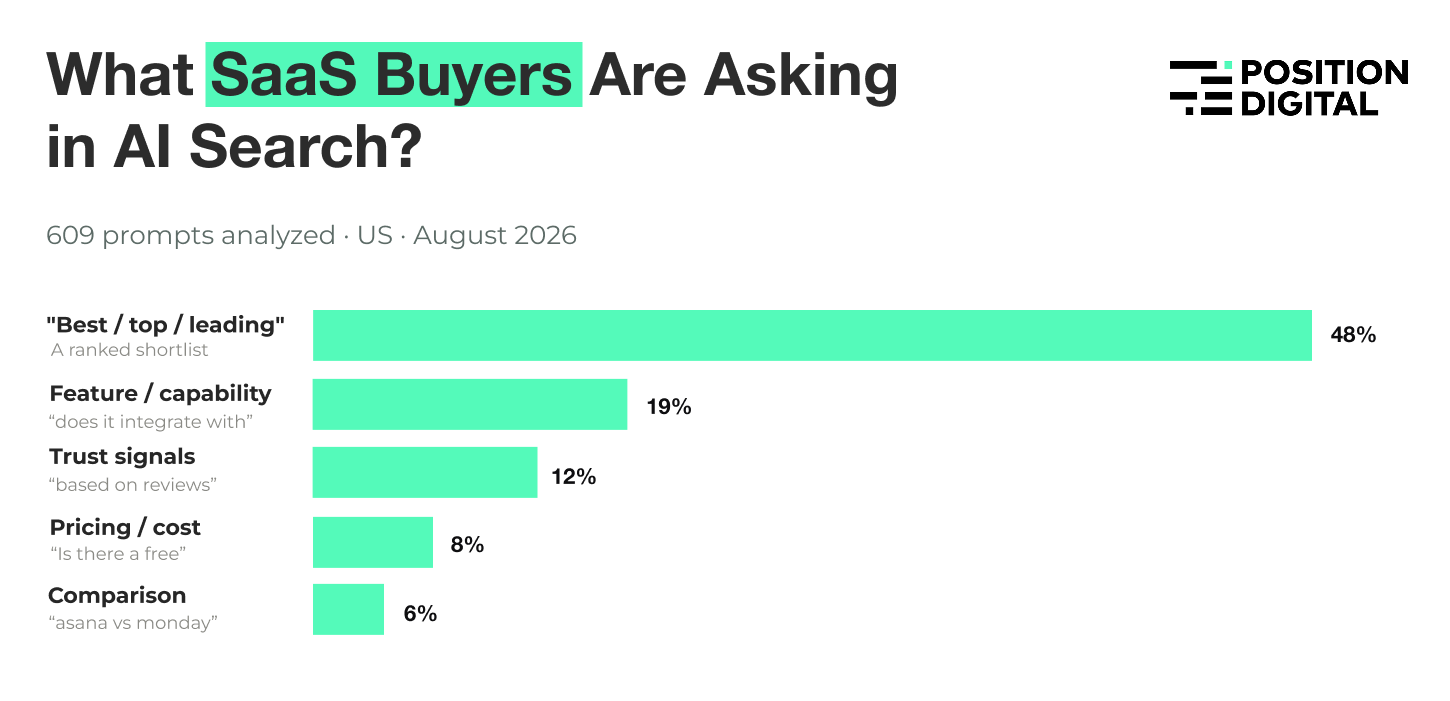
| What buyers are looking for | % of commercial queries | Prompt example |
|---|---|---|
| Best, top, or leading tools | 48% | what are the best commerce media platforms for digital advertising? |
| Specific features or integrations | 19% | which platforms combine an ai readiness audit with ai citation tracking? |
| Reviews and other trust signals | 12% | what’s the most trusted low code mobile app builder based on user reviews |
| Pricing / cost | 8% | how much do compensation benchmarking platforms typically cost? |
| Head-to-head comparison | 6% | suede vs scrunch ai: which handles reputation nuance better? |
What this tells us
A few takeaways from this data:
- Position your brand clearly: what your product does and who it’s best suited for.
- Continue investing in BOFU content: “best X” listicles, alternative roundups, and comparison pages. When writing listicles, make sure to include each software’s features, integrations, pricing, and user reviews.
- Get featured in relevant third-party listicles, too. You can use ListBrew to find these opportunities.
- Explain your product’s key features, integrations, and pricing clearly on your homepage, product pages, social media, editorial content, press releases, guest posts, etc.
- Build a strong presence in review platforms like G2 and Capterra. Optimize your profiles and ask existing users to leave positive ratings and reviews.
Finding 5: Only 8% of Prompts Are Personalized
This might be surprising, but the majority (92%) of queries in AI Overviews and AI Mode are generic.
For example:
- what are the top salary benchmarking tools?
- which data room provider is the best?
Only 8% of prompts contain personalization values like job title and company details (location, niche, number of employees, etc), such as:
- i’m a cmo at a mid-market company. what’s the best ai visibility tool that doesn’t require an enterprise contract?
- we’re a finance firm with 500 employees and need to implement occupational health management quickly. looking for platforms that don’t require extensive it setup and can integrate with our existing hr systems. what options are there?
- best HRIS for UK companies 200–1000 employees
What this tells us
Most SaaS buyers are still using broad, generic prompts when researching software in Google AI Overviews and AI Mode.
But don’t ignore personalized prompts, as they contain much richer information about what buyers actually use to evaluate a product.
The takeaway here is to cover both ends of the spectrum: broad, generic questions that introduce buyers to your category, and highly specific questions that help them decide whether your product fits their particular needs.
What Can You Do With These Insights
Based on our study, here’s what you need to implement to increase your SaaS visibility in AI search:
- Create content around problems, not just products. Answer the questions buyers have before they even know which software category they need.
- Cover questions at every stage. Create content for everything from “what is X?” and “how does it work?” to “best tools”, “X vs Y”, and “is X right for me?”
- Make your product easy to understand. Clearly explain your features, integrations, pricing, use cases, ideal customers, implementation and limitations so AI can accurately compare your product with others.
- Build a positive brand reputation. With 12% of commercial queries looking for reviews or other trust signals, maintain a strong presence across review platforms, social media, and forum threads.
- Target both broad and specific searches. Most queries were generic, but personalized searches reveal valuable buying criteria. Cover broad category questions alongside specific use cases and requirements.
Work With a SaaS GEO Agency
Want your SaaS brand to show up when buyers ask AI for recommendations?
Position Digital helps SaaS companies improve their visibility across AI search by creating the content, authority, and offsite signals that AI engines use to understand and recommend brands.
Explore our AI search optimization services, or talk directly to our SaaS GEO experts to find out where your brand stands and how to improve its AI visibility.